HOLAP (Hybrid OLAP) (original) (raw)
Last Updated : 1 Dec, 2025
Hybrid OLAP (HOLAP) combines the best of MOLAP and ROLAP. It stores summary data in multidimensional cubes for fast queries and keeps detailed data in relational databases for flexible analysis. This makes HOLAP both fast and scalable.
- HOLAP utilizes relational databases for storing large volumes of data and multidimensional cubes for storing aggregated data, offering the best of both worlds.
- By using pre-aggregated cubes, HOLAP provides faster query performance for summarized data while maintaining the flexibility of relational databases for detailed analysis.
- HOLAP can efficiently handle large datasets and complex queries, making it suitable for businesses with growing data needs.
- It provides real-time data access for detailed analysis and supports the dynamic creation of data views when needed.
Working of HOLAP
Suppose you have 2 years of retail sales data collected from multiple stores, containing daily transaction-level details such as product IDs, quantities sold, prices, and store information.
MOLAP Storage (Cube): Stores monthly or quarterly summaries:
- Total Sales per Region
- Profit per Category
- Units sold per Quarter
ROLAP Storage (Relational DB): Stores all detailed transactions:
- Each invoice
- Item-level transaction data
- Customer-level details
Query Routing
- If a user asks: "Show me total sales per region for last year" → MOLAP cube responds instantly.
- If a user asks: "Show me all 10,000 transactions for customer X" → Query goes to relational tables.
This selective routing is what makes HOLAP efficient.
HOLAP Architecture
The architecture of Hybrid OLAP (HOLAP) combines the features of both MOLAP (Multidimensional OLAP) and ROLAP (Relational OLAP) for optimal performance and flexibility. Below is an explanation of how the components work together in HOLAP:
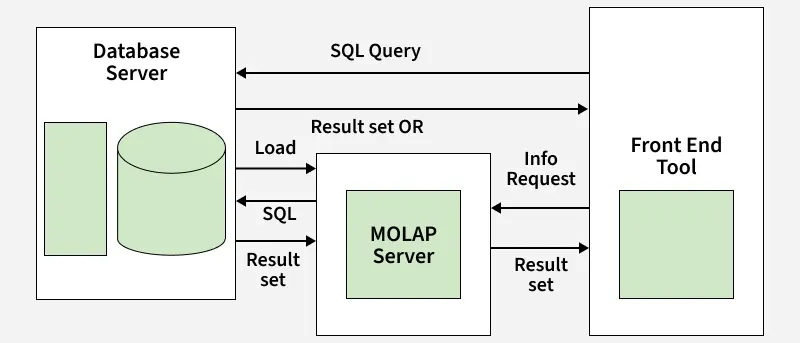
HOLAP Architecture
- **Database Server (RDBMS): The database server stores detailed data in relational databases (RDBMS). This server is responsible for managing large datasets and is used for both querying and loading data. It handles raw data and stores it in a structured, relational format.
- **MOLAP Server: The MOLAP server in HOLAP manages pre-aggregated data in multidimensional cubes for fast query performance. It retrieves data from relational databases, organizes it for efficient access, and processes complex queries using both detailed and summarized data.
- **SQL Query Processing: When a user submits a query through a front-end tool, the system processes the request by sending SQL queries to the database server. Depending on the query type, data is either fetched directly from the relational database or retrieved from the MOLAP server's multidimensional cubes.
- **Front-End Tool: The front-end tool is the user interface that interacts with the HOLAP system. It allows users to request information from the MOLAP server. After processing the query, the MOLAP server sends the result set back to the front-end tool, where users can view the results and perform further analysis or generate reports.
Applications of HOLAP
- Business Intelligence: Generates real-time reports and insights for better decision-making.
- Financial Analysis: Helps with budgeting, forecasting, and tracking financial performance.
- Sales & Marketing: Analyzes sales trends and customer behavior to improve campaigns.
- Supply Chain: Tracks inventory and supplier performance to boost efficiency.
- Retail & E-commerce: Monitors sales and customer data to optimize pricing and inventory.
- Oracle OLAP: Integrates with Oracle databases for advanced multidimensional analysis and reporting.
- IBM Cognos: BI platform with dynamic queries, real-time access, and strong reporting features.
- Microsoft SSAS: Supports complex queries and large data sets with ROLAP and MOLAP options.
- SAP BusinessObjects: Offers real-time relational data analysis and ad-hoc reporting.
- MicroStrategy: Enables interactive reports and real-time analysis with ROLAP support.
- Pentaho BI: Open-source suite with ROLAP, reporting, and real-time analytics capabilities.
Advantages and Disadvantages
| Advantage | Disadvantage |
|---|---|
| Combines speed (MOLAP) and flexibility (ROLAP) | More complex to implement and manage |
| Fast query performance for summary data | May require more advanced infrastructure |
| Real-time access to detailed data | Slightly slower than pure MOLAP for some queries |
| Scales well with large datasets | Performance depends on relational DB efficiency |
| Efficient use of storage | Integration between MOLAP and ROLAP can be tricky |