SVG Introduction (original) (raw)
Last Updated : 27 Jul, 2025
**SVG stands for **Scalable Vector Graphic is a **XML language used to make graphics and animations like in HTML canvas. It is a type of vector graphic that may be scaled up or down. SVG is a web standard for vector-based graphics. It is an XML format that defines graphics.
In SVG files, every element and property can be animated. SVG is compatible with other **W3C standards such as the Document Object Model (DOM) and XSL.
**Prerequisite: Before you continue, you should have some basic understanding of the following: HTML and XML.
**Advantages of SVG
- SVG provides good printing quality at any resolution and therefore is highly usable.
- It is an Open Standard and easy to use.
- We can use any text editor to create and edit SVG images.
- It is highly scalable and never compromises on quality on resizing.
**Disadvantages
- The size of text formatted raster images is bigger than binary formatted raster images.
- Even for a simple image, the size can be large.
SVG Example
Now let's understand SVG better using an example.
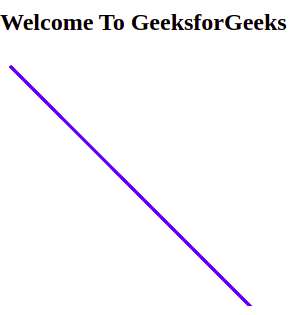
**Example: In this example, We create an SVG line in HTML.
HTML `
Welcome To GeeksforGeeks
`
**Output: