TCS Coding Practice Question | Prime Numbers upto N (original) (raw)
Last Updated : 11 Jul, 2025
Given a number N, the task is to find the Prime Numbers from 1 to N using Command Line Arguments.
Examples:
Input: N = 7
Output: 2, 3, 5, 7Input: N = 13
Output: 2, 3, 5, 7, 11, 13
Approach:
- Since the number is entered as Command line Argument, there is no need for a dedicated input line
- Extract the input number from the command line argument
- This extracted number will be in String type.
- Convert this number into integer type and store it in a variable, say N
- Now loop through the numbers from 2 to N, using a variable say i, to check if they are prime or not. This is done as follows:
In each iteration,- Check if any numbers from 2 to (i/2+1) divide i completely (i.e. if it is a factor of i).
- If yes, then i is not a prime number. Hence check for next number
- If no, then i is a prime number. Hence print the value of i and check for next number
- After the loop has ended, the prime numbers from 1 to N are printed on the screen.
Note: Please note that 1 is not checked in this scenarios because 1 is neither prime nor composite.
Program:
C `
// C program to find // the Prime Numbers from 1 to N // using command line arguments
#include <stdio.h>
#include <stdlib.h> /* atoi */
// Function to check if x is prime int isPrime(int x) { int i;
// Loop to check if x has any factor
// other than 1 and x itself
for (i = 2; i < x / 2 + 1; i++) {
    if (x % i == 0) {
        // Since i is a factor of x
        // x is not prime
        return 0;
    }
}

// x is prime
return 1;
}
// Function to find prime numbers up to n void findPrimes(int n) { int i;
// Loop from 2 to n
// to find all prime numbers in between
for (i = 2; i <= n; i++) {

    // Check if i is prime
    // If yes then print it
    // else continue to next number
    if (isPrime(i) == 1)
        printf("%d, ", i);
}

printf("\n");
}
// Driver code int main(int argc, char* argv[]) {
int n;

// Check if the length of args array is 1
if (argc == 1)
    printf("No command line arguments found.\n");
else {

    // Get the command line argument and
    // Convert it from string type to integer type
    // using function "atoi( argument)"
    n = atoi(argv[1]);

    // Find all prime numbers upto n
    findPrimes(n);
}
return 0;
}
Java
// Java program to find // the Prime Numbers from 1 to N // using command line arguments
class GFG {
// Function to check if x is prime
public static int isPrime(int x)
{
    int i;

    // Loop to check if x has any factor
    // other than 1 and x itself
    for (i = 2; i < x / 2 + 1; i++) {
        if (x % i == 0) {
            // Since i is a factor of x
            // x is not prime
            return 0;
        }
    }

    // x is prime
    return 1;
}

// Function to find prime numbers up to n
public static void findPrimes(int n)
{
    int i;

    // Loop from 2 to n
    // to find all prime numbers in between
    for (i = 2; i <= n; i++) {

        // Check if i is prime
        // If yes then print it
        // else continue to next number
        if (isPrime(i) == 1)
            System.out.print(i + ", ");
    }

    System.out.println();
}

// Driver code
public static void main(String[] args)
{

    // Check if length of args array is
    // greater than 0
    if (args.length > 0) {

        // Get the command line argument and
        // Convert it from string type to integer type
        int n = Integer.parseInt(args[0]);

        // Find all prime numbers upto n
        findPrimes(n);
    }
    else
        System.out.println("No command line "
                           + "arguments found.");
}
}
`
Output:
- In C:
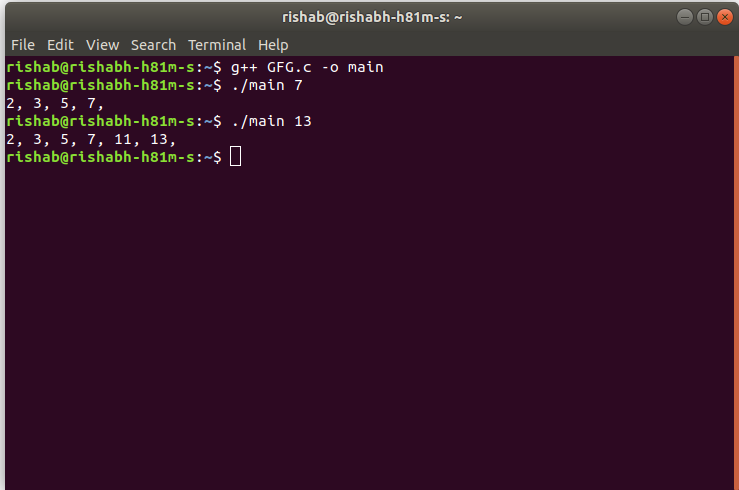
- In Java:
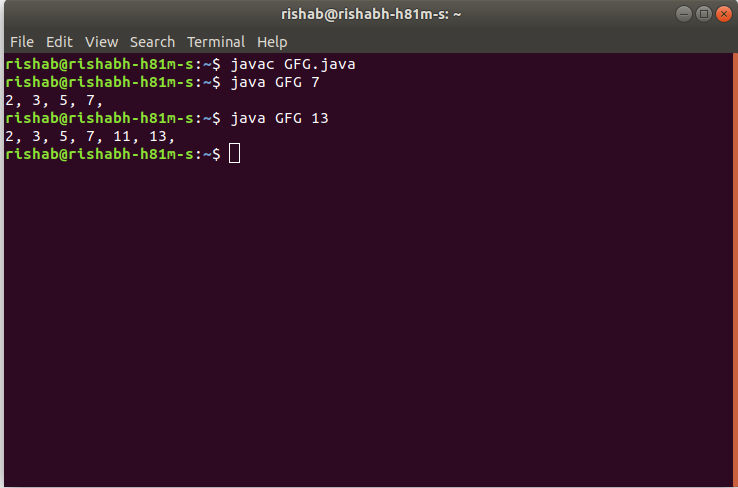
Time Complexity: O(N*N)
Auxiliary Space: O(1)