Association, Composition and Aggregation in Java (original) (raw)
Last Updated : 30 May, 2026
In object-oriented programming, relationships between classes play a crucial role in defining how objects interact with each other. Java, being an object-oriented language, provides mechanisms to model these relationships through association, aggregation, and composition.
- These relationships help model interactions between objects in real-world applications.
- They define the level of dependency and ownership between classes.
- Understanding them improves software design, maintainability, and code reusability.
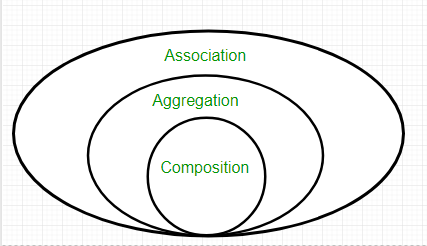
Association
Association is a relationship between two independent classes where one object uses or interacts with another object. Both objects can exist independently of each other.
- Represents a Uses-A relationship.
- Objects are loosely coupled.
- Both classes can exist independently.
Types of Association
- **Unidirectional Association: One class knows about another, but not vice versa. **Example: A Student has a LibraryCard, but the LibraryCard doesn't know about the Student.
- **Bidirectional Association: Both classes know about and interact with each other. **Example: A Teacher is assigned to a Classroom, and the Classroom knows its Teacher.
**Example:
Java `
import java.io.; import java.util.;
// Class 1 // Bank class class Bank {
// Attributes of bank
private String bankName;
private Set<Employee> employees;

// Constructor of Bank class
public Bank(String bankName)
{
    this.bankName = bankName;
}

// Method of Bank class
public String getBankName()
{
    // Returning name of bank
    return this.bankName;
}

public void setEmployees(Set<Employee> employees)
{
    this.employees = employees;
}

public Set<Employee> getEmployees()
{
    return this.employees;
}
}
// Class 2 // Employee class class Employee {
// Attributes of employee
private String name;

// Constructor of Employee class
public Employee(String name)
{
    // this keyword refers to current instance
    this.name = name;
}

// Method of Employee class
public String getEmployeeName()
{
    // returning the name of employee
    return this.name;
}
}
// Class 3 // Association between both the // classes in main method class AssociationExample {
// Main driver method
public static void main(String[] args)
{
    // Creating Employee objects
    Employee emp1 = new Employee("Ridhi");
      Employee emp2 = new Employee("Vijay");

      // adding the employees to a set
    Set<Employee> employees = new HashSet<>();
    employees.add(emp1);
      employees.add(emp2);

      // Creating a Bank object
      Bank bank = new Bank("ICICI");

      // setting the employees for the Bank object
    bank.setEmployees(employees);

      // traversing and displaying the bank employees
      for (Employee emp : bank.getEmployees()) {
          System.out.println(emp.getEmployeeName()
                             + " belongs to bank "
                             + bank.getBankName());
    }
}
}
`
Output
Ridhi belongs to bank ICICI Vijay belongs to bank ICICI
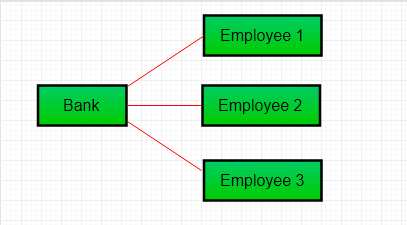
**Explanation: In the above example, two separate classes Bank and Employee are associated through their Objects. Bank can have many employees, So, it is a one-to-many relationship.
Aggregation
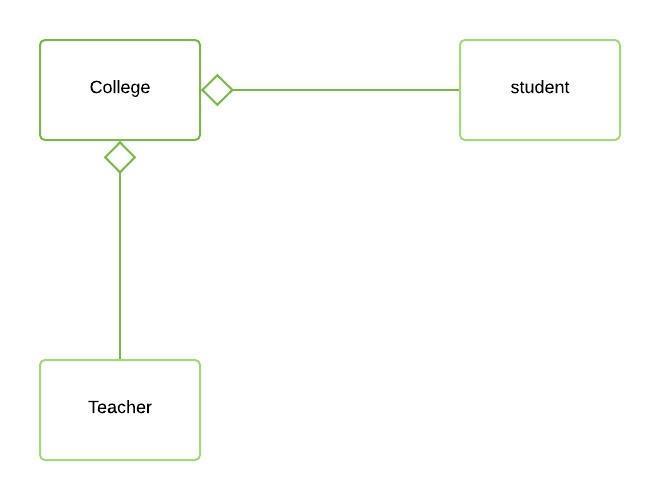
Aggregation is a special form of Association that represents a Has-A relationship with weak ownership. The contained object can exist independently of the container object.
- Represents a Has-A relationship.
- It is a weak association.
- Child objects can exist independently of the parent object.
**Example:
Java `
import java.io.; import java.util.;
// Class 1 // Student class class Student {
// Attributes of Student
private String studentName;
private int studentId;

// Constructor of Student class
public Student(String studentName, int studentId)
{
    this.studentName = studentName;
    this.studentId = studentId;
}

public int getstudentId() {
  return studentId;
}

public String getstudentName() {
  return studentName;
}
}
// Class 2 // Department class // Department class contains list of Students class Department {
// Attributes of Department class
private String deptName;
private List<Student> students;

// Constructor of Department class
public Department(String deptName, List<Student> students)
{
    this.deptName = deptName;
    this.students = students;
}

public List<Student> getStudents() {
  return students;
}

public void addStudent(Student student)
{
    students.add(student);
}
}
// Class 3 // Institute class // Institute class contains the list of Departments class Institute {
// Attributes of Institute
private String instituteName;
private List<Department> departments;

// Constructor of Institute class
public Institute(String instituteName,
                 List<Department> departments)
{
    // This keyword refers to current instance itself
    this.instituteName = instituteName;
    this.departments = departments;
}

public void addDepartment(Department department)
{
    departments.add(department);
}

// Method of Institute class
// Counting total students in the institute
public int getTotalStudentsInInstitute()
{
    int noOfStudents = 0;
    List<Student> students = null;

    for (Department dept : departments) {
        students = dept.getStudents();

        for (Student s : students) {
            noOfStudents++;
        }
    }
    return noOfStudents;
}
}
// Class 4 // main class class AggregationExample {
// main driver method
public static void main(String[] args)
{
    // Creating independent Student objects
    Student s1 = new Student("Parul", 1);
    Student s2 = new Student("Sachin", 2);
    Student s3 = new Student("Priya", 1);
    Student s4 = new Student("Rahul", 2);

    // Creating an list of CSE Students
    List<Student> cse_students = new ArrayList<Student>();
    cse_students.add(s1);
    cse_students.add(s2);

    // Creating an initial list of EE Students
    List<Student> ee_students = new ArrayList<Student>();
    ee_students.add(s3);
    ee_students.add(s4);

    // Creating Department object with a Students list
    // using Aggregation (Department "has" students)
    Department CSE = new Department("CSE", cse_students);
    Department EE = new Department("EE", ee_students);

    // Creating an initial list of Departments
    List<Department> departments = new ArrayList<Department>();
    departments.add(CSE);
    departments.add(EE);

    // Creating an Institute object with Departments list
    // using Aggregation (Institute "has" Departments)
    Institute institute = new Institute("BITS", departments);

    // Display message for better readability
    System.out.print("Total students in institute: ");

    // Calling method to get total number of students
    // in the institute and printing on console
    System.out.print(
        institute.getTotalStudentsInInstitute());
}
}
`
Output
Total students in institute: 4
**Explanation:
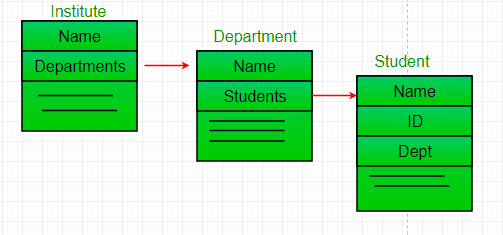
- There is an Institute which has no. of departments like CSE, EE. Every department has no. of students.
- So, we make an Institute class that has a reference to Object or no. of Objects (i.e. List of Objects) of the Department class.
- That means Institute class is associated with Department class through its Object(s).
- And Department class has also a reference to Object or Objects (i.e. List of Objects) of the Student class means it is associated with the Student class through its Object(s).
It represents a **Has-A relationship. In the above example: Student **Has-A name. Student **Has-A ID. Department **Has-A Students as depicted from the below media.
**Note: Code reuse is best achieved by aggregation.
Composition
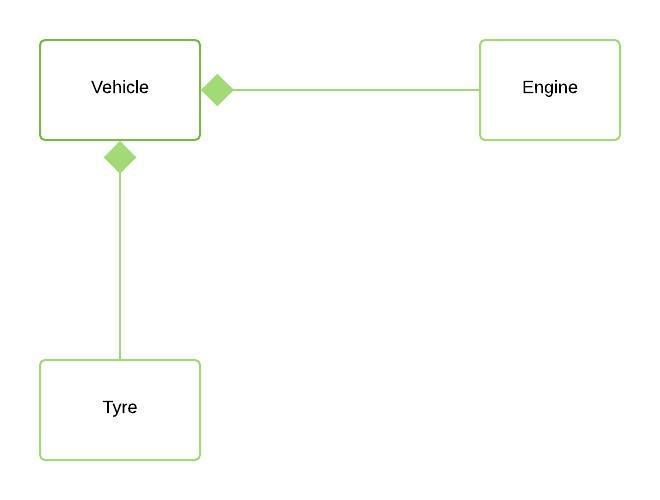
Composition is a strong form of Aggregation that represents a Part-Of relationship. In Composition, the lifecycle of the contained object depends completely on the container object.
- Represents a Part-Of relationship.
- Strong ownership exists between objects.
- Child objects cannot exist without the parent object.
**Example:
Java `
import java.io.; import java.util.;
// Room class class Room {
private String roomName;

public Room(String roomName) {
    this.roomName = roomName;
}

public String getRoomName() {
    return roomName;
}
}
// House class class House {
private String houseName;
private List<Room> rooms;

public House(String houseName) {
    this.houseName = houseName;
    this.rooms = new ArrayList<>();
}

public void addRoom(Room room) {
    rooms.add(room);
}

public List<Room> getRooms() {
    return new ArrayList<>(rooms);
}

public int getTotalRooms() {
    return rooms.size();
}
}
// Main class class CompositionExample {
public static void main(String[] args) {
    House house = new House("Dream House");

    house.addRoom(new Room("Living Room"));
    house.addRoom(new Room("Bedroom"));
    house.addRoom(new Room("Kitchen"));
    house.addRoom(new Room("Bathroom"));

    int r = house.getTotalRooms();
    System.out.println("Total Rooms: " + r);

    System.out.println("Room names: ");
    for (Room room : house.getRooms()) {
        System.out.println("- " + room.getRoomName());
    }
}
}
`
Output
Total Rooms: 4 Room names:
- Living Room
- Bedroom
- Kitchen
- Bathroom
**Explanation: In the above example, if the house is destroyed, its room also get destroyed this represents a complete composition relationship, where the room is the part of the house and the life cycle of room completely depends on the house.
Difference Between Association, Aggregation and Composition
| Feature | Association | Aggregation | Composition |
|---|---|---|---|
| Definition | General relationship between two classes | A special form of association with a "has-a" relationship | A stronger form of association with a "part-of" relationship |
| Dependency | Classes are related but can exist independently | Contained objects can exist independently of the container object | Contained objects cannot exist without the container object |
| Lifecycle | Independent lifecycles | Independent lifecycles | Dependent lifecycles |
| Ownership | No ownership implied | Shared ownership | Exclusive ownership |
| Strength | Weak | Moderate | Strong |
| Cardinality | One-to-one, one-to-many, many-to-one, many-to-many | One-to-one, one-to-many, many-to-one, many-to-many | One-to-one, one-to-many |
| Example | Teacher and Student | Library and Books | Car and Engine |
| Representation | Uses a direct reference | Uses a reference to the contained object(s) | Contains instances of the contained object(s) |
| Illustrative Example Code | java class Teacher { private Student student; } | java class Library { private List books; } | java class Car { private Engine engine; } |