How to Create a REST API using Java Spring Boot (original) (raw)
Last Updated : 30 Apr, 2026
Creating a REST API using Spring Boot allows developers to build scalable and production-ready web services with minimal configuration. It simplifies RESTful service development by providing built-in support for HTTP methods, dependency injection, and auto-configuration.
- Offers embedded servers (Tomcat/Jetty) to run applications without external deployment
- Supports API testing using tools like Postman or Swagger UI
- Allows easy configuration via application.properties or application.yml
Why Spring Boot?
Spring Boot makes it easy to create production-ready apps:
- Built on top of Spring Framework
- Reduces boilerplate code with auto-configurations
- Quick setup for REST APIs
- Beginner-friendly
Steps to Implements a REST API in Spring Boot
Follow the below steps to create and run a REST API in Spring Boot.
Step 1: Create the Spring Boot Project
Using Spring Initializr (Recommended)
1. Open Spring Initializr in your browser.
2. Fill in the project details:
- **Project: Maven
- **Language: Java
- **Spring Boot version: (latest stable, e.g., 3.1.x)
- **Group: com. example
- **Artifact: demo
- **Name: demo
- **Packaging: Jar
- **Java version: 17+
3. Click Add Dependencies-> Select Spring Web.
4. Click Generate-> It will download a .zip file.
5. Extract the zip-> Open it in your IDE (IntelliJ / Eclipse / VS Code).
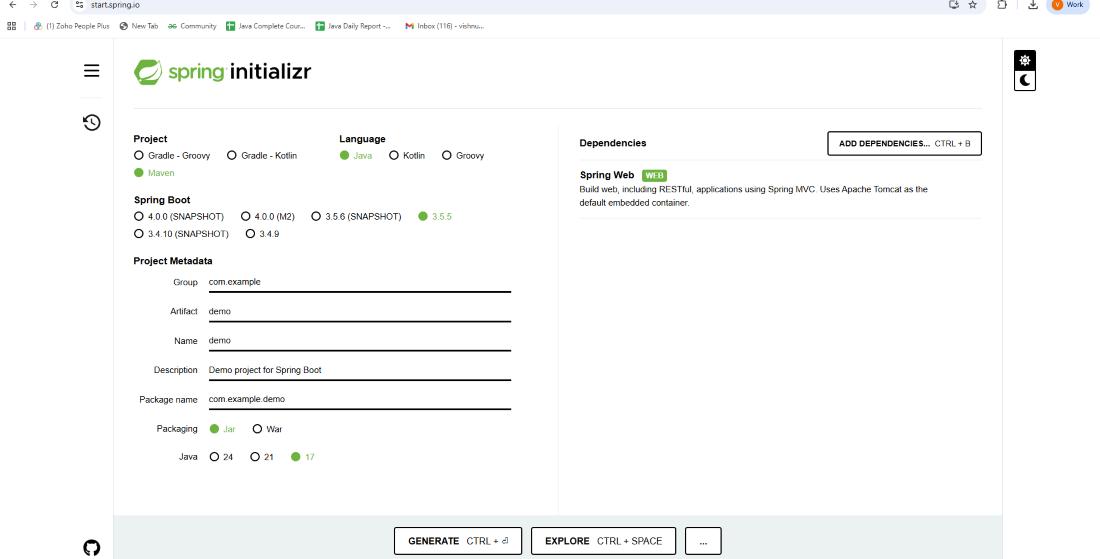
Project
Step 2: Define the Employee Entity
Create a simple Employee class inside com.example.demo:
Java `
package com.example.demo;
// Employee entity class public class Employee {
private Integer id;
private String firstName;
private String lastName;
private String email;

// Default constructor
public Employee() {}

// Parameterized constructor
public Employee(Integer id, String firstName, String lastName, String email) {
    this.id = id;
    this.firstName = firstName;
    this.lastName = lastName;
    this.email = email;
}

// Getters and Setters
public Integer getId() {
    return id;
}

public void setId(Integer id) {
    this.id = id;
}

public String getFirstName() {
    return firstName;
}

public void setFirstName(String firstName) {
    this.firstName = firstName;
}

public String getLastName() {
    return lastName;
}

public void setLastName(String lastName) {
    this.lastName = lastName;
}

public String getEmail() {
    return email;
}

public void setEmail(String email) {
    this.email = email;
}

@Override
public String toString() {
    return "Employee [id=" + id + ", firstName=" + firstName +
            ", lastName=" + lastName + ", email=" + email + "]";
}
}
`
Step 3: Create a Storage Class
Create a class to hold a list of employees.
Java `
package com.example.demo;
import java.util.ArrayList; import java.util.List;
// Storage class for employees public class Employees {
private List<Employee> employeeList;

// Get the employee list (initialize if null)
public List<Employee> getEmployeeList() {
    if (employeeList == null) {
        employeeList = new ArrayList<>();
    }
    return employeeList;
}

public void setEmployeeList(List<Employee> employeeList) {
    this.employeeList = employeeList;
}
}
`
Step 4: Create the DAO Class
The DAO class will handle adding and retrieving employees.
Java `
package com.example.demo;
import org.springframework.stereotype.Repository;
@Repository public class EmployeeDAO {
private static Employees employees = new Employees();

static {
    // Initialize with sample employees
    employees.getEmployeeList()
      .add(new Employee(1, "Prem", "Tiwari", "prem@gmail.com"));
    employees.getEmployeeList()
      .add(new Employee(2, "Vikash", "Kumar", "vikash@gmail.com"));
    employees.getEmployeeList()
      .add(new Employee(3, "Ritesh", "Ojha", "ritesh@gmail.com"));
}

// Retrieve all employees
public Employees getAllEmployees() {
    return employees;
}

// Add an employee
public void addEmployee(Employee employee) {
    employees.getEmployeeList().add(employee);
}
}
`
Step 5: Create the Controller
The controller contains the REST API endpoints.
Java `
package com.example.demo;
import org.springframework.beans.factory.annotation.Autowired; import org.springframework.http.ResponseEntity; import org.springframework.web.bind.annotation.*; import org.springframework.web.servlet.support.ServletUriComponentsBuilder;
import java.net.URI;
// REST Controller for managing employees @RestController @RequestMapping("/employees") public class EmployeeController {
@Autowired
private EmployeeDAO employeeDao;

// GET endpoint to fetch all employees
@GetMapping("/")
public Employees getEmployees() {
    return employeeDao.getAllEmployees();
}

// POST endpoint to add a new employee
@PostMapping("/")
public ResponseEntity<Object>
  addEmployee(@RequestBody Employee employee) {

    // Generate ID for the new employee
    Integer id = employeeDao.getAllEmployees()
      .getEmployeeList().size() + 1;
    employee.setId(id);

    // Add employee to the list
    employeeDao.addEmployee(employee);

    // Build location URI for the new employee
    URI location = ServletUriComponentsBuilder
      .fromCurrentRequest()
            .path("/{id}")
            .buildAndExpand(employee.getId())
            .toUri();

    return ResponseEntity.created(location).build();
}
}
`
Step 6: Run the Application
Open DemoApplication.java (already generated by Spring Boot) and run it:
Java `
package com.example.demo;
import org.springframework.boot.SpringApplication; import org.springframework.boot.autoconfigure.SpringBootApplication;
@SpringBootApplication public class DemoApplication { public static void main(String[] args) { SpringApplication.run(DemoApplication.class, args); } }
`
Step 7: Testing the API
Now we can test the API using tools like Postman or a web browser.
**GET Request: Fetch all employees
**Response:
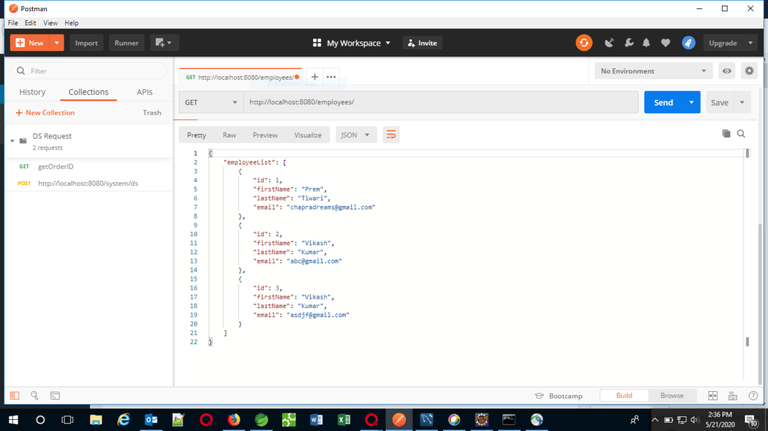
**POST Request: Add a new employee
**Response:
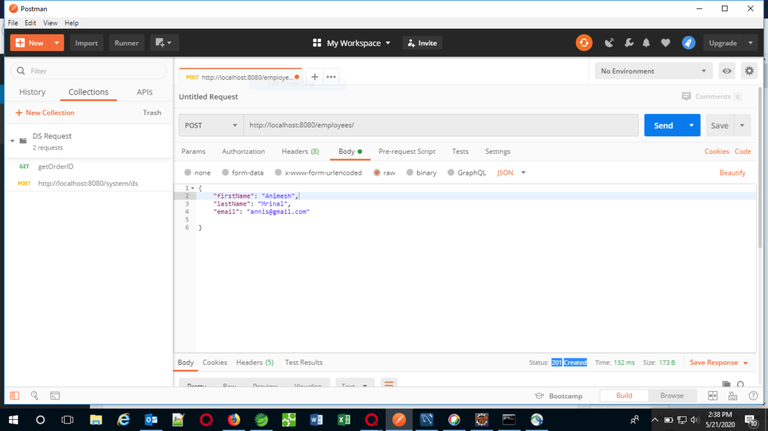
Again hitting the GET request after performing the POST request:
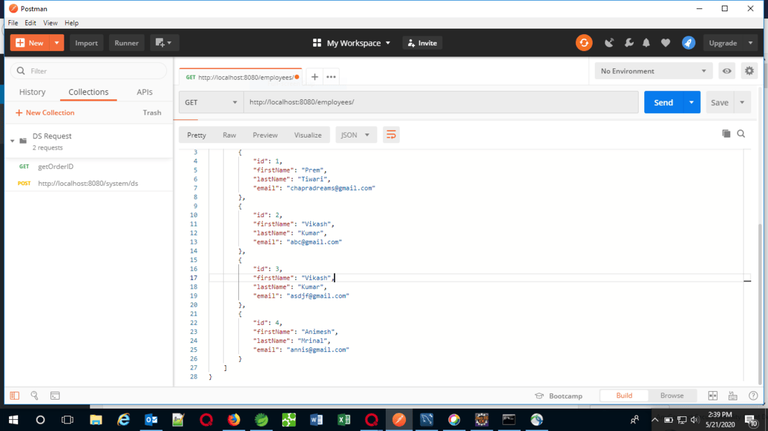
This concludes creating a REST API using Spring Boot. Now we have a fully functioning API to manage employees.