How to Implement AOP in Spring Boot Application (original) (raw)
Aspect-Oriented Programming (AOP) in Spring Boot is used to separate cross-cutting concerns like logging, security, and transaction management from business logic. It improves code modularity by applying these concerns across multiple layers without modifying the core functionality. Spring Boot simplifies AOP integration using annotations and auto-configuration.
- Enables separation of cross-cutting concerns such as logging, security, and transactions.
- Uses annotations like @Aspect, @Before, @After, @Around, and @Pointcut.
- Implemented using proxy-based mechanism (JDK dynamic proxies or CGLIB).
- Easily enabled in Spring Boot using @EnableAspectJAutoProxy or auto-configuration.
Types of AOP Advice in Spring
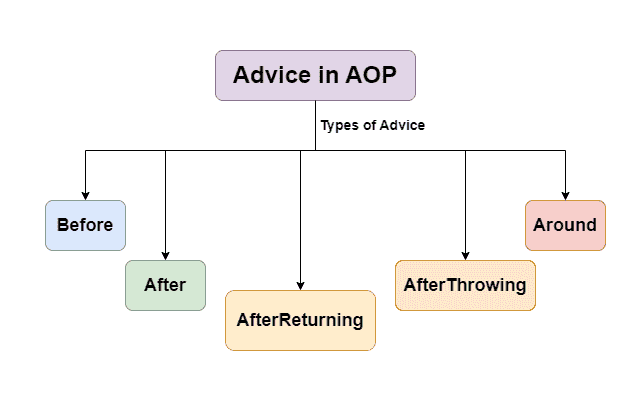
1. @Around
It executes both before and after the target method. The first parameter must be of type ProceedingJoinPoint, and it must invoke the proceed() method to continue the target method’s execution.
Java `
@Pointcut("execution(* com.gfg.examples.service.ServiceExample.*(..))") private void printLogs() {}
@Around("printLogs()") public void logsAroundAdvice(ProceedingJoinPoint joinPoint) throws Throwable { System.out.println("Before invoking method: " + joinPoint.getSignature().getName()); try { joinPoint.proceed(); } finally { System.out.println("After invoking method: " + joinPoint.getSignature().getName()); } }
`
**Use Cases:
- Track execution time of methods
- Centralized logging before and after service calls
- Profiling or performance monitoring
2. @Before
Executes before the target method is invoked. If @Around advice exists, its “before” portion executes first, followed by @Before.
Java `
@Before("execution(* com.gfg.examples.service.ServiceExample.*(..))") public void logBeforeMethod() { System.out.println("Executing @Before advice before the target method."); }
`
**Use Case: Performing input validation or pre-condition checks before a method executes.
3. @After
Executes after the method execution, regardless of its outcome (successful or exception). If @Around advice exists, its “after” part executes first.
**Sample code snippet:
Java `
@After("execution(* com.gfg.examples.service.ServiceExample.*(..))") public void logAfterMethod() { System.out.println("Executing @After advice after the target method."); }
`
**Use Case: Performing resource cleanup, sending notifications, or closing database connections.
4. @AfterReturning
Executes only when the method successfully returns a result. It can capture the return value of the method.
Java `
@AfterReturning( value = "execution(* com.gfg.examples.service.ServiceExample.*(..))", returning = "result") public void logAfterReturning(JoinPoint joinPoint, Object result) { System.out.println("Method " + joinPoint.getSignature().getName() + " returned: " + result); }
`
****Use Case:**Logging successful operations or triggering dependent actions after a successful method call.
5. @AfterThrowing
Executes only when a method throws an exception. It helps log or handle exceptions globally.
Java `
@AfterThrowing( value = "execution(* com.gfg.examples.service.ServiceExample.*(..))", throwing = "ex") public void logAfterThrowing(JoinPoint joinPoint, Exception ex) { System.out.println("Exception in method: " + joinPoint.getSignature().getName()); System.out.println("Exception Message: " + ex.getMessage()); }
`
**Use Case: Error logging, alert notifications, or rollback operations in case of failure.
Steps to Implement AOP in Spring Boot Application
Step 1: Create Spring Boot Project
- Create a Spring Boot project using Spring Initializr or IDE.
- Add dependencies: Spring Web and Spring AOP.
**Project Structure:
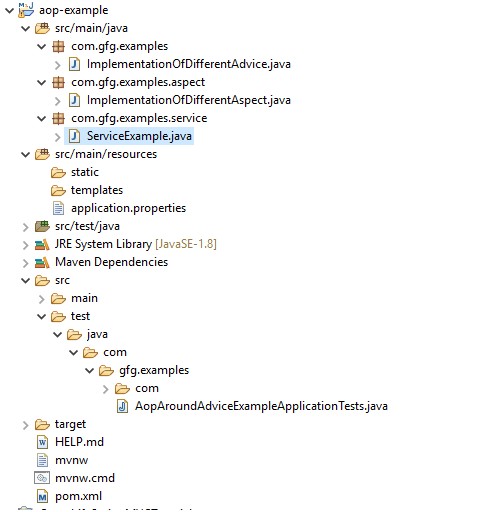
Project Structure
Step 2: Configure pom.xml
- Add spring-boot-starter-aop for AOP support.
- Ensure Spring Boot parent and plugins are properly configured.
**pom.xml
XML `
4.0.0 org.springframework.boot spring-boot-starter-parent 2.2.2.RELEASE com.gfg.examples aop-example 0.0.1-SNAPSHOT Demo project for Spring Boot AOP
<properties>
    <java.version>1.8</java.version>
</properties>

<dependencies>
    <dependency>
        <groupId>org.springframework.boot</groupId>
        <artifactId>spring-boot-starter-web</artifactId>
    </dependency>
    <dependency>
        <groupId>org.springframework.boot</groupId>
        <artifactId>spring-boot-starter-aop</artifactId>
    </dependency>
    <dependency>
        <groupId>org.springframework.boot</groupId>
        <artifactId>spring-boot-starter-test</artifactId>
        <scope>test</scope>
    </dependency>
</dependencies>

<build>
    <plugins>
        <plugin>
            <groupId>org.springframework.boot</groupId>
            <artifactId>spring-boot-maven-plugin</artifactId>
        </plugin>
    </plugins>
</build>
`
**Step 3: Create Service Class
- Create a service class (ServiceExample) with business methods.
- These methods act as target methods where AOP advice will be applied.
**ServiceExample.java
Java `
package com.gfg.examples.service;
import org.springframework.stereotype.Service;
@Service public class ServiceExample {
public void getAccountBalance(String employeeAccountNumber) {
    System.out.println("Inside getAccountBalance() method");
    if ("Emp1212".equals(employeeAccountNumber)) {
        System.out.println("Total balance: 50,000");
    } else {
        System.out.println("Invalid account number.");
    }
}

public String employeeStatus(String employeeNumber) {
    System.out.println("Inside employeeStatus() method");
    if ("emp12345".equals(employeeNumber)) {
        System.out.println(employeeNumber + " is active");
        return "active";
    } else {
        System.out.println(employeeNumber + " is inactive");
        return "inactive";
    }
}

public String eligibilityForPromotion(int promotionExamMarks) {
    System.out.println("Inside eligibilityForPromotion() method");
    if (promotionExamMarks >= 650) {
        System.out.println("Eligible for promotion");
        return "eligible";
    } else {
        System.out.println("Not eligible for promotion");
        return "not eligible";
    }
}
}
`
**Step 4: Create Aspect Class
- Create a class annotated with @Aspect and @Component.
- Define a Pointcut to target service methods. Add different types of advice:
@Before: runs before method execution@After: runs after execution@AfterReturning: runs after successful execution@AfterThrowing: runs on exception@Around: runs before and after (full control)
**ImplementationOfDifferentAspect.java
Java `
package com.gfg.examples.aspect;
import org.aspectj.lang.JoinPoint; import org.aspectj.lang.ProceedingJoinPoint; import org.aspectj.lang.annotation.*; import org.springframework.stereotype.Component;
@Aspect @Component public class ImplementationOfDifferentAspect {
@Pointcut("execution(* com.gfg.examples.service.ServiceExample.*(..))")
private void serviceMethods() {}

@Before("serviceMethods()")
public void logBefore() {
    System.out.println("Executing @Before advice before service method.");
}

@After("serviceMethods()")
public void logAfter() {
    System.out.println("Executing @After advice after service method.");
}

@AfterReturning(value = "serviceMethods()", returning = "result")
public void logAfterReturning(JoinPoint joinPoint, Object result) {
    System.out.println("Method returned successfully: " + joinPoint.getSignature().getName());
}

@AfterThrowing(value = "serviceMethods()", throwing = "ex")
public void logAfterThrowing(JoinPoint joinPoint, Exception ex) {
    System.out.println("Exception in method: " + joinPoint.getSignature().getName());
    System.out.println("Error: " + ex.getMessage());
}

@Around("serviceMethods()")
public void logAround(ProceedingJoinPoint joinPoint) throws Throwable {
    System.out.println("Before executing method: " + joinPoint.getSignature().getName());
    joinPoint.proceed();
    System.out.println("After executing method: " + joinPoint.getSignature().getName());
}
}
`
**Step 5: Enable AOP
- Add
@EnableAspectJAutoProxyin the main class. - This enables Spring AOP proxy mechanism.
**ImplementationOfDifferentAdvice.java
Java `
package com.gfg.examples;
import com.gfg.examples.service.ServiceExample; import org.springframework.boot.SpringApplication; import org.springframework.boot.autoconfigure.SpringBootApplication; import org.springframework.context.ConfigurableApplicationContext; import org.springframework.context.annotation.EnableAspectJAutoProxy;
@SpringBootApplication @EnableAspectJAutoProxy public class ImplementationOfDifferentAdvice {
public static void main(String[] args) {
    ConfigurableApplicationContext context =
            SpringApplication.run(ImplementationOfDifferentAdvice.class, args);

    ServiceExample service = context.getBean(ServiceExample.class);

    service.employeeStatus("emp12345");
    service.getAccountBalance("Emp1212");
    service.eligibilityForPromotion(650);

    context.close();
}
}
`
**Step 6: Run the Application
- Start the Spring Boot application.
- Get the service bean from the context and call methods.
**Output:
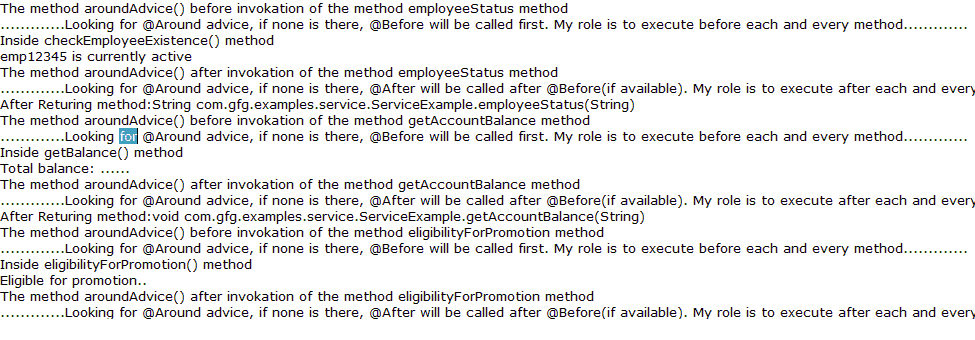
Output
Step 7: Observe Output
AOP advices execute automatically:
- Logs before method execution.
- Logs after execution.
- Logs on success or exception.