ipcrm command in Linux with examples (original) (raw)
Last Updated : 11 Jul, 2025
**ipcrm command in Linux is used to remove some IPC(Inter-Process Communication) resources. It eliminates the IPC objects and their associated data structure form the system. One must be a creator or superuser or the owner of the object in order to remove these objects. There are _three types of System V IPC objects i.e. _semaphores,_shared memory, and _message queues.
**Note:
When all the currently attached processes will remove the object from their virtual address space then only shared memory object can be removed.
**Syntax:
ipcrm [options]
_or
ipcrm {shm|msg|sem} id...
**Options:
- **-a, --all [shm] [msg] [sem] : Remove all resources. When an option argument is provided, the removal is performed only for the specified resource types.
- **-M, --shmem-key shmkey : Remove the shared memory segment created with shmkey after the last detach is performed.
- **-m, --shmem-id shmid : Remove the shared memory segment identified by _shmid after the last detach is performed.
- **-Q, --queue-key msgkey : Remove the message queue created with _msgkey.
- **-q, --queue-id msgid : Remove the message queue identified by _msgid.
- **-S, --semaphore-key semkey : Remove the semaphore created with _semkey.
- **-s, --semaphore-id semid : Remove the semaphore identified by _semid.
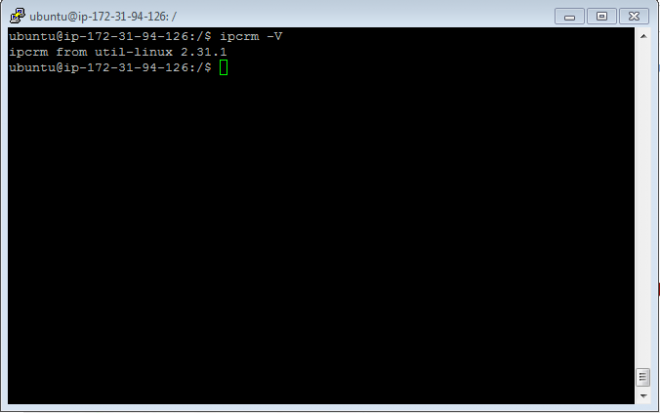
- **-V, --version : Display version information and exit.
- **-h, --help : Display help text and exit.
