Tail command in Linux with examples (original) (raw)
Last Updated : 9 Jan, 2026
Tail Command in Linux is used to display the last part of a file, showing recent content such as logs or updates.
- By default, it shows the last 10 lines of a file.
- Commonly used for monitoring log files and debugging.
- You can customize the number of lines displayed using the -n option.
- Useful for viewing the most recent entries without opening the entire file.
Example
Let us consider two files having a name state.txt and capital.txt containing all the names of the
Indian states and capitals, respectively.
**Command:
cat state.txt
**Output:
Andhra Pradesh
Arunachal Pradesh
Assam
Bihar
Chhattisgarh
Goa
Gujarat
Haryana
Himachal Pradesh
Jammu and Kashmir
Jharkhand
Karnataka
Kerala
Madhya Pradesh
Maharashtra
Manipur
Meghalaya
Mizoram
Nagaland
Odisha
Punjab
Rajasthan
Sikkim
Tamil Nadu
Telangana
Tripura
Uttar Pradesh
Uttarakhand
West Bengal
- Without any option it display only the last 10 lines of the file specified.
tail state.txt
- Here we will only get names of last 10 states after using tail command.

tail command in Linux
**Syntax of Tail Command in Linux
tail [OPTION]... [FILE]...
**Options and Practical Examples of Tail Command in Linux
This section covers the most commonly used options and practical examples of the tail command to help you efficiently view and monitor the end of files in Linux.

1. `**-n` num Option in Tail Command in Linux
- By default, the
tailcommand displays the last 10 lines of a file. - To print a specific number of lines, use the
-noption followed by the desired number. - The
numvalue is mandatory; leaving out a number will cause an error. - You can also use the command without the
noption, but the-sign is required.
tail -n 3 state.txt
or
tail -3 state.txt

- The tail command also supports the ‘+’ option, which is not available in the
headcommand. - Using this option, the command prints data starting from the specified line number to the end of the file.
tail +25 state.txt
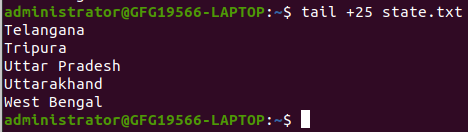
tail +n option in Linux
2. `**-c` num Option in Tail Command in Linux
- The
-coption in thetailcommand is used to print the last ‘num’ bytes from the specified file. - Newlines count as single bytes, so each newline character is also included in the count.
- It is mandatory to specify
-cfollowed by a positive or negative number depending on your requirement. - Using
-c -numdisplays the last num bytes from the file. - Using
-c +numdisplays all data after skipping num bytes from the beginning of the file.
**Note: Without positive or negative sign before **num, command will display the last **num bytes from the file specified.
Example
- Display the last 7 bytes of the file:
tail -c -7 state.txt
or
tail -c 7 state.txt

-c option in tail command in Linux (using negative)
- Display all data after skipping the first 263 bytes:
tail -c +263 state.txt

-c option in tail command in Linux (using positive)
3. `**-q` Option in Tail Command in Linux
- It is used if more than 1 file is given. Because of this command, data from each file is not precedes by its file name.
- But before lets see text inside capital.txt file.
**Command:
cat capital.txt
**Output:
Amaravati
Itanagar
Dispur
Patna
Raipur
Panaji
Gandhinagar
Chandigarh
Shimla
Srinagar (summer), Jammu (winter)
Ranchi
Bengaluru
Thiruvananthapuram
Bhopal
Mumbai
Imphal
Shillong
Aizawl
Kohima
Bhubaneswar
Chandigarh
Jaipur
Gangtok
Chennai
Hyderabad
Agartala
Lucknow
Dehradun
Kolkata
**Without using -q option
**Command:
tail state.txt capital.txt
**Output:

Without using -q option in tail command in Linux
**With using -q option
tail state.txt -q capital.txt

With using -q option in tail command in Linux
4. `**-f` Option in Tail Command in Linux
- The
-foption in thetailcommand is used to continuously monitor a file in real-time. - It displays the last 10 lines of a file and automatically updates as new lines are added.
- Commonly used by system administrators to track log files or error messages as programs run.
- The command does not exit automatically — you must stop it manually using
Ctrl + C.
****$ tail -f logfile**
5. `**-v` Option in Tail Command in Linux
By using this option, data from the specified file is always preceded by its file name.
tail -v state.txt
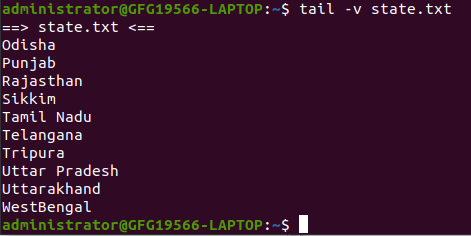
-v option in tail command in Linux
6. `**--version` Option in Tail Command in Linux
This option is used to display the version of tail which is currently running on your system.
tail --version

To check version of tail command in Linux
**How to use tail with pipes(|)?
The tail command can be piped with many other commands of the unix. In the following example output of the tail command is given as input to the sort command with -r option to sort the last 7 state names coming from file state.txt in the reverse order.
tail -n 7 state.txt

tail command
Using Tail command with pipe `|`
tail -n 7 state.txt | sort -r
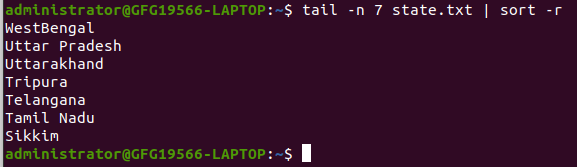
Using Tail command with pipe `|`
It can also be piped with one or more filters for additional processing. Like in the following example, we are using cat, head and tail command and whose output is stored in the file name list.txt using directive(>).
cat state.txt | head -n 20 | tail -n 5 > list.txt
cat list.txt

using `>` operator in tail command