Proximal Policy Optimization (PPO) (original) (raw)
Last Updated : 11 Dec, 2025
Proximal Policy Optimization (PPO) is a reinforcement learning algorithm that helps agents improve their actions while keeping learning stable. It directly updates the policy like other policy gradient methods but uses a clipping rule to limit large destabilizing changes.
This balance between maximizing rewards and keeping updates small makes PPO simpler, more reliable, and suitable for applications in robotics, games, and generative AI.
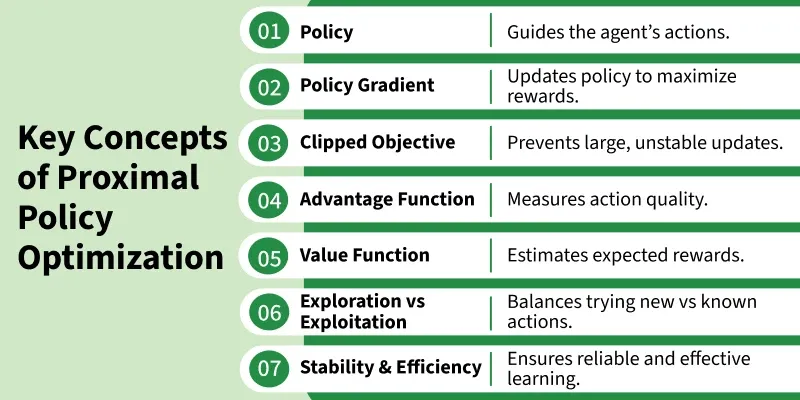
PPO vs Earlier Methods
Comparison of PPO with earlier policy gradient methods:
- **Reinforce: Simple and easy to understand but often unstable due to high variance in updates. PPO improves stability by limiting how much the policy can change at each step.
- **Actor-Critic: Uses an actor to choose actions and a critic to evaluate them, thereby reducing the variance of policy gradients. PPO achieves similar stability while still leveraging a value function (critic) for advantage estimation.
PPO provides more reliable training in challenging environments. While it still needs careful tuning and adequate hardware, it's a great choice for many real world applications.
Role of PPO in Generative AI
Reasons for using PPO in Generative AI are:
- **Fine Tuning with Human Feedback: PPO is the backbone of RLHF aligning large language models with human preferences.
- **Stability in Training: Ensures safe and steady updates while optimizing massive generative models.
- **Balancing Exploration and Safety: Helps GenAI systems generate creative responses without drifting into harmful outputs.
- **Efficient Large Scale Optimization: Handles huge datasets and parameters making training feasible at scale.
- **Human Like Interaction: Improves coherence, relevance and alignment of AI outputs with human intent.
Parameters in PPO
Here are the main parameters in PPO:
- **Clip Range (ε): Controls how much the new policy can deviate from the old one ensuring stable updates.
- **Learning Rate: Step size for updating network weights during training.
- **Discount Factor (γ): Determines how much future rewards are valued compared to immediate rewards.
- **GAE Lambda (λ): Balances bias and variance in advantage estimation using Generalized Advantage Estimation.
- **Number of Epochs: How many times each batch of data is used for policy updates.
- **Batch Size: Number of samples per update affecting stability and efficiency.
- **Value Loss Coefficient (c1): Weight given to the critic loss in the total objective.
- **Entropy Coefficient (c2): Encourages exploration by penalizing low entropy i.e. overconfident policies.
Mathematical Implementation
Mathematical formulation and algorithm of PPO:
1. Policy Update Rule
- PPO updates the agent’s policy using policy gradients adjusting it in the direction that maximizes the expected cumulative reward.
- Unlike standard policy gradient methods, it ensures updates are controlled and stable.
2. Surrogate Objective
- Instead of directly maximizing rewards, PPO maximizes a surrogate objective that measures improvement over the old policy:
L(\theta) = \mathbb{E}_t \Big[ \frac{\pi_{\theta} (a_t \mid s_t)}{\pi_{\theta_{\text{old}}} (a_t \mid s_t)} A_t \Big]
- This allows the algorithm to evaluate the benefit of new actions while referencing the old policy.
3. Clipping Mechanism
- Introduces a clip function to limit the probability ratio between new and old policies:
\text{clip}\Big(\frac{\pi_{\theta}(a_t \mid s_t)}{\pi_{\theta_{\text{old}}}(a_t \mid s_t)}, 1 - \epsilon, 1 + \epsilon \Big)
- Prevents excessively large policy updates that could destabilize learning.
4. Advantage Estimation
- Computes the advantage A_t to determine how much better or worse an action was compared to the expected value of the state.
- Guides the policy update by increasing the probability of better actions and decreasing that of worse actions.
Integrating PPO with Generative AI
Ways to integrate PPO with Gen AI are:
- **Multi Modal Alignment: It can be extended to align text with images, audio or video by rewarding outputs that stay consistent across modalities.
- **Personalization of Models: Integrate it to fine tune GenAI systems for individual users by optimizing toward user specific feedback and preferences.
- **Continuous Online Learning: Use it in a feedback loop where the model adapts to new data and user interactions in real time keeping outputs fresh and relevant.
- **Safety Constrained Generation: It can integrate safety filters directly into the reward function penalizing harmful or biased generations during training.
- **Task Specific Fine Tuning: Beyond general alignment, It can fine tune GenAI for specialized domains like legal document drafting or educational tutoring.
Working
Workflow of PPO is mentioned below:
- **Collect Experiences: The agent interacts with the environment to gather states, actions and rewards.
- **Compute Advantages: Estimate how much better or worse an action is compared to the average expected reward.
- **Update Policy: Adjust the policy to maximize rewards and use clipping to prevent large destabilizing changes.
- **Update Value Function: Train a value network to accurately predict expected rewards, which is crucial for advantage estimation.
- **Repeat: Continue collecting experiences and updating the policy until performance stabilizes.
Implementation
Step by step implementation of PPO for Generative AI:
Step 1: Import Libraries
Importing libraries like Numpy, Transformers and Pytorch modules.
Python `
import torch import torch.nn as nn import torch.optim as optim from transformers import GPT2LMHeadModel, GPT2Tokenizer from torch.utils.data import Dataset, DataLoader import numpy as np from collections import deque import random
`
Step 2: Environment Setup
- **Setup device and model: Using GPU if available, loading GPT-2 model and tokenizer.
- **Prepare tokenizer and move model: Setting padding token and moving model to device i.e. GPU or CPU.
- **Optimizer: Using Adam optimizer for training. Python `
class MiniPPO: def init(self): self.device = 'cuda' if torch.cuda.is_available() else 'cpu' self.model = GPT2LMHeadModel.from_pretrained('gpt2') self.tokenizer = GPT2Tokenizer.from_pretrained('gpt2') self.tokenizer.pad_token = self.tokenizer.eos_token self.model.to(self.device) self.optimizer = torch.optim.Adam(self.model.parameters(), lr=1e-5) self.epsilon = 0.2
`
Step 3: Training
**1. Prepare input and generate text:
- Encoding the prompt into tokens and send to device.
- Letting GPT-2 generate continuation up to 30 tokens.
- Decoding generated tokens to readable text.
**2. Compute probabilities:
- Feeding generated sequence back to GPT-2 to get logits.
- Converting logits to log probabilities of each token.
**3. Select log probs of generated tokens: Picking only the log probabilities for the generated words.
**4. Compute reward:
- Base reward = text length / 25 (max 1).
- Bonus +0.5 if text contains “good” or “great”.
**5. Compute loss and update model:
- Loss = negative log-prob * reward which encourages high reward text.
- Backpropagating loss and step optimizer.
- Returning generated text and reward. Python `
def train_step(self, prompt): self.model.train() inputs = self.tokenizer.encode(prompt, return_tensors='pt').to(self.device)
    outputs = self.model.generate(
        inputs,
        max_length=inputs.shape[1] + 30,
        do_sample=True,
        return_dict_in_generate=True,
        output_scores=True,
        pad_token_id=self.tokenizer.eos_token_id
    )

    generated_sequence = outputs.sequences[0]
    gen_tokens = generated_sequence[inputs.shape[1]:]
    text = self.tokenizer.decode(gen_tokens, skip_special_tokens=True)

    full_outputs = self.model(generated_sequence.unsqueeze(0), labels=generated_sequence.unsqueeze(0))
    logits = full_outputs.logits[:, :-1, :]
    log_probs = torch.log_softmax(logits, dim=-1)

    current_log_probs = log_probs[0, inputs.shape[1]-1:generated_sequence.shape[0]-1].gather(1, gen_tokens.unsqueeze(-1)).squeeze(-1)

    reward = min(len(text.split()) / 25, 1.0)
    if 'good' in text.lower() or 'great' in text.lower():
        reward += 0.5

    reward_tensor = torch.tensor([reward], device=self.device)

    loss = -(current_log_probs * reward_tensor).mean()

    self.optimizer.zero_grad()
    loss.backward()
    self.optimizer.step()

    return text, reward
`
Step 4: Track Rewards
- **Create PPO trainer: ppo = MiniPPO() initializes the model, tokenizer and optimizer.
- **Training loop: Running train_step 50 times to generate text and update the model.
- **Print progress: Every 10 steps, showing the generated text and its reward to see learning over time.
**Output:
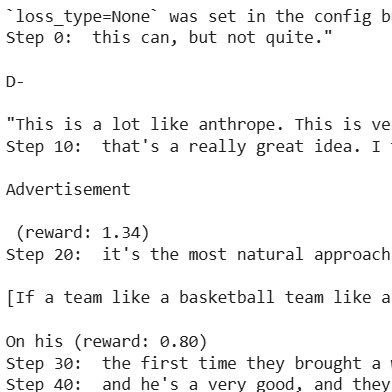
Result
Comparison with Other Policy Gradient Methods
Comparison table of PPO with other RL algorithms:
| Feature | PPO | TRPO | DDPG / SAC | Vanilla Policy Gradient |
|---|---|---|---|---|
| Stability | High | Very High | Moderate | Low |
| Sample Efficiency | Moderate | Moderate | High | Low |
| Action Space | Continuous and Discrete | Continuous and Discrete | Continuous | Continuous and Discrete |
| Ease of Implementation | Simple | Complex | Moderate | Simple |
| Computational Cost | Moderate | High | Moderate | Low |
| Use Case | Robotics, Games, Gen AI | Robotics, Control | Continuous control tasks | Simple environments |
Applications
Some of the applications of PPO are:
- **Robotics and Control: It trains robots to perform complex control tasks like walking, grasping or balancing by learning optimal movement policies.
- **Game Playing: Used in training agents to play video games or board games by learning strategies to maximize rewards over time.
- **Autonomous Vehicles: Helps self driving cars or drones make sequential decisions for navigation, obstacle avoidance and route optimization.
- **Resource Management: Applied in dynamic resource allocation problems such as optimizing energy usage, server workloads or traffic flow.
- **Finance and Trading: Used to develop trading strategies by training agents to make sequential buy or sell decisions based on market conditions.
Advantages
Some of the advantages of PPO are:
- **Stable Training: The clipping mechanism prevents large policy updates improving stability over vanilla policy gradient methods.
- **Sample Efficiency: Makes efficient use of collected trajectories reducing the number of interactions needed with the environment.
- **Simplicity: Easier to implement than more complex algorithms like TRPO with fewer hyperparameters to tune.
- **Flexibility: Works well for both continuous and discrete action spaces across a variety of tasks.
- **Reliable Performance: Balances exploration and exploitation effectively, often achieving high reward performance.
Disadvantages
Some of the disadvantages of PPO are:
- **Computational Cost: Requires multiple epochs of training on collected batches which can be computationally expensive.
- **Hyperparameter Sensitivity: Performance depends on careful tuning of learning rate, clipping parameter and batch size.
- **Sample Inefficiency: Although better than vanilla policy gradients, it can still require many interactions in very large or complex environments.
- **Limited Theoretical Guarantees: Unlike TRPO, PPO does not guarantee monotonic policy improvement.
- **Potential Overfitting: Over optimization on collected batches can lead to poor generalization to unseen states.