Matlab | Erosion of an Image (original) (raw)
Last Updated : 30 Nov, 2021
Morphology is known as the broad set of image processing operations that process images based on shapes. It is also known as a tool used for extracting image components that are useful in the representation and description of region shape.
The basic morphological operations are:
- Erosion
- Dilation
In this article, we will be discussing Erosion.
Erosion:
- Erosion shrink-ens the image pixels i.e. it is used for shrinking of element A by using element B.
- Erosion removes pixels on object boundaries.:
- The value of the output pixel is the minimum value of all the pixels in the neighborhood. A pixel is set to 0 if any of the neighboring pixels have the value 0.
Approach:
- Read the RGB image.
- Using function im2bw(), convert the RGB image to a binary image.
- Create a structuring element or you can use any predefined mask eg. special('sobel').
- Store the number of rows and columns in an array and loop through it.
- Create a zero matrix of the size same as the size of our image.
- Leaving the boundary pixels start moving the structuring element on the image and start comparing the pixel with the pixels present in the neighborhood.
- If the value of the neighborhood pixel is 0, then change the value of that pixel to 0.
Example:
MATLAB `
% Matlab code for Erosion % read image I=imread('lenna.png');
% convert to binary
I=im2bw(I);
% create structuring element
se=ones(5, 5);
% store number of rows
% in P and number of columns in Q.
[P, Q]=size(se);
% create a zero matrix of size I.
In=zeros(size(I, 1), size(I, 2));
for i=ceil(P/2):size(I, 1)-floor(P/2) for j=ceil(Q/2):size(I, 2)-floor(Q/2)
    % take all the neighbourhoods.
    on=I(i-floor(P/2):i+floor(P/2), j-floor(Q/2):j+floor(Q/2));

    % take logical se
    nh=on(logical(se));

    % compare and take minimum value of the neighbor
    % and set the pixel value to that minimum value.
    In(i, j)=min(nh(:));
end
end
imshow(In);
`
Output:

figure: Input image
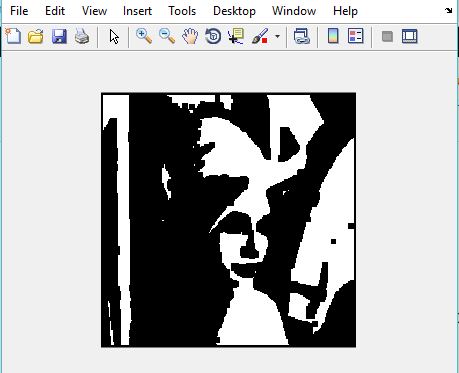
figure: Output Image
Let's take another image to perform Erosion and here we use different MATLAB functions.
Syntax:
- imread() function is used to read the image.
- strel() function is used to define the structuring element. We have chosen disk-shaped SE, of radius 5.
- imerode() function is used to perform the erosion operation.
- imtool() function is used to display the image.
Example:
Matlab `
% MATLAB code for Erison % read the image. k=imread("erosion.png");
%define the structuring element. SE=strel('disk',5);
%apply the erosion operation. e=imerode(k,SE);
%display all the images. imtool(k,[]); imtool(e,[]);
%see the effective reduction in org,image imtool(k-e,[]);
`
Output:
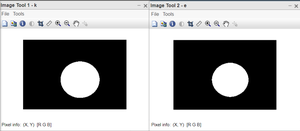
Figure: Left: Original image, Right: Eroded image
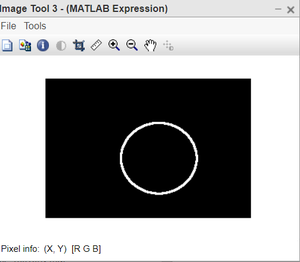
Figure: Output image
Code explanation:
- k=imread("erosion_exmp.png"); this line reads the image.
- SE=strel('disk',5); this line defines the structuring element.
- e=imerode(k,SE); this line applies the erosion operation.
- imtool(k,[]); this line displays the original image.
- imtool(e,[]); this line displays the eroded image.
- imtool(k-e,[]); this line shows the effective reduction in original image.
The last image shows the extent to which the original image got eroded. We have used the Structuring element of disk-shaped and the image we used is also circular in shape. This gives us the very desired output to understand erosion.