Linear Regression using Boston Housing Dataset ML (original) (raw)
Last Updated : 11 Jul, 2025
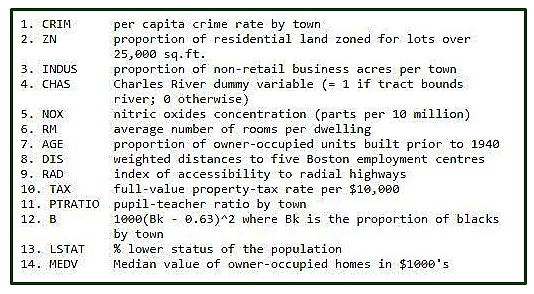
**Boston Housing Data: This dataset was taken from the StatLib library and is maintained by Carnegie Mellon University. This dataset concerns the housing prices in the housing city of Boston. The dataset provided has 506 instances with 13 features.
The Description of the dataset is taken from the below reference as shown in the table follows:
Let's make the Linear Regression Model, predicting housing prices by Inputting Libraries and datasets.
Python `
import numpy as np import pandas as pd import matplotlib.pyplot as plt
from sklearn.datasets import fetch_openml
boston = fetch_openml(name="boston", version=1)
`
The shape of input Boston data and getting feature_names.
Python `
boston.data.shape
`

Python `
boston.feature_names
`

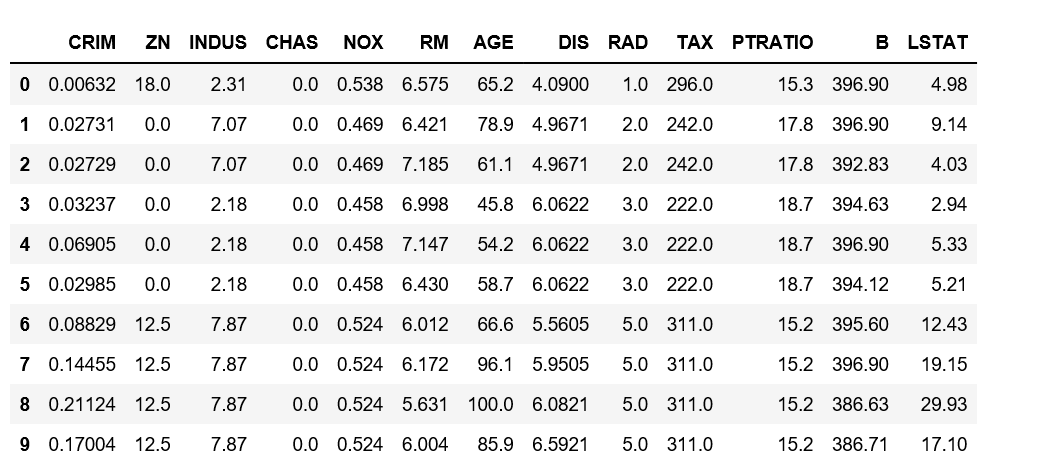
Converting data from nd-array to data frame and adding feature names to the data
Python `
data = pd.DataFrame(boston.data) data.columns = boston.feature_names
data.head(10)
`
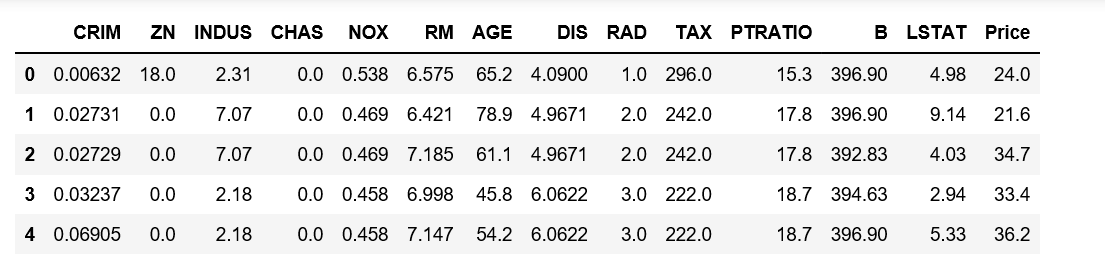
Adding the 'Price' column to the dataset
Python `
Adding 'Price' (target) column to the data
boston.target.shape
`

Python `
data['Price'] = boston.target data.head()
`
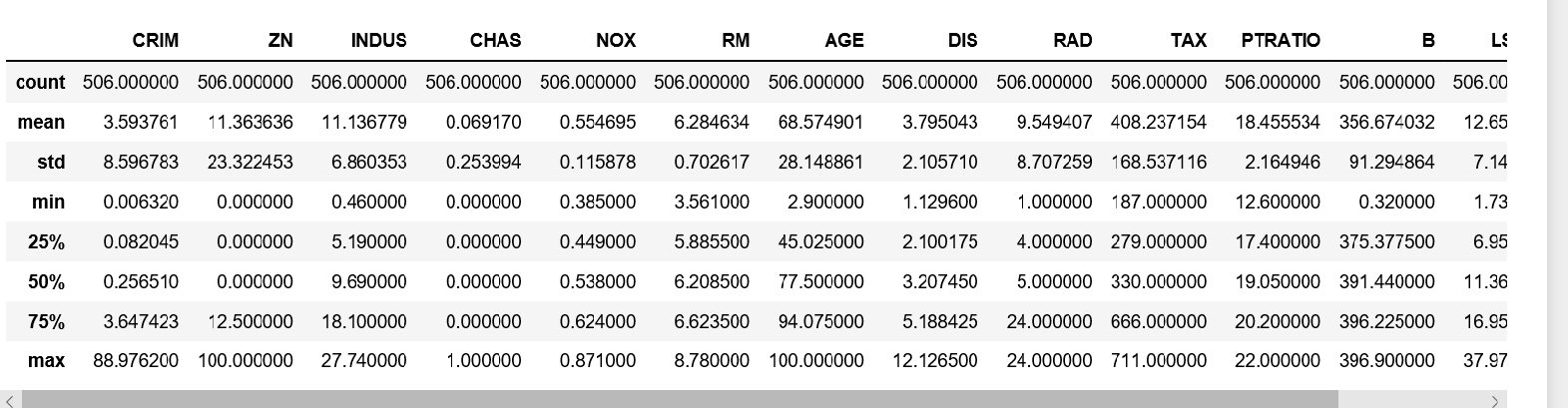
Description of Boston dataset
Python `
data.describe()
`
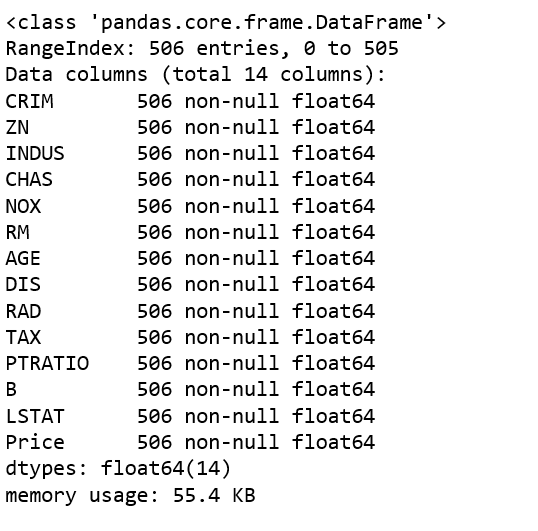
Info of Boston Dataset
Python `
data.info()
`
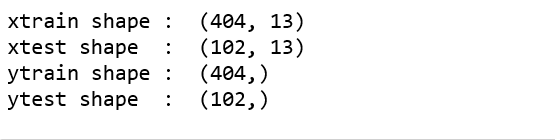
Getting input and output data and further splitting data to training and testing dataset.
Python `
Input Data
x = boston.data
Output Data
y = boston.target
splitting data to training and testing dataset.
#from sklearn.cross_validation import train_test_split #the submodule cross_validation is renamed and deprecated to model_selection from sklearn.model_selection import train_test_split
xtrain, xtest, ytrain, ytest = train_test_split(x, y, test_size =0.2, random_state = 0)
print("xtrain shape : ", xtrain.shape) print("xtest shape : ", xtest.shape) print("ytrain shape : ", ytrain.shape) print("ytest shape : ", ytest.shape)
`
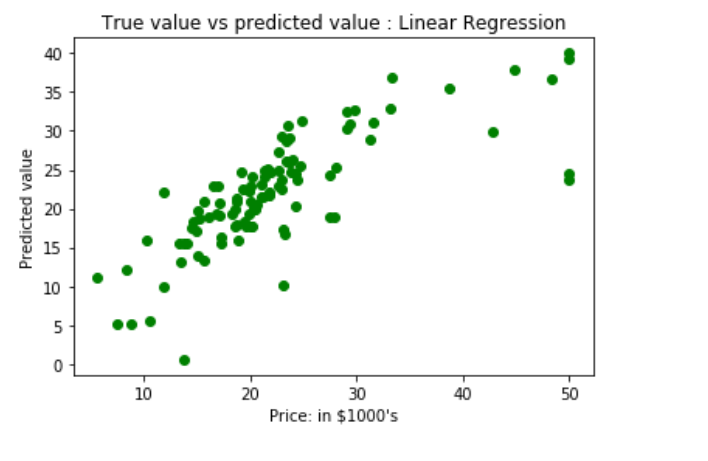
Applying Linear Regression Model to the dataset and predicting the prices.
Python `
Fitting Multi Linear regression model to training model
from sklearn.linear_model import LinearRegression regressor = LinearRegression() regressor.fit(xtrain, ytrain)
predicting the test set results
y_pred = regressor.predict(xtest)
`
Plotting Scatter graph to show the prediction results - 'y_true' value vs 'y_pred' value.
Python `
Plotting Scatter graph to show the prediction
results - 'ytrue' value vs 'y_pred' value
plt.scatter(ytest, y_pred, c = 'green') plt.xlabel("Price: in $1000's") plt.ylabel("Predicted value") plt.title("True value vs predicted value : Linear Regression") plt.show()
`
Results of Linear Regression i.e. Mean Squared Error and Mean Absolute Error.
Python `
from sklearn.metrics import mean_squared_error, mean_absolute_error mse = mean_squared_error(ytest, y_pred) mae = mean_absolute_error(ytest,y_pred) print("Mean Square Error : ", mse) print("Mean Absolute Error : ", mae)
`
Mean Square Error : 33.448979997676496
Mean Absolute Error : 3.8429092204444966
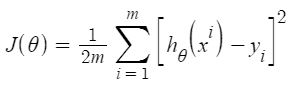
As per the result, our model is only 66.55% accurate. So, the prepared model is not very good for predicting housing prices. One can improve the prediction results using many other possible machine learning algorithms and techniques.
Here are a few further steps on how you can improve your model.