SemiSupervised Learning in ML (original) (raw)
Semi-Supervised Learning in ML
Last Updated : 30 Apr, 2026
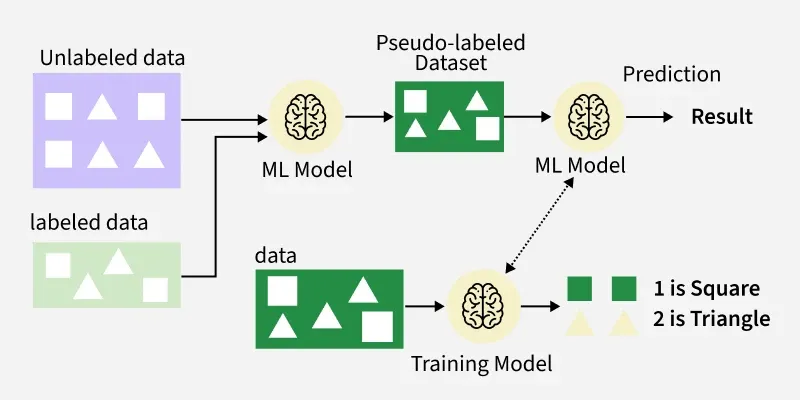
Semi-supervised learning is a distinct machine learning approach that uses a small amount of labeled data along with a large amount of unlabeled data to improve model performance. The goal is to learn a function that accurately predicts outputs based on inputs, similar to supervised learning, but with much less labelled data.
Semi-Supervised Learning
Semi-supervised learning is particularly valuable when acquiring labelled data is expensive or time-consuming, yet unlabelled data is plentiful and easy to collect.
- **Supervised learning: Similar to a student being taught concepts by a teacher both in class and at home.
- **Unsupervised learning: Like a student figuring out concepts independently without instruction like a math problem.
- **Semi-supervised learning: A mix where the teacher provides some concepts in class and the student practices with homework assignments based on those concepts.
Working of Semi-Supervised Learning
- **Self-Training: The model is first trained on labeled data. It then predicts labels for unlabeled data, adding high-confidence predictions to the labeled set iteratively to refine the model.
- **Co-Training: Two models are trained on different feature subsets of the data. Each model labels unlabeled data for the other, enabling them to learn from complementary views.
- **Multi-View Training: A variation of co-training where models train on different data representations (e.g., images and text) to predict the same output.
- **Graph-Based Models: Data is represented as a graph with nodes (data points) and edges (similarities). Labels are propagated from labeled nodes to unlabeled ones based on graph connectivity.
Let's see an example to understand better.
Step 1: Importing Libraries and Loading Data
We will import the necessary libraries such as numpy, matplotlib and sklearn. We will load IRIS Dataset.
Python `
import numpy as np import matplotlib.pyplot as plt from sklearn import datasets from sklearn.semi_supervised import LabelPropagation from sklearn.metrics import accuracy_score
iris = datasets.load_iris() X = iris.data[:, :2] y = iris.target
`
Step 2: Semi-Supervised Setup (Mask Labels)
We will setup the semi-supervised working,
- labels is what we pass to the algorithm (contains -1 for unlabeled).
- mask is a boolean array indicating which points keep their labels.
- labels[~mask] = -1 is a scikit-learn convention where -1 represents unlabeled data.
- Print helps readers see how many labels remain (important when describing experiments). Python `
labels = np.copy(y)
rng = np.random.RandomState(42)
mask = rng.rand(len(y)) < 0.1
labels[mask] = -1
print(f"Labeled: {np.sum(mask)}, Unlabeled: {np.sum(mask)}")
`
Step 3: Train a Graph-Based Model (Label Propagation)
We will train a graph-based model,
- LabelPropagation() builds a graph on X (similarities) and propagates labels from labeled nodes to unlabeled ones.
- fit(X, labels) performs the label diffusion — no separate .predict() needed for transduction. Python `
model = LabelPropagation() model.fit(X, labels)
`
Step 4: Get Transduced Labels and Evaluate
Labels are assigned to all points,
- model.transduction_ gives the inferred labels for every sample (including previously unlabeled).
- Evaluate both on the small originally-labeled subset (y[mask]) and on the true labels (y) to show how well propagation recovered the full labeling.
- accuracy_score is a simple, interpretable metric. Python `
y_pred = model.transduction_ acc_labeled = accuracy_score(y[mask], y_pred[mask]) acc_overall = accuracy_score(y, y_pred) print(f"Acc (on original labeled subset): {acc_labeled:.3f}") print(f"Acc (overall after propagation): {acc_overall:.3f}")
`
**Output:
Labeled samples: 18, Unlabeled samples: 132
Accuracy on labeled data: 1.00
Overall accuracy after label propagation: 0.71
Step 5: Visualize
We will visualize results:
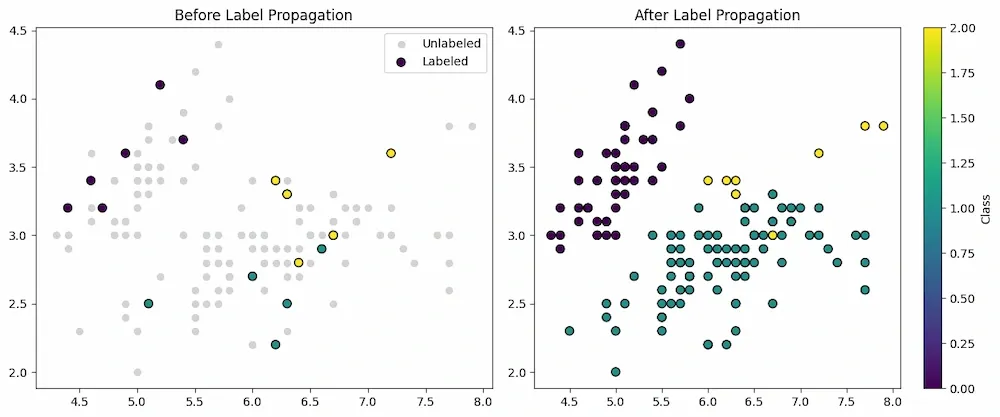
- Left plot shows the few labeled examples (colored) against unlabeled (gray).
- Right plot shows model’s assigned labels for every point after propagation.
- Removing edgecolor avoids common scatter warnings. Python `
fig, ax = plt.subplots(1, 2, figsize=(12, 4))
ax[0].scatter(X[:, 0], X[:, 1], c='lightgray', s=30) ax[0].scatter(X[mask, 0], X[mask, 1], c=y[mask], cmap='viridis', s=60) ax[0].set_title("Before propagation — few labels")
ax[1].scatter(X[:, 0], X[:, 1], c=y_pred, cmap='viridis', s=60) ax[1].set_title("After propagation — all labeled")
plt.tight_layout() plt.show()
`
**Output:
Result
As we can see in the result that the model was able to classify images into the categories or labels after successful operations of semi-supervised learning.
When to Use
- When labeled data is scarce or costly, such as medical imaging requiring expert annotation.
- When large volumes of unlabeled data exist, like social media or web content.
- For unstructured data types (text, images, audio) where labeling is difficult.
- When classes are rare and labeled examples few, improving class recognition.
- When purely supervised or unsupervised methods are insufficient.
Applications
- **Face Recognition: Enhancing accuracy by learning from limited labeled face images plus many unlabeled ones using graph-based methods.
- **Handwritten Text Recognition: Adapting models to diverse handwriting styles through generative models.
- **Speech Recognition: Improving transcription quality by using unlabeled speech data with CNNs and other techniques.
- **Security: Google uses semi-supervised learning for anomaly detection in network traffic and malware detection.
- **Finance: PayPal applies it for fraud detection and creditworthiness assessment using transaction data.
Advantages
- **Better Generalization: Utilizes both labeled and unlabeled data to capture the whole data structure, improving prediction robustness.
- **Cost Efficient: Reduces dependency on costly manual labeling by exploiting unlabeled data.
- **Flexible and Robust: Handles different data types and sources, adapting well to changing data distributions.
- **Improved Clustering: Refines clusters by leveraging unlabeled data, yielding better class separation.
- **Handling Rare Classes: Enhances learning for underrepresented classes where labeled examples are minimal.
Limitations
- **Model Complexity: Requires careful choice of architecture and hyperparameters, which may require extensive tuning.
- **Noisy Data: Unlabeled data may contain errors or irrelevant information, risking degraded model performance.
- **Assumption Sensitivity: Relies on assumptions such as data consistency and clusterability, which may not hold in all cases.
- **Evaluation Challenge: Assessing performance is difficult due to limited labeled data and varied quality of unlabeled data.