Monte Carlo Tree Search (MCTS) in Machine Learning (original) (raw)
Last Updated : 11 May, 2026
Monte Carlo Tree Search (MCTS) is a method used for problems with very large decision spaces, such as game Go, which has around 10170 possible states. It builds a search tree step-by-step using random simulations to choose better moves.
- Avoids exploring every possible move.
- Balances trying new moves (exploration) and using good known moves (exploitation).
- Uses statistical sampling to guide decisions.
- Works well when the search space is too large to evaluate fully.
The Four-Phase Algorithm
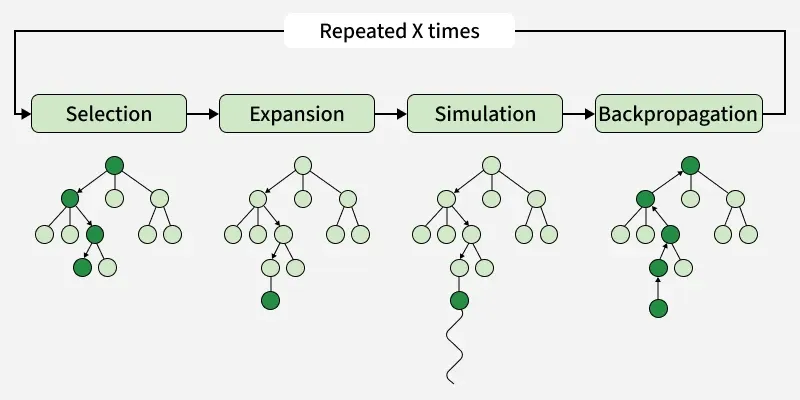
MCTS steps
**1. Selection : Starting at the root node, MCTS moves down the tree using a selection rule. The most common rule is UCT (Upper Confidence Bounds for Trees), which balances:
- **Exploitation: choosing moves with higher average reward
- **Exploration: trying moves with less information
**2. Expansion : When the selection phase reaches a leaf node that isn't terminal, the algorithm expands the tree by adding one or more child nodes representing possible actions from that state.
**3. Simulation Phase: From the newly added node, a random playout is performed until reaching a terminal state. During this phase, moves are chosen randomly or using simple heuristics, making the simulation computationally inexpensive.
**4. Backpropagation Phase: The result of the simulation is propagated back up the tree to the root, updating statistics (visit counts and win rates) for all nodes visited during the selection phase.
Mathematical Foundation: UCB1 Formula
The selection phase relies on the UCB1 (Upper Confidence Bound) formula to determine which child node to visit next:
UCB1(i) = \bar{X}_i + c \sqrt{\frac{\ln N}{n_i}}
**Where:
- \bar{X}_i is the average reward of node i
- c is the exploration parameter (typically √2)
- N is the total number of visits to the parent node
- n_i is the number of visits to node i
The first part encourages exploitation, while the second drives exploration. The logarithm ensures exploration reduces as data increases.
Monte Carlo Tree Search Example
**Game: Pair
- **Players: 2
- **Board: 4 boxes
- **Winning Condition: A player wins by marking any two adjacent boxes.
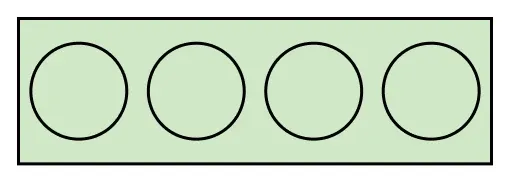
Empty board for the Pair game
The full game tree contains three types of terminal (leaf) states:
- **Yellow leaves: Winning positions (+1) -> Total: 6 nodes
- **Blue leaves: Draw positions (0) -> Total: 4 nodes
- **Red leaves: Losing positions (–1) -> Total: 2 nodes
These values will be used during simulation and backpropagation.
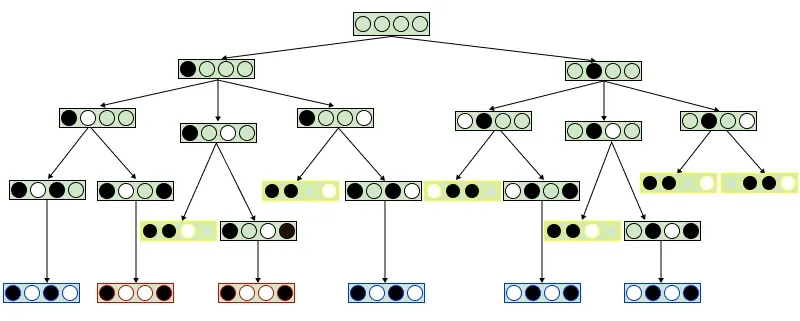
Monte carlo tree search game tree for pair game0
Iteration 1
**1. Selection & Expansion
- Start at root S0; two moves m1 and m2 lead to S1 and S2.
- Compute UCB for S1 and S2. Both are unvisited leaf nodes -> UCB = ∞ -> pick randomly -> select S1.
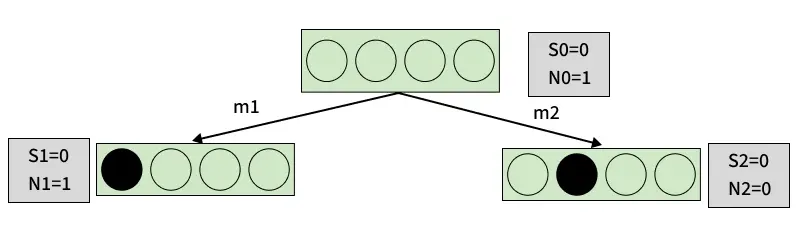
Second selection phase for Monte Carlo tree search
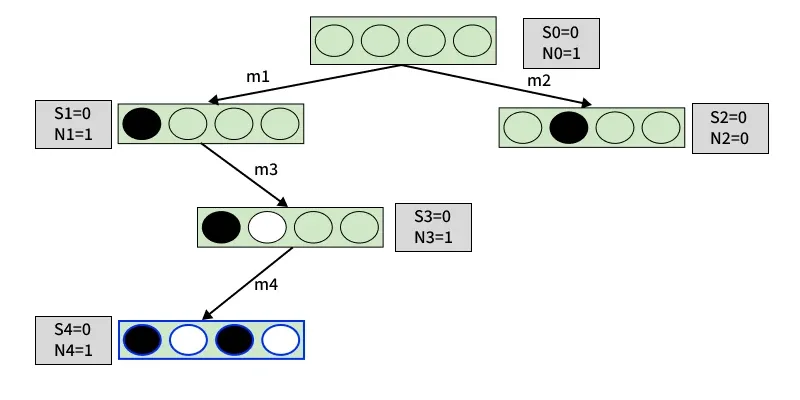
**2. Simulation (from S 1 )
- Roll out randomly from S1 to a terminal state.
- One playout (moves m3, m4) ends in a draw (0).
- Record: e.g., S4 = 0, N4 = 1.
**3. Backpropagation
Backpropagate the 0 result along the path to S0 (update values/visits on each node).
Tree search backpropagation to the root
Iteration 2
**1. Selection
Now we compare S1 and S2:
- S1 has been visited once -> finite UCB
- S2 not visited -> UCB = ∞
So we select S2.
Second selection phase for Monte Carlo tree search
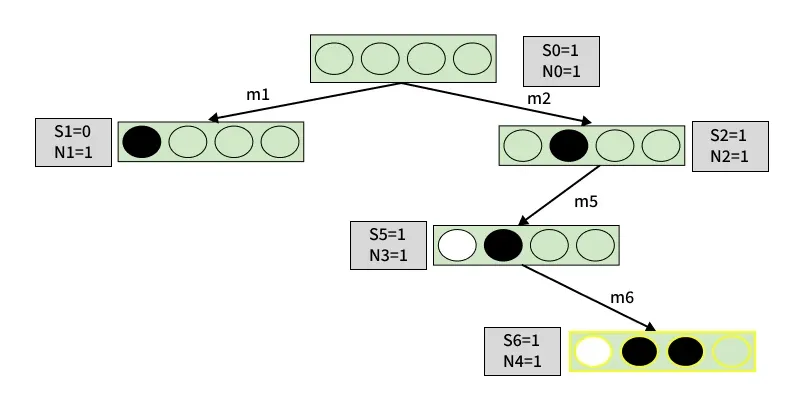
**2. Simulation (from S2)
- Roll out randomly from S2.
- One playout (moves m5, m6) ends in a win (+1).
- Record: e.g., S6 = +1, N6 = 1.
**3. Backpropagation
Update values along the path:
- Value(S2) = 1
- Visits(S2) = 1
The root now has results from both S1 and S2.
Backpropagation for the second iteration of Monte Carlo tree search
**Iteration 3
**1. Selection
- After two interactions, both S1 and S2 have N = 1.
- UCB favors S2 (it has a win), so select S2 again.
Python Implementation
1. Importing Libraries
We will start by importing required libraries:
- **math: to perform mathematical operations like logarithms and square roots for UCB1 calculations.
- **random: to randomly pick moves during simulations (rollouts).
- **deepcopy: to safely copy board state Python `
import math import random from copy import deepcopy
BOARD_SIZE = 3
`
2. check_winner_state(state)
Checks if any player (1 or 2) has won. Returns:
- **1: Player 1 wins
- **2: Player 2 wins
- **None: No winner Python `
def check_winner_state(state): for i in range(BOARD_SIZE): if state[i][0] == state[i][1] == state[i][2] != 0: return state[i][0] if state[0][i] == state[1][i] == state[2][i] != 0: return state[0][i] if state[0][0] == state[1][1] == state[2][2] != 0: return state[0][0] if state[0][2] == state[1][1] == state[2][0] != 0: return state[0][2] return None
`
3. available_actions(state)
Returns all empty cells (i, j) where a move can be placed.
Python `
def available_actions(state): return [(i, j) for i in range(BOARD_SIZE) for j in range(BOARD_SIZE) if state[i][j] == 0]
`
4. **get_current_player(state)
Determines whose turn it is by counting Xs and Os.
- If equal: Player 1
- Else: Player 2 Python `
def get_current_player(state): x_count = sum(row.count(1) for row in state) o_count = sum(row.count(2) for row in state) return 1 if x_count == o_count else 2
`
5. **MCTS Node Class
Each node represents a game state in the search tree.
- **state: 3×3 board
- **parent: previous node
- **action: move applied at the parent to get here
- **player: who made that move
- **children: child nodes
- **visits: number of times this node was visited
- **wins: total reward from simulations
- **untried_actions: moves not explored yet Python `
class MCTSNode:
def init(self, state, parent=None, action=None, player=None):
self.state = state
self.parent = parent
self.action = action
self.player = player
self.children = []
self.visits = 0
self.wins = 0.0
self.untried_actions = available_actions(state)
`
6. Helper Function
- **is_terminal(): Checks if the game is finished.
- **is_fully_expanded(): Returns True if all moves are explored.
- **expand(): Takes one untried move → creates a child node → adds it to the tree.
- **best_child(): Selects the best child using UCB1 formula (exploitation + exploration). Python `
class MCTSNode: def init(self, state, parent=None, action=None, player=None): self.state = state self.parent = parent self.action = action self.player = player self.children = [] self.visits = 0 self.wins = 0.0 self.untried_actions = available_actions(state)
# Check if node is terminal
def is_terminal(self):
    return check_winner_state(self.state) is not None or not available_actions(self.state)

# Check if all actions are explored
def is_fully_expanded(self):
    return len(self.untried_actions) == 0

# Expand node
def expand(self):
    action = self.untried_actions.pop()
    new_state = deepcopy(self.state)

    player_to_move = get_current_player(self.state)
    new_state[action[0]][action[1]] = player_to_move

    child = MCTSNode(new_state, parent=self, action=action, player=player_to_move)
    self.children.append(child)
    return child

# Select best child using UCB
def best_child(self, c=1.4):
    for child in self.children:
        if child.visits == 0:
            return child

    def ucb(child):
        exploit = child.wins / child.visits
        explore = c * math.sqrt(math.log(self.visits) / child.visits)
        return exploit + explore

    return max(self.children, key=ucb)
`
**7. rollout()
Plays random moves until the game finishes. Returns:
- **1 or 2: winner
- **None: draw Python `
def rollout(self): state = deepcopy(self.state) player = get_current_player(state)
while True:
    winner = check_winner_state(state)
    if winner is not None:
        return winner
    actions = available_actions(state)
    if not actions:
        return None
    move = random.choice(actions)
    state[move[0]][move[1]] = player
    player = 1 if player == 2 else 2
`
**8. backpropagate()
Updates the wins and visits from simulation results.
Python `
def backpropagate(self, winner): self.visits += 1
if self.player is not None:
    if winner is None:
        self.wins += 0.5
    elif winner == self.player:
        self.wins += 1.0

if self.parent:
    self.parent.backpropagate(winner)
`
**9. MCTS Search Function
Runs the complete MCTS process:
- Selection
- Expansion
- Simulation
- Backpropagation Python `
def mcts_search(root_state, iterations=500): root = MCTSNode(root_state, player=None)
for _ in range(iterations):
    node = root

    while not node.is_terminal() and node.is_fully_expanded():
        node = node.best_child()

    if not node.is_terminal() and not node.is_fully_expanded():
        node = node.expand()

    winner = node.rollout()
    node.backpropagate(winner)

best = max(root.children, key=lambda c: c.visits)
return best.action
`
10. Playing the Game (MCTS vs Random)
Python `
def play_game(): board = [[0]*3 for _ in range(3)] current_player = 1
print("MCTS Tic-Tac-Toe Demo")
print("0 = empty, 1 = X, 2 = O\n")

for turn in range(9):
    for row in board: print(row)
    print()

    if current_player == 1:
        move = mcts_search(board, iterations=300)
        print(f"MCTS plays: {move}")
    else:
        empty = available_actions(board)
        move = random.choice(empty)
        print(f"Random plays: {move}")

    board[move[0]][move[1]] = current_player

    winner = check_winner_state(board)
    if winner:
        for row in board: print(row)
        print(f"Player {winner} wins!")
        return

    current_player = 1 if current_player == 2 else 2

print("Draw!")
`
11. Run the Game
Python `
if name == "main": play_game()
`
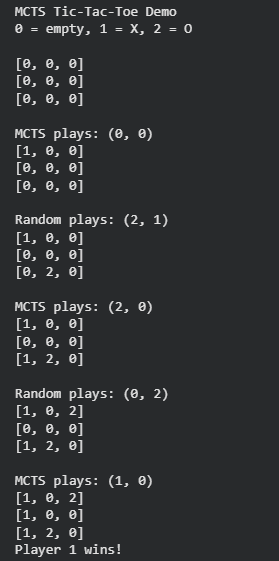
**Output:
Sample run output
With enough iterations, MCTS plays strong and avoids losing lines. Increasing simulation count improves decision quality. A real-world example is AlphaGo, which combined MCTS with neural networks and achieved world-class performance by running millions of simulations per move.
Practical Applications Beyond Games
- **Planning and Scheduling: The algorithm can optimize resource allocation and task scheduling in complex systems where traditional optimization methods struggle.
- **Neural Architecture Search: MCTS guides the exploration of neural network architectures, helping to discover optimal designs for specific tasks.
- **Portfolio Management: Financial applications use MCTS for portfolio optimization under uncertainty, where the algorithm balances risk and return through simulated market scenarios.
Advantages
- **No domain knowledge needed: MCTS only needs valid moves and end conditions.
- **Balances exploration and exploitation: Uses UCB to pick promising and less-explored moves.
- **Anytime algorithm: Can stop at any moment and still return the best estimated move.
- **Works well with large search spaces: Focuses on useful parts of the tree instead of exploring everything.
- **Asymmetric tree growth: Spends more time on good branches, improving decision quality efficiently.
**Limitations
- **Simulation-heavy: needs many rollouts for consistent results
- **High variance: random rollouts can lead to noisy estimates
- **Tactical blindness: may miss short forced sequences
- **Parameter tuning: exploration constant (c) impacts results