Null Space and Nullity of a Matrix (original) (raw)
Last Updated : 11 Jan, 2023
Null Space and Nullity are concepts in linear algebra which are used to identify the linear relationship among attributes.
Null Space:
The null space of any matrix A consists of all the vectors B such that AB = 0 and B is not zero. It can also be thought as the solution obtained from AB = 0 where A is known matrix of size m x n and B is matrix to be found of size n x k. The size of the null space of the matrix provides us with the number of linear relations among attributes. **A generalized description:**Let a matrix be 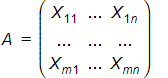 and there is one vector in the null space of A, i.e,
 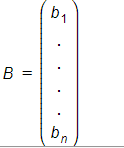 then B satisfies the given equations,
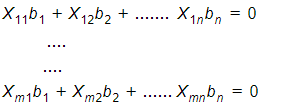 The idea -
1. AB = 0 implies every row of A when multiplied by B goes to zero. 2. Variable values in each sample(represented by a row) behave the same. 3. This helps in identifying the linear relationships in the attributes. 4. Every null space vector corresponds to one linear relationship.
Nullity:
Nullity can be defined as the number of vectors present in the null space of a given matrix. In other words, the dimension of the null space of the matrix A is called the nullity of A. The number of linear relations among the attributes is given by the size of the null space. The null space vectors B can be used to identify these linear relationship.**Rank Nullity Theorem:**The rank-nullity theorem helps us to relate the nullity of the data matrix to the rank and the number of attributes in the data. The rank-nullity theorem is given by -
Nullity of A + Rank of A = Total number of attributes of A (i.e. total number of columns in A)
**Rank:**Rank of a matrix refers to the number of linearly independent rows or columns of the matrix.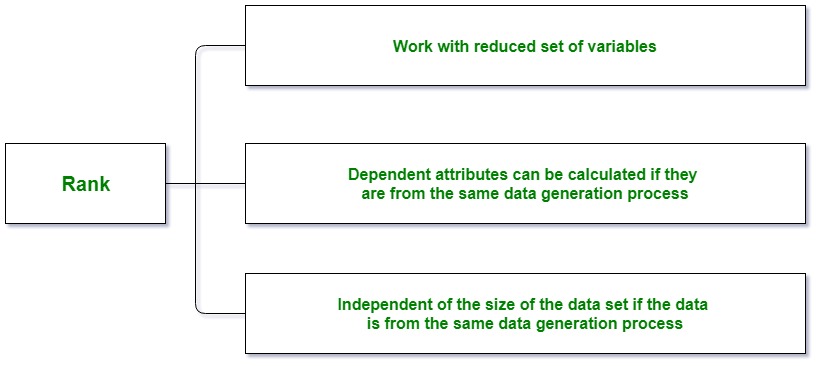 Example with proof of rank-nullity theorem:
Consider the matrix A with attributes {X1, X2, X3} 1 2 0 A = 2 4 0 3 6 1 then, Number of columns in A = 3
\left(\begin{array}{ccc} 1 & 2 & 0\ 0 & 0 & 0\ 3 & 6 & 1 \end{array}\right) [R2 -> R2 - 2R1]
R1 and R3 are linearly independent. The rank of the matrix A which is the number of non-zero rows in its echelon form are 2. we have, AB = 0
\left(\begin{array}{ccc} 1 & 2 & 0\ 2 & 4 & 0\ 3 & 6 & 1 \end{array}\right) \left(\begin{array}{c} b1\b2\b3 \end{array}\right) = 0
Then we get, b1 + 2*b2 = 0 b3 = 0 The null vector we can get is
B = \left(\begin{array}{c} b1\b2\b3 \end{array}\right)
\left(\begin{array}{c} -2b2\b2\0 \end{array}\right)
\left(\begin{array}{c} -2\1\0 \end{array}\right)
The number of parameter in the general solution is the dimension of the null space (which is 1 in this example). Thus, the sum of the rank and the nullity of A is 2 + 1 which is equal to the number of columns of A.
This rank and nullity relationship holds true for any matrix.Python Example to find null space of a Matrix:
Python3 `
Sympy is a library in python for
symbolic Mathematics
from sympy import Matrix
List A
A = [[1, 2, 0], [2, 4, 0], [3, 6, 1]]
Matrix A
A = Matrix(A)
Null Space of A
NullSpace = A.nullspace() # Here NullSpace is a list
NullSpace = Matrix(NullSpace) # Here NullSpace is a Matrix print("Null Space : ", NullSpace)
checking whether NullSpace satisfies the
given condition or not as A * NullSpace = 0
if NullSpace is null space of A
print(A * NullSpace)
`
Output:
Null Space : Matrix([[-2], [1], [0]]) Matrix([[0], [0], [0]])
Python Example to find nullity of a Matrix:
Python3 `
from sympy import Matrix
A = [[1, 2, 0], [2, 4, 0], [3, 6, 1]]
A = Matrix(A)
Number of Columns
NoC = A.shape[1]
Rank of A
rank = A.rank()
Nullity of the Matrix
nullity = NoC - rank
print("Nullity : ", nullity)
`
Output:
Nullity : 1