Population vs Sample in Statistics (original) (raw)
Last Updated : 15 Jun, 2026
In statistics, population and sample are fundamental concepts used to describe groups of data:
A population refers to the entire set of individuals, objects, or data points that you want to study. It can be large or small depending on the scope of your research.
- **For example, all students in a school or all people in a country.
- It provides a complete picture and is usually denoted by **N.
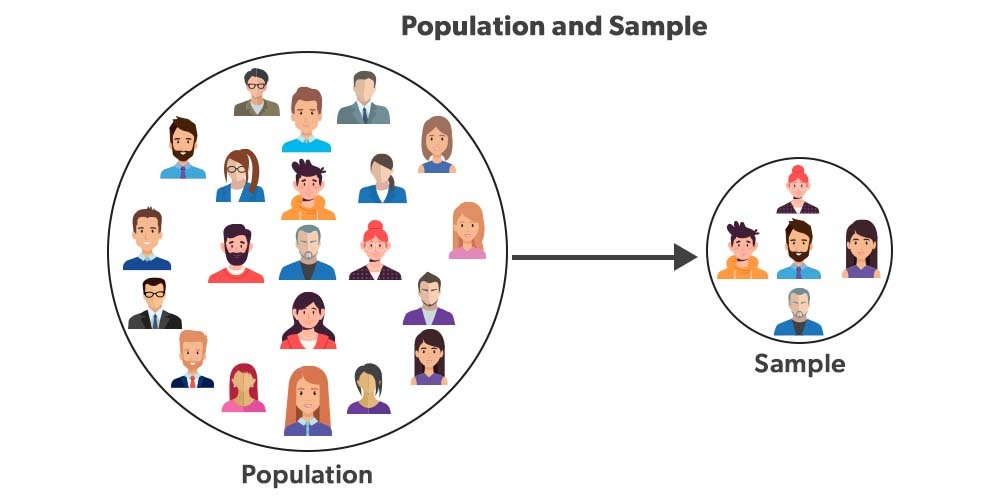
A sample is a subset of the population that is selected for analysis. It's used when studying the entire population is impractical or impossible. Sampling allows for inferences about the population using statistical techniques.
- **For example, if the population is all students in a school, a sample could be 50 students randomly chosen from different classes to participate in a survey.
- It offers an estimate and is denoted by **n.
Parameters (like population mean) describe the population, while statistics (like sample mean) describe the sample. Sampling enables us to make inferences about the population using statistical techniques.
Collecting Data From the Population and Sample
**When to use a Population:
Populations are used when your research question requires it, or when you have access to data from every member of the population. Usually, it is only straightforward to collect data from a whole population when it is small, accessible and cooperative.
**Example:
- A marketing manager at a small local bakery wants to understand customer preferences.
- They collect data on every customer’s bread purchase over a month.
- Since the customer base is limited and accessible, they analyze the entire population to identify trends.
**When to use a Sample:
When your population is large in size, geographically dispersed, or difficult to contact, it’s necessary to use a sample. With statistical analysis, you can use sample data to make estimates or test hypotheses about population data.
**Example:
- You're researching smartphone usage among teenagers in a city.
- The population includes all teenagers aged 13–18, which could be tens of thousands.
- You select a random sample of 500 teens from different schools.
- This sample participates in surveys to provide insights into broader usage patterns.
Formulas
Some important formulas related to population and sample are:
Population Parameters:
**Mean: The population mean is defined by \mu. And its formula is given by,
\mu = \frac 1 N \Sigma X , N = Number of elements in population.
**Standard Deviation: The population standard deviation is given by \sigma. And it's formula is given by:
\sigma = \sqrt {\frac 1 N {\Sigma(X-\mu)^2}}
Sample Statistic:
**Mean: The Sample mean is given by \bar x. And its formula is given by,
\bar x = \frac 1 n \Sigma x
**Standard Deviation: The sample standard deviation is given by s. And it's formula is given by,
s= \sqrt {\frac 1 {n-1} {\Sigma(x-\bar x)^2}}
Population Parameter vs Sample Statistic
| Population Parameter | Sample Statistic |
|---|---|
| It is a numerical characteristic that describes the entire population | Statistics are calculated from sample data and serve as estimates or approximations of the corresponding population parameters |
| Parameters are typically unknown and must be estimated. | Calculated using data from a sample drawn from the population. Statistics are directly computed from sample data. |
| Calculated using data from a sample drawn from the population. Statistics are directly computed from sample data. | Used to estimate population parameters based on sample data. Statistics help researchers infer population characteristics from a representative subset of the population |
**Example: Estimating Population Height
Suppose you want to determine the average height of adult males in a country.
- The population includes all adult males nationwide.
- The true average height of this population is called the population parameter (denoted by μ). However, measuring the height of every adult male in the country is impractical.
To overcome this, you take a sample:
- You select 500 adult males randomly from various regions of the country.
- You measure their heights and calculate the sample mean height (denoted by x̄).
The sample mean (x̄) is a sample statistic, and it serves as an estimate of the population mean (μ).
Using this sample, researchers can draw conclusions about the height distribution of all adult males in th
Importance in CS
Population and sample are very important in Computer Science especially in fields involving data analysis, machine learning, artificial intelligence, cybersecurity, and more.
1. **Data Analysis & Machine Learning
- Real-world datasets are often too large (or even infinite), so we work with samples to train and test algorithms.
- Example: In training a spam filter, we don’t analyze every email ever sent. Instead, we use a sample of emails to train the model and draw conclusions.
2. **Performance Evaluation
- When testing software or systems, we use a sample of test cases, users, or inputs to evaluate performance, rather than the entire input space (the population).
- Example: Load testing a server with a subset of users to predict performance for the whole user base.
3. **Big Data and Cloud Systems
- It’s often impossible to process all the data due to volume and velocity, so sampling techniques are used to summarize trends or build predictive models.
4. **Security & Intrusion Detection
- Analyzing sample network traffic helps detect suspicious activity without needing to process every packet in real time.
- Helps estimate trends or detect anomalies with fewer computational resources.