Stacking in Machine Learning (original) (raw)
Last Updated : 11 Sep, 2025
Stacking is a ensemble learning technique where the final model known as the “stacked model" combines the predictions from multiple base models. The goal is to create a stronger model by using different models and combining them.
**Architecture of Stacking
Stacking architecture is like a team of models working together in two layers to improve prediction accuracy. Each layer has a specific job and the process is designed to make the final result more accurate than any single model alone. It has two parts:
**1. Base Models (Level-0)
These are the first models that directly learn from the original training data. You can think of them as the “helpers” that try to make predictions in their own way.
- Base models can be Decision Tree, Logistic Regression, Random Forest, etc.
- Each model is trained separately using the same training data.
**2. Meta-Model (Level-1)
This is the final model that learns from the output of the base models instead of the raw data. Its job is to combine the base models predictions in a smart way to make the final prediction.
- A simple Linear Regression or Logistic Regression can act as a meta-model.
- It looks at the outputs of the base models and finds patterns in how they make mistakes or agree.
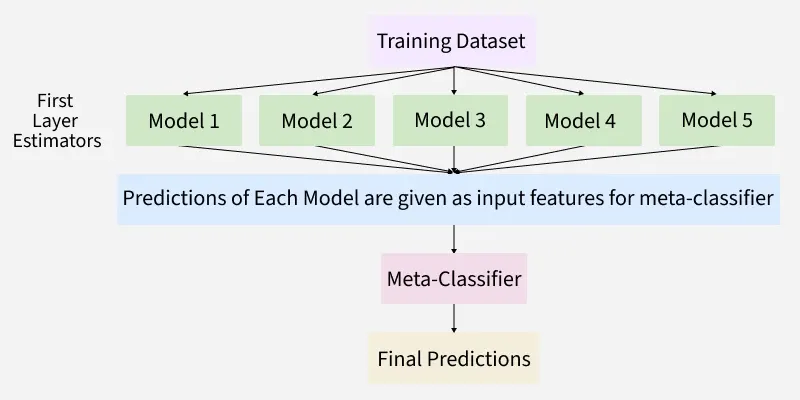
Stacking in Machine Learning
**Working of Stacking
The process can be summarized in the following steps:
- **Start with training data: We begin with the usual training data that contains both input features and the target output.
- **Train base models: The base models are trained on this training data. Each model tries to make predictions based on what it learns.
- **Generate predictions: After training the base models make predictions on new data called validation data or out-of-fold data. These predictions are collected.
- **Train meta-model: The meta-model is trained using the predictions from the base models as new features. The target output stays the same and the meta-model learns how to combine the base model predictions.
- **Final prediction: When testing the base models make predictions on new, unseen data. These predictions are passed to the meta-model which then gives the final prediction.
With stacking we can improve our models performance and its accuracy.
**Implementation of Stacking
Lets see its implementation step by step:
**Step 1: Importing the required Libraries
We will import pandas, matplotlib and scikit learn for data handling, visualization and modeling.
python `
import pandas as pd import matplotlib.pyplot as plt from mlxtend.classifier import StackingClassifier from sklearn.model_selection import train_test_split from sklearn.preprocessing import StandardScaler from sklearn.linear_model import LogisticRegression from sklearn.neighbors import KNeighborsClassifier from sklearn.naive_bayes import GaussianNB from sklearn.metrics import accuracy_score
`
Step 2: Loading the Dataset
We will load the dataset into a pandas DataFrame and separate features from the target variable.
- **pd.read_csv(): Reads the dataset from a CSV file.
- **drop(): Removes the target column from features.
- **df['target']: Selects the target column for prediction.
You can Download the dataset from this link Heart Dataset.
python `
df = pd.read_csv('heart.csv')
X = df.drop('target', axis = 1) y = df['target']
df.head()
`
**Output:
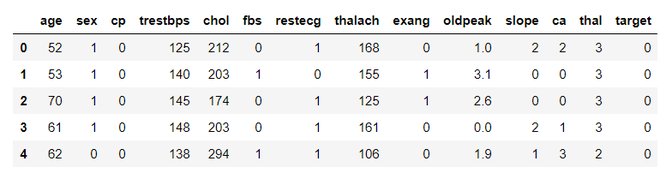
**Step 3: Splitting the Data into Training and Testing Sets
We will split the dataset into training and testing sets so we can train models and evaluate their performance.
- **train_test_split(): Splits data into train and test sets.
- **test_size = 0.2: Specifies that 20% of the data should be used for testing, leaving 80% for training.
- **random_state = 42: Ensures reproducibility by setting a fixed seed for random number generation. python `
X_train, X_test, y_train, y_test = train_test_split(X, y, test_size = 0.2, random_state = 42)
`
**Step 4: Standardizing the Data
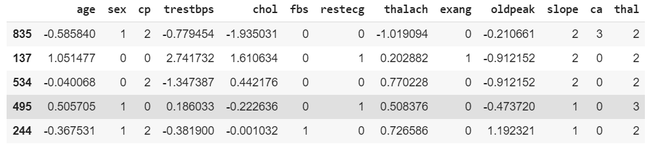
We will standardize numerical features so they have a mean of 0 and standard deviation of 1. This helps some models perform better.
- **StandardScaler(): Standardizes features.
- **fit_transform(): Learns scaling parameters from training data and applies them.
- **transform(): Applies learned scaling to test data.
- **var_transform: Specifies the list of feature columns that need to be standardized.
- **X_train[var_transform]: Applies the **fit_transform method to standardize the selected columns in the training data.
- **X_test[var_transform]: Applies the transform method to standardize the corresponding columns in the test data using the scaling parameters from the training data. python `
sc = StandardScaler()
var_transform = ['thalach', 'age', 'trestbps', 'oldpeak', 'chol']
X_train[var_transform] = sc.fit_transform(X_train[var_transform])
X_test[var_transform] = sc.transform(X_test[var_transform])
X_train.head()
`
**Output:
**Step 5: Building First Layer Estimators
We will create base models that will form the first layer of our stacking model. For this example we’ll use K-Nearest Neighbors classifier and Naive Bayes classifier.
- **KNeighborsClassifier(): A model based on nearest neighbors.
- **GaussianNB(): A Naive Bayes classifier assuming Gaussian distribution. python `
KNC = KNeighborsClassifier()
NB = GaussianNB()
`
**Step 6: Training and Evaluating KNeighborsClassifier
We will Train the KNN model and check its accuracy on the test set.
- **fit(): Trains the model.
- **predict(): Makes predictions on test data.
- **accuracy_score(): Calculates accuracy python `
model_kNeighborsClassifier = KNC.fit(X_train, y_train)
pred_knc = model_kNeighborsClassifier.predict(X_test)
acc_knc = accuracy_score(y_test, pred_knc)
print('Accuracy Score of KNeighbors Classifier:', acc_knc * 100)
`
**Output:
Accuracy Score of KNeighbors Classifier: 86.88524590163934
**Step 7: Training and Evaluating Naive Bayes Classifier
Similarly, we will train the Naive Bayes model and check its accuracy.
python `
model_NaiveBayes = NB.fit(X_train, y_train) pred_nb = model_NaiveBayes.predict(X_test)
acc_nb = accuracy_score(y_test, pred_nb) print('Accuracy of Naive Bayes Classifier:', acc_nb * 100)
`
**Output:
Accuracy of Naive Bayes Classifier: 86.88524590163934
**Step 8: Implementing the Stacking Classifier
Now, we will combine the base models using a Stacking Classifier. The meta-model will be a logistic regression model which will take the predictions of KNN and Naive Bayes as input.
- **StackingClassifier(): Combines base models and a meta-model.
- **classifiers: List of base learners.
- **meta_classifier: Model that learns from base learners’ predictions.
- **use_probas=True: Passes probability outputs to the meta-model instead of class labels. python `
base_learners = [ KNeighborsClassifier(), GaussianNB() ] meta_model = LogisticRegression()
stacking_model = StackingClassifier(classifiers=base_learners, meta_classifier=meta_model, use_probas=True)
`
Step 9: Training Stacking Classifier
Next we will rain the stacking classifier and evaluate its accuracy.
python `
model_stack = stacking_model.fit(X_train, y_train)
pred_stack = model_stack.predict(X_test)
acc_stack = accuracy_score(y_test, pred_stack) print('Accuracy Score of Stacked Model:', acc_stack * 100)
`
**Output:
Accuracy Score of Stacked Model: 88.52459016393442
Both individual models (KNN and Naive Bayes) achieved an accuracy of approximately 86.88%, while the stacked model achieved an accuracy of around 88.52%. This shows that combining the predictions of multiple models using stacking can slightly improve overall performance compared to using a single model.
**Advantages of Stacking
Here are some of the key advantages of stacking:
- **Better Performance: Stacking often results in higher accuracy by combining predictions from multiple models making the final output more reliable.
- **Combines Different Models: It allow to use various types of models like decision trees, logistic regression, SVM made from each model’s unique strengths.
- **Reduces Overfitting: When implemented with proper cross-validation it can reduce the risk of overfitting by balancing out the weaknesses of individual models.
- **Learns from Mistakes: The meta-model is trained to recognize where base models go wrong and improves the final prediction by correcting those errors.
- **Customizable: We can choose any combination of base and meta-models depending on our dataset and problem type making it highly flexible.
Limitations of Stacking
Stacking also have some limitations as well:
- **Complex to Implement: Compared to simple models or even bagging or boosting, stacking requires more steps and careful setup.
- **Slow Training Time: Since you're training multiple models plus a meta-model it can be slow and computationally expensive.
- **Hard to Interpret: With multiple layers of models it becomes difficult to explain how the final prediction was made.
- **Risk of Overfitting: If the meta-model is too complex or if there's data leakage it can overfit the training data.
- **Needs More Data: It performs better when you have enough data, especially for training both base and meta-models effectively