Super Resolution GAN (SRGAN) (original) (raw)
Last Updated : 16 May, 2026
Super-Resolution Generative Adversarial Networks (SRGANs) are used for image upscaling by converting low-resolution images into sharper and more realistic high-resolution images while preserving important textures and details.
- Enhances low-resolution images into high-resolution outputs
- Preserves textures, edges, and fine image details
- Uses adversarial training for realistic image generation
- Traditional interpolation methods often produce overly smooth images
- Focuses on improving perceptual quality, not just pixel accuracy
Architecture Overview
SRGAN follows the GAN framework using two neural networks, a generator and a discriminator. The generator converts low-resolution images into super-resolution images, while the discriminator distinguishes between real high-resolution images and generated images.
- Generator creates high-resolution images from low-resolution inputs
- Discriminator identifies real and generated images
- Adversarial training improves image realism and quality
- Helps generate sharper and more detailed outputs
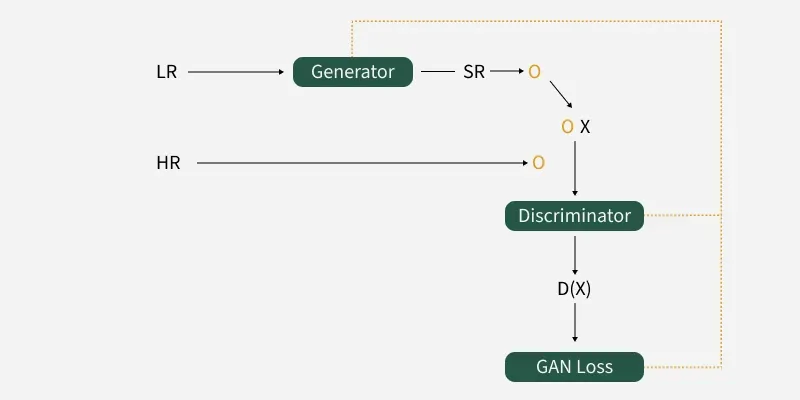
SRGAN-Architecture
Generator Architecture
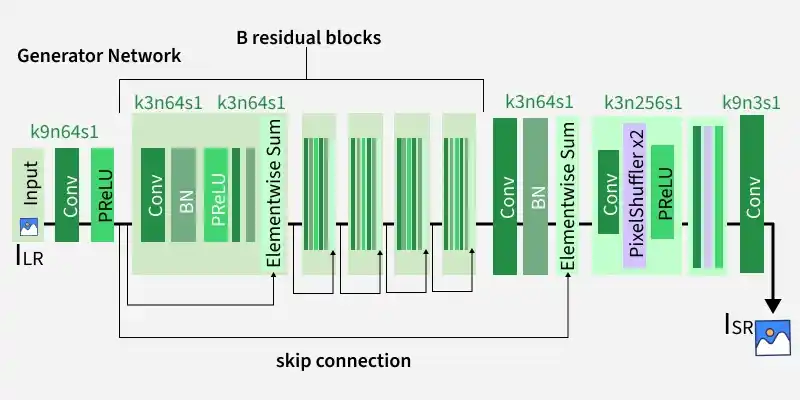
The SRGAN generator uses a Residual Network (ResNet) architecture to generate high-resolution images effectively. Residual connections help improve gradient flow and support deeper network training.
Generator Architecture
- Uses 16 residual blocks for feature learning
- Each block contains two 3×3 convolution layers with 64 feature maps
- Batch normalization improves training stability
- PReLU activation learns adaptive negative slopes for better performance
- Uses sub-pixel convolution layers for efficient learned upsampling
- Produces sharper and more detailed high-resolution images
Discriminator Architecture
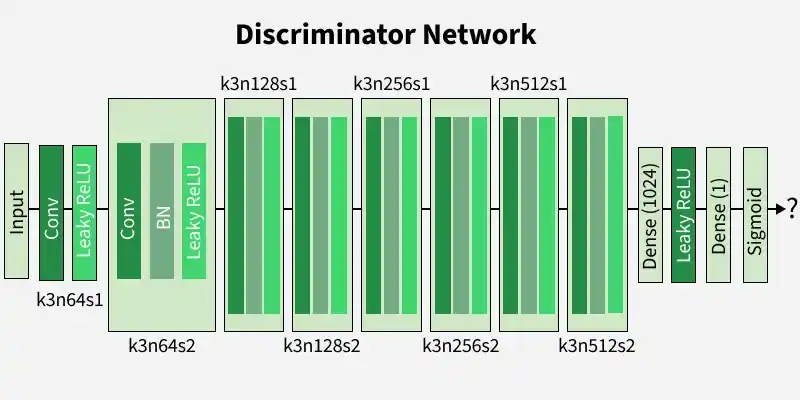
The discriminator uses multiple convolutional layers to distinguish between real high-resolution images and generated images.
Discriminator Architecture
- Uses eight convolutional layers with 3×33 \times 33×3 kernels
- Feature maps increase from 64 to 512 through strided convolutions
- Spatial resolution decreases progressively during processing
- Ends with dense layers and a sigmoid activation function
- Outputs the probability of an image being real or generated
Loss Function Design
SRGAN uses a perceptual loss function that combines content loss and adversarial loss to improve both image quality and realism.
Content Loss
Traditional super-resolution methods typically use Mean Squared Error (MSE) as the content loss, which measures pixel-wise differences between generated and target images. However, MSE tends to produce overly smooth images because it averages over all possible high-resolution images that could relate to a given low-resolution input.
l^{SR}_{VGG/i,j} = \frac{1}{W_{i,j} H_{i,j}} \sum_{x=1}^{W_{i,j}} \sum_{y=1}^{H_{i,j}} \left( \left( \phi_{i,j}(I^{HR})_{x,y} - \phi_{i,j}(G_{\theta_G}(I^{LR}))_{x,y} \right)^2 \right)
- l^{SR}_{VGG/i,j}**: Perceptual (VGG) loss at layer (i,j).
- W_{i,j}, H_{i,j}**: Width and height of the VGG feature map, used for normalization.
- \phi_{i,j}**: Feature map extracted from layer (i,j) of the pre-trained VGG network.
- I^{HR}: Ground-truth high-resolution image.
- I^{LR}: Low-resolution input image.
- G_{\theta_G}(I^{LR}): Super-resolved output image generated by the generator GGG.
- (x,y): Spatial position in the feature map.
SRGAN proposes using VGG loss instead, which computes the difference between feature representations extracted from a pre-trained VGG-19 network. This approach focuses on perceptually important features rather than raw pixel values. The VGG loss can be computed at different network depths:
- **VGG2,2: Features from the second convolution layer before the second max-pooling (low-level features)
- **VGG5,4: Features from the fourth convolution layer before the fifth max-pooling (high-level features)
Adversarial Loss
Adversarial loss encourages the generator to produce images that appear realistic to the discriminator.
l^{SR}_{Gen} = \sum_{n=1}^{N} -\log D_{\theta_D}(G_{\theta_G}(I^{LR}))
- l^{SR}_{Gen}: Adversarial (generator) loss for super-resolution.
- N: Total number of training samples.
- G_{\theta_G}(I^{LR}): Super-resolved image generated by the generator GGG using low-resolution input I^{LR}.
- D_{\theta_D}(\cdot): Discriminator’s probability that the input image is real.
- -\log D_{\theta_D}(G_{\theta_G}(I^{LR})): Penalizes the generator if the discriminator easily detects the fake image.
Total Loss - Perceptual loss
l^{SR} = l^{SR}_X + 10^{-3} l^{SR}_{Gen}
- l^{SR}: Overall super-resolution loss.
- l^{SR}_X: Content loss (often based on VGG perceptual loss).
- l^{SR}_{Gen}**: Adversarial loss from the generator.
Training Process and Results
During training, high-resolution images are downsampled to create low-resolution inputs for the generator. The generator and discriminator then train adversarially to improve image quality and realism.
- Generator converts low-resolution images into high-resolution outputs
- Discriminator checks whether images are real or generated
- Adversarial training continuously improves image realism
- Produces sharper textures and finer image details
- Achieves strong performance in objective metrics and Mean Opinion Score (MOS)
Limitations
Although SRGAN produces high-quality images, it also has some limitations.
- Training can be unstable and may face convergence issues
- Requires high computational power and GPU memory
- Performance depends heavily on training data quality
- May prioritize perceptual quality over exact pixel accuracy
- Real-time applications may require model optimization
Applications
SRGAN is widely used in tasks where high visual quality is important.
- Medical image enhancement
- Satellite image super-resolution
- Mobile photography and image enhancement
- Consumer applications requiring realistic image upscaling
- Foundation for advanced models like ESRGAN and Real-ESRGAN