Introduction To Convolution Layers (original) (raw)
Last Updated : 19 May, 2026
Convolution layers are core components of CNNs used in image processing. They apply filters (kernels) over the input to extract important patterns and features.
- Apply convolution operation using filters (kernels)
- Perform element-wise multiplication and summation
- Generate feature maps from input data
- Detect patterns like edges, textures and shapes
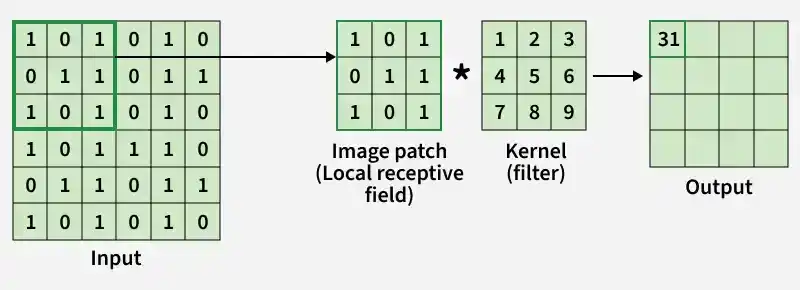
convolution operation
Key Components of a Convolution Layer
**1. Filters (Kernels)
- Small matrices that extract specific features from the input.
- For example, one filter might detect horizontal edges while another detects vertical edges.
- The values of filters are learned and updated during training.
**2. Stride
- Refers to the step size with which the filter moves across the input data.
- Larger strides result in smaller output feature maps and faster computation.
**3. Padding
- Zeros or other values may be added around the input to control the spatial dimensions of the output.
- Common types: "valid" (no padding) and "same" (pads output so feature map dimensions match input).
**4. Activation Function
- After convolution, a non-linear function like ReLU (Rectified Linear Unit) is often applied allowing the network to learn complex relationships in data.
- Common activations: ReLU, Tanh, Leaky ReLU.
Types of Convolution Layers
Different types of convolution layers are used based on the task and efficiency requirements.
- **2D Convolution (Conv2D): Most common for images; filters move across height and width
- **Depthwise Separable Convolution: Reduces computation by separating depthwise and pointwise operations
- **Dilated (Atrous) Convolution: Expands receptive field by adding gaps in the kernel without increasing computation
Steps in a Convolution Layer
- **Initialize Filters: Randomly initialize a set of filters with learnable parameters.
- **Convolve Filters with Input: Slide the filters across the width and height of the input data, computing the dot product between the filter and the input sub-region.
- **Apply Activation Function: Apply a non-linear activation function to the convolved output to introduce non-linearity.
- **Pooling (Optional): Often followed by a pooling layer (like max pooling) to reduce the spatial dimensions of the feature map and retain the most important information.
Example Of Convolution Layer
A convolution layer transforms input data into feature maps by applying multiple filters.
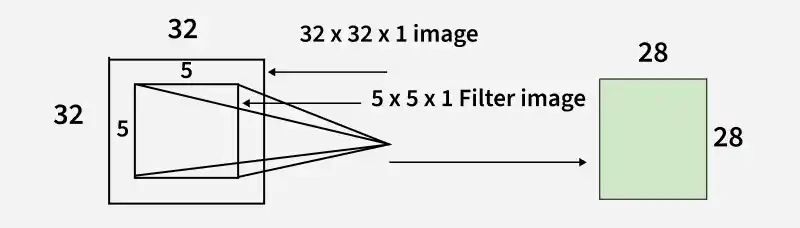
Convolution Layer
- Input size: 32×32×3 (image with 3 channels)
- Uses 10 filters of size 5×5, stride = 1, same padding
- Output size: 32×32×10
- Each filter captures different features from the image
Convolutional Layers vs Fully Connected Layers
| Aspect | Convolutional Layers | Fully Connected Layers |
|---|---|---|
| Connectivity | Local (each neuron connects to local regions) | Global (each neuron connects to all inputs) |
| Parameter Count | Lower (weight sharing) | Higher |
| Spatial Information | Preserved (via convolution operations) | Lost (flattening removes spatial structure) |
| Typical Use | Feature extraction | Classification, regression |
Applications
- Used in image and video recognition for detecting objects, faces and scenes
- Applied in medical imaging for disease detection (e.g., X-rays, MRIs)
- Used in autonomous vehicles for recognizing lanes, signs and obstacles
- Applied in NLP and speech tasks like text classification and speech recognition
- Used in industry for quality control, fraud detection and recommendations
Advantages
- Uses parameter sharing, reducing number of model parameters
- Captures local patterns through small receptive regions
- Learns hierarchical features from simple to complex
- Computationally efficient compared to fully connected layers
Limitations
- Requires high computational power and memory
- Needs large amounts of labeled data
- Limited in capturing long-range/global dependencies
- Prone to overfitting with small datasets