Important Formulas in Macroeconomics | Class 12 (original) (raw)
Last Updated : 6 May, 2026
Chapter 1: Introduction
**1. **Net Investment**= Gross Investment – Depreciation
**2. **Net Indirect Tax = Indirect Taxes - Subsidies
**3. **Market Price**= Market Price = Factor Cost + Net Indirect Taxes
OR
Factor Cost + (Indirect Taxes - Subsidies)
**4. **Net factor Income from Abroad (NFIA)**= Factor income earned from abroad – Factor income paid abroad
OR
Net Compensation of Employees + Net Income from Property and Entrepreneurship + Net Retained Earnings
**5. **National Income (using NFIA) = Domestic Income + NFIA
**6. **Depreciation = Gross Value - Net Value
**7. **Leakagesin Different Types of Economies
| **Leakages in Different Types of Economies | |
|---|---|
| Two-Sector Economy (with Financial Market) | Savings |
| Two-Sector Economy (without Financial Market) | No Leakages |
| Three-Sector Economy | Savings + Taxes |
| Four-Sector Economy | Savings + Taxes + Imports |
8. Injections in Different Types of Economies
| **Injections in Different Types of Economies | |
|---|---|
| Two-Sector Economy (with Financial Market) | Investment |
| Two-Sector Economy (without Financial Market) | No Injection |
| Three-Sector Economy | Investment + Government Expenditure |
| Four-Sector Economy | Investment + Government Expenditure + Exports |
Chapter 2 : National Income Accounting
1. **National Income and Related Aggregates
- Gross Domestic Product at Factor Cost (GDPFC) = GDPMP – Net Indirect Taxes
- Net Domestic Product at Market Price (NDPMP) = GDPMP – Depreciation
- Net Domestic Product at Factor Cost (NDPFC) or Domestic Income = GDPMP – Net Indirect Taxes – Depreciation
- Gross National Product at Market Price (GNPMP) = GDPMP + Net Factor Income from Abroad
- Gross National Product at Factor Cost (GNPFC) = GNPMP – Net Indirect Taxes
- Net National Product at Market Price (NNPMP) = GNPMP – Depreciation
- Net National Product at Factor Cost (NNPFC) or National Income = GNPMP – Net Indirect Taxes – Depreciation
- Domestic Income
Income from Domestic Product accruing to Private Sector = NDPFC - Income from Property and Entrepreneurship accruing to Government Administrative Departments - Savings of Non-Departmental Enterprises
**3. Private Income = Factor Income earned (within domestic territory + from rest of the world) + Transfer Income received (within domestic territory + from rest of the world)
OR
= Income from Domestic Product Accruing to Private Sector + NFIA + Interest on National Debt + Current Transfers from Government + Net Current Transfer from Rest of the World
**4.Personal Disposable Income = Personal Income - Personal Taxes Miscellaneous Receipts of Government
OR
= Personal Consumption Expenditure + Personal Savings
**5. National Disposable Income = National Income + Net Indirect Taxes + Net Current Transfers from the rest of the world
OR
= National Consumption Expenditure + National Savings
6. **Gross National Disposable Income = Net National Disposable Income + Depreciation
7. Product or Value Added Method of calculating National Income
- **GDP MP using Value Added Method (∑GVAMP) = GDPMP
- **Value Added = Value of Output – Intermediate Consumption
- **Value of Output when the whole output is sold in a financial year = Sales
- **Value of Output when the whole output is not sold in a financial year
Value of Output = Sales + Change in Stock
Change in Stock = Closing Stock – Opening Stock
- **Value of Output = (Quantity × Price) + Change in Stock
- **National Income using Value Added Method( NNPFC) = GDPMP – Depreciation – Net Indirect Taxes + NFIA
OR
=Domestic Income or NDPFC + NFIA
8. Expenditure Method of calculating National Income
- **GDP MP using Expenditure Method(GDPMP) = ∑ Final Expenditure
∑ Final Expenditure = Private Final Consumption Expenditure (PFCE) + Government Final Consumption Expenditure (GFCE) + Gross Domestic Capital Formation (GDCF) + Net Exports (NX)
- **Private Final Consumption Expenditure (PFCE) = Household Final Consumption Expenditure + Non-profit Private Institutions Final Consumption Expenditure
- **Government Final Consumption Expenditure (GFCE) = Intermediate Consumption of Government + COE paid by Government +Direct purchases from abroad for embassies and consulates located abroad – Sale of goods and services produced by general government
- **Gross Domestic Capital Formation (GDCF) = Gross Fixed Capital formation + Inventory Investment
OR
= Gross Business Fixed Investment + Gross Residential Construction Investment + Gross Public Investment + Inventory Investment
- **Net Exports (X – M) = Exports – Imports or (X-M)
- **National Income using Expenditure Method (NNPFC) = ∑Final Expenditure or GDPMP – Depreciation – Indirect taxes + NFIA
OR
= Domestic Income or NDPFC + NFIA
**9. Income Method of calculating National Income
- **Profit = Corporate Tax + Dividend + Retained Earnings
- **Operating Surplus = Rent + Royalty + Interest + Profit
OR
= Value of Output – Intermediate Consumption – Compensation of Employees – Mixed Income – Consumption of Fixed Capital – Net Indirect Taxes
- **National Income using Income Method(NNPFC) = NDPFC + NFIA
Where,
NDPFC = Compensation of Employees + Profit + Rent & Royalty + Interest + Mixed income
**10. National Income at Constant Price
National~Income~at~Constant~Price=\frac{National~Income~at~Current~Price}{Current~Price~Index}\times{100}
11. **Nominal GDP or GDP at Current Price
Nominal~GDP=\frac{Real~GDP\times{Price~Index}}{100}
12. **Real GDP or GDP at Constant Price
Real~GDP=\frac{Nominal~GDP}{Price~Index}\times100
13. **GDP Deflator or Price Index =
GDP~Deflator~(or~Price~Index)=\frac{Nominal~GDP}{Real~GDP}\times100
Chapter 3 : Money and Banking
- **M 1 = Currency and coins with public + Demand deposits of commercial banks + Other deposits with Reserve Bank of India
- **M 2 = M1 + Savings Deposits with Post Office Saving Bank
- **M 3 = M1 + Net Time Deposits with Banks
- **M 4 = M3 + Total Deposits with Post Office Saving Bank
Money~Multiplier=\frac{1}{LRR}~or~\frac{1}{r}
Chapter 4 : Determination of Income and Employment
1. Aggregate Demand (AD) = C + I + G + (X - M)
= Private Consumption Expenditure + Investment Expenditure + Government Expenditure + Net Exports (Exports - Imports)
**2. Aggregate Supply (AS) or National Income (Y) = Consumption (C) + Saving (S)
**3. Consumption Function(C) = f(Y)
Where,
C = Consumption
f = Functional Relationship
Y = National Income
4. Average Propensity to Consume (APC)
Average~Propensity~to~Consume~(APC)=\frac{Consumption~(C)}{Income~(Y)}
5. Marginal Propensity to Consumer (MPC)
Marginal~Propensity~to~Consume~(MPC)=\frac{Change~in~Consumption~(\Delta{C})}{Change~in~Income~(\Delta{Y})}
6. Saving Function(S) = f(Y)
Where,
S = Saving
f = Functional Relationship
Y = National Income
7. Average Propensity to Save (APS)
Average~Propensity~to~Save~(APS)=\frac{Saving~(S)}{Income~(Y)}
8. Marginal Propensity to Save (MPS)
Marginal~Propensity~to~Save~(MPS)=\frac{Change~in~Saving~(\Delta{S})}{Change~in~Income~(\Delta{Y})}
**9. Relationship between APC ad APS=APC + APS = 1
**10. Relationship between MPC and MPS =MPC + MPS = 1
**11. Values of APC, APS, MPC, and MPS
| Value | APC | APS | MPC | MPS |
|---|---|---|---|---|
| **Negative (less than zero) | APC can never be less than zero, because of the presence of \bar{c} | APS can be less than zero when C>Y; i.e., before Break-even Point. | MPC can never be less than zero, as \Delta{S} can never be more than \Delta{Y} | MPS can never be less than zero, as \Delta{C} can never be more than \Delta{Y} |
| **Zero | APC can never be zero, because of the presence of \bar{c} | APS can be zero when C=Y; i.e., at Break-even Point. | MPC can never be zero, when \Delta{S}=\Delta{Y} | MPS can never be zero, when \Delta{C}=\Delta{Y} |
| **One | APC can be one when C=Y; i.e., at BEP | APS can never by one as savings can never be equal to income | MPC can never be zero, when \Delta{C}=\Delta{Y} | MPS can never be zero, when \Delta{S}=\Delta{Y} |
| **More than One | APC can be more than one when C>Y; i.e., before Break-even Point. | APS can never be more than one as savings can never be more than income | MPC can never be less than zero, as \Delta{C} can never be more than \Delta{Y} | MPS can never be less than zero, as \Delta{S} can never be more than \Delta{Y} |
**12. Equation of Consumption Function
C=\bar{c}+b(Y)
Where,
C = Consumption
\bar{c}=Autonomous~Consumption
b = MPC
Y = Income
1**3. Equation of Saving Function
S=-\bar{c}+(1-b)Y
Where,
S = Saving
-\bar{c}=Amount~of~negative~saving~at~zero~income~level
1-b = MPS
Y = Income
**14. Marginal Efficiency of Investment (MEI)
Marginal~Efficiency~of~Investment~(MEI)=\frac{Prospective~Yield}{Supply~Price}\times{100}
15. Two Approaches for Determination of Equilibrium Level
- **Aggregate Demand-Aggregate Supply Approach (AD-AS Approach): Equilibrium will be achieved when,
AD = AS
- **Saving-Investment Approach (S-I Approach): Equilibrium will be achieved when,
S = I
**16. Investment Multiplier
k=\frac{\Delta{Y}}{\Delta{I}}
OR
k=\frac{1}{1-MPC}
OR
k=\frac{1}{MPS}
The maximum value of the Multiplier is ∞ when MPC = 1
The minimum value of Multiplier is 1 when MPC = 0
Chapter 5 : Government Budget and the Economy
**1. **Measures of Government Deficit
- **Revenue Deficit = Revenue Expenditure – Revenue Receipts
- **Fiscal Deficit = Total Expenditure – Total Receipts (except borrowings)
OR
= (Revenue Expenditure + Capital Expenditure) – (Revenue Receipts + Capital Receipts excluding Borrowings)
OR
= (Revenue Expenditure – Revenue Receipts) + (Capital Expenditure – Capital Receipts excluding Borrowings)
OR
= Revenue Deficit + (Capital Expenditure – Capital Receipts excluding Borrowings)
- **Primary Deficit = Fiscal Deficit – Interest Payment
Chapter 6 : Balance of Payments
1. Balance of Trade = Exports of Goods – Imports of Goods
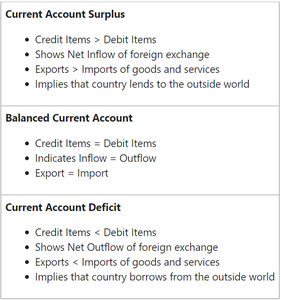
2****. Balance on** **Current Account
**3. Balance on **Capital Account
