Addition of Fractions (original) (raw)
Last Updated : 11 Feb, 2026
Addition of Fractions is a simple process in which we add two fractions together to get a single fraction. A fraction represents the division of one number by another, written with a numerator (top number) and a denominator (bottom number) separated by a horizontal line.

Adding Fractions with Same Denominators
Fractions with the same denominator are also called **like fractions.
We can easily add these fractions using the following formula,
**a/b + c/b = (a+c)/b
To add fractions with the same denominators we simply add the numerators specified in the fraction and use the same denominator to obtain the result.
Let’s consider an example of 1/4 + 2/4, which is a like fraction. We will represent both fractions in the form of a circle as follows:
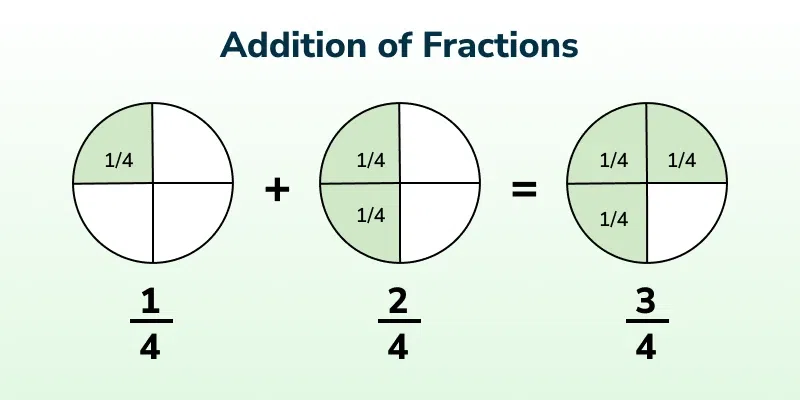
The denominator is the same for both i.e., both circles are divided in equal parts which can be easily added. So there is no need to modify the denominator , As a result, our answer is (1+2)/4 = 3/4, as indicated in the image below.
Example: Add 2/5 and 3/5. These fractions have the same denominator.
**Solution:
**Given fractions : 2/5 and 3/5
Here 5 and 5 are the denominator of the given fractions****,** As both denominators are the same.
Since, the Denominators are the same we can simply add the numerators.2/5 + 3/5= (2 + 3) /5 = 5/5 = 1
Our numerators are 2 and 3 add it (2+3 = 5) and hence we got 5/5. Simplify it and the result will be 1.
Adding Fractions with Different Denominators
Fractions with different denominators are also called **unlike fractions.
We add unlike fractions using the following formula:
**a/b + c/d = (a/b) × (d/d) (c/d) × (b/b) = ad/bd + cb/bd = (ad + bc)/bd
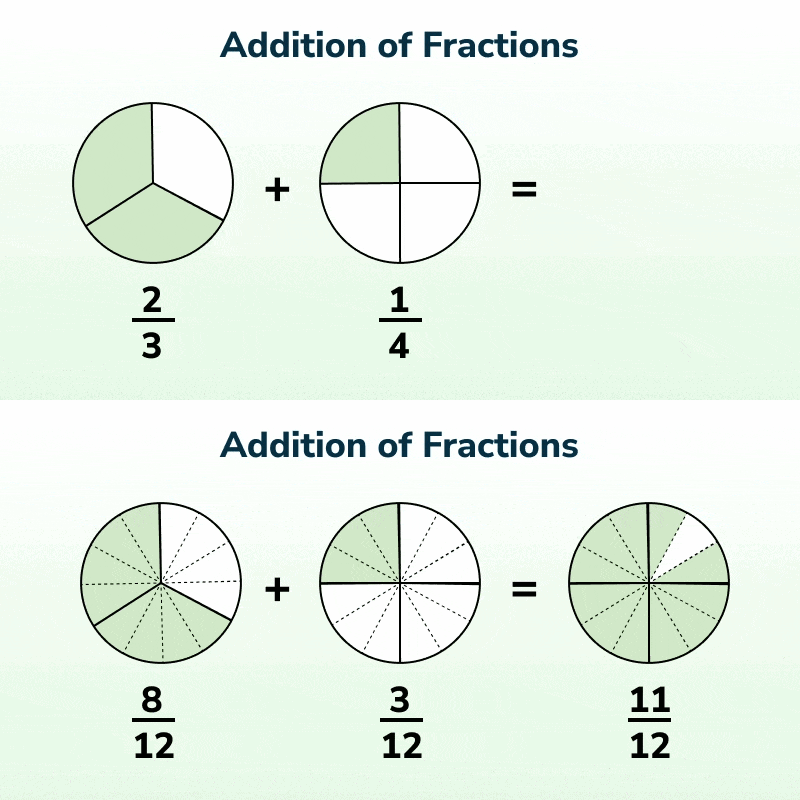
**Steps to Add Fractions with Different Denominators:
**Step 1: Find the different denominators of the fractions you wish to add .
**Step 2: Determine lowest common multiples (LCM) of the denominators of the fractions.
**Step 3: Multiply the numerator and denominator by the same number to make the denominator equal to the LCM.
**Step 4: Add the fractions' numerators while maintaining the LCM as the denominator.
Let's try to understand this with the help of examples.
**Example 1:Add 1/4 and 3/8. These fractions have different denominators, so we need to find a common denominator.
**Step 1: The denominators, 4, and 8, are dissimilar.
**Step 2: Determine the denominators' least common multiple (LCM).
8 is the LCM of 4 and 8.
**Step 3: To make the denominator equal, multiply the numerator and denominator by the LCM factor.
1/4 = (1 × 2)/(4 × 2) = 2/8
3/8 = (3 × 1)/(8 × 1) = 3/8
**Step 4: Add the fractions' numerators while maintaining the LCM as the denominator.
2/8 + 3/8 = 5/8
5/8 is the final answer.
**Learn more about, **Adding Fractions with Unlike Denominators
How To Add Mixed Fractions?
Mixed fractions are numbers that combine a whole number and a fraction, such as 2 \frac{1}{3}. Adding mixed fractions involves a few extra steps compared to regular fractions.
**Steps to Add Mixed Fractions:
**Step 1: Convert the mixed fractions into improper fractions.
- Multiply the whole number with the denominator and add the numerator, the result will become our numerator and the denominator will be the same as given fractions.
- a(b/c) will be written as ((a × c) +b) / c.
**Step 2: Determine the denominators' least common multiples (LCM), or the lowest integer that can be divided equally by each denominator.
**Step 3: To make the denominator equal, multiply the numerator and denominator by the LCM factor.
**Step 4: Add the fractions' numerators while maintaining the LCM as the denominator.
Here is an example to illustrate how to add mixed fractions.
**Example: Consider two numbers 2(3/4) and 1(1/2). Add the given mixed fractions.
Convert the mixed fractions into improper fractions.
2(3/4) = (2 × 4 + 3) / 4 = 11/4
1(1/2) = (1 × 2 + 1) / 2 = 3/2Find a common denominator.
The denominators are 4 and 2, so the LCM of 4 and 2 is 4.To make the denominator equal, multiply the numerator and denominator by the LCM factor.
11/4 remains the same.
3/2 = (3 × 2) / (2 × 2) = 6/4Add the fractions' numerators while maintaining the LCM as the denominator.
11/4 + 6/4 = 17/4
How to Add Fractions with Whole Numbers
To add fractions with whole numbers, first we convert the whole number into a fraction. Take the denominator of the whole number as one. Then add the fraction as you would when adding fractions with different denominators.
**Steps to add fractions with whole numbers:
**Step 1: Convert the whole number into an Improper Fraction.
- Multiply the whole number by the denominator of the given fraction.
- The result becomes the new numerator, and the denominator will be the same as given fraction.
**Step 2: Add the improper fraction and the given fraction just like adding with same denominators.
**Step 3: Simplify the resulting fraction, if possible.
**Example: Suppose we want to add 2/3 and 1. To add a fraction and a whole number, simply express the whole number as a fraction with the same denominator as the other fraction.
**Solution :
**Step 1: Convert the whole number to an improper fraction: Multiply 1 by the denominator of the given fraction which is 3. So,1 can be written by 3/3 .
**Step 2: Now , we have to add 2/3 + 3/3 which is equal to 5/3 .(just like adding fractions with same denominators)
**Step 3: We can write 5/3 in mixed fraction 1\frac{2}{3}
Solved Examples on Addition of Fractions
Here are some solved examples on addition of fractions:
**Example 1: Add 2/3 and 1/3
**Solution:
3 is the denominator in the both given fractions. (Like Fractions)
Given Fractions : 2/3, 1/3
So, 2/3 + 1/3
= (2+1) / 3
= 3/3
= 1
**Example 2: Add 1/4 and 2/3
**Solution:
Given Fraction: 1/4, 2/3
LCM of denominators ( 4 & 3) is 12.
First Fractional Number: (1×3)/(4×3) = 3/12
Second Fractional Number: (2×4)/(3×4) = 8/12
So, 3/12 + 8/12 = (3+8) / 12
= 11/12
**Example 3: Add 3/2 and 1
**Solution:
1 can be represented as, (1 /1) = ( 1 × 2) / ( 1 × 2) = 2/2
= 3/2 + 1
= 3/2 + 2/2
= (3+2)/2
= 5/2
5/2 in mixed fraction is 2\frac{1}{2}
**Example 4: Add 1(2/5) and 2(1/5)
**Solution:
Change mixed fraction to improper fraction
= 1(2/5) = ((1 × 5)+2)/5 = 7/5
= 2(1/5) = ((2 × 5)+1)/5 = 11/5
= 7/5 + 11/5
= 18/5
= 3\frac{3}{5}