Algebra of Real Functions (original) (raw)
Last Updated : 2 Jun, 2026
Algebra of functions means performing basic arithmetic operations on functions, just like we do with numbers. To perform these operations on two functions, both functions should have the same domain.
Operations on Real Functions
The algebra of real functions means performing mathematical operations on functions that take real numbers as input and give real numbers as output. These operations include addition, subtraction, multiplication, and division of functions. It helps combine two or more functions to solve complex mathematical problems more easily.
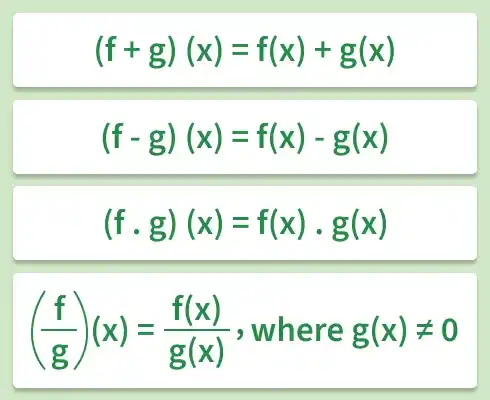
Here are the formulas for these operations:
**Addition of Functions
Let f and g be two real functions. The addition of two functions is defined by adding their corresponding values at the same input value x. It is written as
- ****(f + g)(x) = f(x) + g(x)**, for all values of x that belong to the common domain of both functions.
The domain of the sum of two functions is the intersection of the domains of the individual functions, i.e.,
- **D(f + g) = D(f) ∩ D(g).
**Example : Given f(x) = x + 3 and g(x) = 2x. Find (f + g)(x).
**Solution:
(f + g) (x) = f (x) + g (x).
Since f(x) = x + 3 and g(x) = 2x.
(f + g)(x) = x + 3 + 2x = 3x + 3
Since domain for both the functions is real number R. The intersection of domain is also R. So, domain of (f + g)(x) is R.
**Subtraction of Functions
Let f and g be two real functions. The subtraction of two functions is defined by subtracting the value of one function from the other at the same input value x. It is written as
- ****(f - g)(x) = f(x) - g(x)**, for all values of x that belong to the common domain of both functions.
The domain of the difference of two functions is the intersection of the domains of the individual functions, i.e.,
- **D(f - g) = D(f) ∩ D(g).
**Example: Given f(x) = 2x + 1 and g(x) = 3x. Find (f-g)(x).
**Solution:
(f - g) (x) = f (x) - g (x).
Since f(x) = 2x + 1 and g(x) = 3x.
(f - g)(x) = 2x + 1 - 3x = 1 - x
**Multiplication by a Scalar
Let f: X → R be a real function and "k" be any scalar belonging to R. Then the product kf is a function from X to R defined by
(kf)(x) = kf(x), x ∈ X
The domain remains the same in this case.
**Multiplication of Functions
Let f and g be two real functions. The multiplication of two functions is defined by multiplying their values at the same input value x. It is written as
- ****(f · g)(x) = f(x) · g(x)**, for all values of x that belong to the common domain of both functions.
The domain of the product of two functions is the intersection of the domains of the individual functions, i.e.,
- **D(f · g) = D(f) ∩ D(g).
The product of two functions may result in a polynomial, quadratic, or cubic function.
**Example: Given f(x) = x2 + 1 and g(x) = 1/x. Find (f × g)(x).
**Solution:
(f × g)(x) = f(x) g(x) = (x2 + 1)(1/x) = \frac{x^{2} + 1}{x}. _Since g(x) = 1/x has domain ℝ − {0}, the domain of (f · g)(x) is also ℝ − {0}.
**Quotient of Two Real Functions
Let f and g be two real functions defined from X → R. The quotient of f by g is denoted by \frac{f}{g} is a function defined from X → R as,
(\frac{f}{g})(x) = \frac{f(x)}{g(x)}, provided g(x) ≠ 0.
Let D(f) and D(g) be the domain of function "f" and "g" respectively. In this case also the domain
Domain for \frac{f}{g}: {x | x ∈ Df ∩ Dg and g(x) ≠ 0}
**Example: Given f(x) = x2 + 1 and g(x) = (x + 1)/x. Find (\frac{f}{g})(x)
**Solution:
Domain for f(x) is R and Domain for g(x) is R - {0}. Also, g(x) = 0 at x = -1.
\left(\frac{f}{g}\right)(x) = \frac{x^{2} + 1}{\frac{x + 1}{x}} \\= (x^{2} + 1)\frac{x}{x + 1} \\= \frac{(x^{2} + 1)x}{x + 1}
We know, domain should be {x | x ∈ D(f ) ∩ D(g) and g(x) ≠ 0 }.
So, domain becomes \mathbb{R} - \{0,-1\}.
**Example: Given the tables below:
| **x | 2 | 4 | 6 | 8 |
|---|---|---|---|---|
| **f(x) | 23 | 16 | 30 | 26 |
| **x | 2 | 4 | 6 | 8 |
|---|---|---|---|---|
| **g(x) | 28 | 32 | -14 | -22 |
**Calculate:
- (f + g)(6)
- (f - g)(8)
- (f × g)(2)
- (f/g)(4)
**Solution:
- (f + g)(6) = f (6) + g(6) = 30 + (-14) = 16
- (f - g)(8) = f (8) - g(8) = 26 - (-22) = 48
- (f * g)(2) = f (2) x g(2) = 23 x 28 = 644
- (f / g)(4) = f (4) / g(4) = 16 / 32 = ½