Algebraic Expressions in Maths (original) (raw)
Last Updated : 27 Apr, 2026
An algebraic expression is a mathematical expression formed by the combination of variables, constants, and mathematical operations such as addition, subtraction, multiplication, and division.
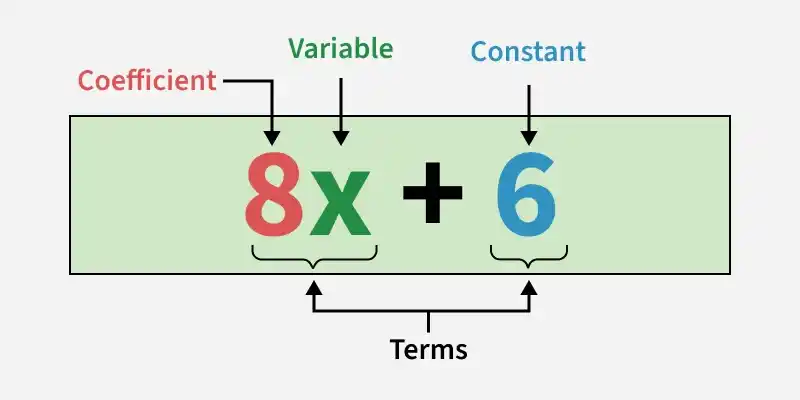
The image showing the constants and variables of an algebraic expression is shown below.
- **Variables: Variables are the unknown values that are present in the algebraic expression. For instance, 4x + 5y has x and y as variables.
- **Coefficients: Coefficients are the fixed values (real numbers) attached to the variables. They are multiplied by the variables. For example, in 5x2 + 3, the coefficient of x2 is 5.
- **Term: A term can be a constant, a variable, or a combination of both. Each term is separated by either addition or subtraction. For example, 3x + 5, 3x, and 5 are the two terms of the algebraic expression 3x + 5.
- **Constant: In an algebraic expression, constants are fixed values that do not change. They are numerical values without any variables attached.
- **Arithmetic Operation: These are basic mathematical operations that involve numbers and are used to perform calculations. For example, in 2x2 - 3, "-" is subtraction, which is an arithmetic operation.
Types of Algebraic Expressions
There are various types of algebraic expressions based on the number of terms in the algebraic expression.
- **Monomial
- **Binomial
- **Trinomial
- **Polynomial
Simplify Algebraic Expressions
Simplifying algebraic expressions means combining like terms. Like terms are terms that have the same variables raised to the same powers, while unlike terms have different variables or powers.
To simplify an expression, group like terms and add or subtract their coefficients. Unlike terms cannot be combined.
An expression is in its simplest form when no like terms remain.
For instance, let's simplify 4x5 + 3x3 - 8x2 + 67 - 4x2 + 6x3,
Same powers that are repeated are cubic and square, upon combining them together, the expression becomes, 4x5 + (3x3 + 6x3) + (-8x2 - 4x2) + 67.
Now, simplifying the expression, the final answer obtained is 4x5 + 9x3 - 12x2 + 67.
This term does not have any terms repeated that have the same power.
Addition of Algebraic Expressions
When an addition operation is performed on two algebraic expressions, like terms are added with like terms only, i.e., coefficients of the like terms are added.
**Example: Add (25x + 34y + 14z) and (9x − 16y + 6z + 17).
**Solution:
(25x + 34y + 14z) + (9x − 16y + 6z + 17)
By writing like terms together, we get
= (25x + 9x) + (34y − 16y) + (14z + 6z) + 17By adding like terms, we get
= 34x + 18y + 20z + 17.Hence, (25x + 34y + 14z) + (9x − 16y + 6z + 17) = 34x + 18y + 20z + 17.
Subtraction of Algebraic Expressions
To subtract an algebraic expression from another, we have to add the additive inverse of the second expression to the first expression.
**Example: Subtract (3b2 − 5b) from (5b2 + 6b + 8).
**Solution:
(5b2 + 6b + 8) − (3b2 − 5b)
= (5b2 + 6b + 8) - 3b2 + 5b
= (5b2 − 3b2) + (6b + 5b) + 8
= 2b2 + 11b + 8
Multiplication of Algebraic Expressions
When a multiplication operation is performed on two algebraic expressions, we have to multiply every term of the first expression with every term of the second expression and then combine all the products.
**Example: Multiply (3x + 2y) with (4x + 6y − 8z)
**Solution:
(3x + 2y)(4x + 6y − 8z)
= 3x(4x) + 3x(6y) − 3x(8z) + 2y(4x) + 2y(6y) − 2y(8z)
= 12x2 + 18xy − 24xz + 8xy + 12y2 − 16yz
= 12x2 + 12y2 + 26xy − 16yz − 24xz
Division of Algebraic Expressions
When we have to divide an algebraic expression from another, we can factorize both the numerator and the denominator, then cancel all the possible terms and simplify the rest, or we can use the long division method when we cannot factorize the algebraic expressions.
**Example: Solve: (x 2 + 5x + 6)/(x + 2)
**Solution:
= (x2 + 5x + 6)/(x + 2)
After factorizing (x2 + 5x + 6) = (x + 2) (x + 3)
= [(x + 2) (x + 3)]/(x + 2)
= (x + 3)
**Also Check
Solved Examples
**Example 1: Find out the constant from the following algebraic expressions.
- x3 + 4x2 - 6
- 9 + y5
**Solution:
Constants are the terms that do not have any variable attached to them, therefore, in the first case, -6 is the constant, and in the second case, 9 is the constant.
**Example 2: Find out the number of terms present in the following expressions.
- 4x2 + 7x - 8
- 5y7 - 12
**Solution:
Terms are separated by each other either by addition or subtraction sign. Therefore, in the first case, there are 3 terms and in the second case, there are 2 terms.
**Example 3: Simplify the algebraic term, z5 + z3 - y6 + 7z5 - 8y + 34 + 10z3
**Solution:
In the expression, there are terms with the same power and same variable that are repeated, first bring them together,
(z5 + 7z5) + (z3 + 10z3) - (y6 - 8y6) + 34.
= 8z5 + 11z3 - 9y6 + 34. (simplifying like terms)
**Example 4: Add (13x2 + 11), (-25x2 + 26x + 42), and (-33x - 29).
**Solution:
Let F = (13x2 + 11) + ( – 25x2 + 26x + 42) + (-33x – 29)
⇒ F = 13x2 – 25x2 + 26x – 33x + 11 + 42 – 29
⇒ F = -12x2 – 7x + 24Hence, (13x2 + 11) + ( – 25x2 + 26x + 42) + (-33x – 29) = -12x2 – 7x + 24.
**Example 5: Solve (5x + 4y + 6z)2 + (3y – 7x)2.
**Solution:
Given, Let F = (5x + 4y + 6z)2 + (3y – 7x)2
From algebraic formulae, we have
- (a + b + c)2 = a2 + b2 + c2 + 2ab + 2bc + 2ca
- (a – b)2 = a2 – 2ab + b2
Thus, F = (5x)2 + (4y)2 + (6z)2 + 2(5x)(4y) + 2(4y)(6z) + 2(6z)(5x) + [(3y)2 – 2(3y)(7x) + (7x)2]
⇒ F= 25x2 + 16y2 + 36z2 + 40xy + 48yz + 60zx +9y2 – 42xy + 49x2
⇒ F = 74x2 + 25y2 + 36z2 – 2xy + 48yz + 60zxHence, (5x + 4y + 6z)2 + (3y – 7x)2 = 74x2 + 25y2 + 36z2 – 2xy + 48yz + 60zx.
Unsolved Question on Algebraic Expressions
**Question 1: Find out the constant from the following algebraic expressions: 7x4−3x2+9
**Question 2: Find the number of terms present in the following expressions. 6a2−5a+12
**Question 3: Simplify: 4p + 7p − 6p + 5p − 9 + 12
**Question 4: Solve (2x+y+3z)2 + (x−5y)2