Algebraic Operations on Complex Numbers (original) (raw)
Last Updated : 22 Apr, 2026
A complex number is a number that includes both a real and an imaginary part. It is written in the form:
z = a + bi
Where:
- **a is the real part,
- **b is the imaginary part,
- **i is the imaginary unit, satisfying **i 2 = −1.
Algebraic operations on complex numbers follow specific rules based on their real and imaginary parts. The four operations on the complex numbers include:
- **Addition
- **Subtraction
- **Multiplication
- **Division
Addition of Complex Numbers
To add two complex numbers, just add the corresponding real and imaginary parts.
(a + bi) + (c + di) = (a + c) + (b + d)i
**Examples:
- (7 + 8i) + (6 + 3i) = (7 + 6) + (8 + 3)i = 13 + 11i
- (2 + 5i) + (13 + 7i) = (2 + 13) + (7 + 5)i = 15 + 12i
- (-3 - 6i) + (-4 + 14i) = (-3 - 4) + (-6 + 14)i = -7 + 8i
- (4 - 3i ) + ( 6 + 3i) = (4 + 6) + (-3 + 3)i = 10
- (6 + 11i) + (4 + 3i) = (4 + 6) + (11 + 3)i = 10 + 14i
Subtraction of Complex Numbers
To subtract two complex numbers, just subtract the corresponding real and imaginary parts.
(a + bi) − (c + di) = (a − c) + (b − d)i
**Examples:
- (6 + 8i) - (3 + 4i) = (6 - 3) + (8 - 4)i = 3 + 4i
- (7 + 15i) - (2 + 5i) = (7 - 2) + (15 - 5)i = 5 + 10i
- (-3 + 5i) - (6 + 9i) = (-3 - 6) + (5 - 9)i = -9 - 4i
- (14 - 3i) - (-7 + 2i) = (14 - (-7)) + (-3 - 2)i = 21 - 5i
- (-2 + 6i) - (4 + 13i) = (-2 - 4) + (6 - 13)i = -6 - 7i
Multiplication of Two Complex Numbers
Multiplication of two complex numbers is the same as the multiplication of two binomials. Let us suppose that we have to multiply a + bi and c + di. We will multiply them term by term.
(a + bi) ∗ (c + di) = (a + bi) ∗ c + (a + bi) ∗ di
= (a ∗ c + (b ∗ c)i)+((a ∗ d)i + b ∗ d ∗ −1)
= (a ∗ c − b ∗ d + i(b ∗ c + a ∗ d))
**Example 1: Multiply (1 + 4i) and (3 + 5i).
(1 + 4i) ∗ (3 + 5i) = (3 + 12i) + (5i + 20i2)
= 3 + 17i − 20
= −17 + 17i
**Example 2: Multiply 3i and (2 + 6i).
3i ∗ (2 + 6i) can be viewed as (0 + 3i) ∗ (2 + 6i)
= 3i ∗ (2 + 6i)
= 6i + 18i2
= 6i − 18
= −18 + 6i
**Example 3: Multiply (5 + 3i) and (3 + 4i).
(5 + 3i) ∗ (3 + 4i) = (5 + 3i) ∗ 3 + (5 + 3i) ∗ 4i
= (15 + 9i) + (20i + 12i2)
= (15 − 12) + (20 + 9)i
= 3 + 29i
**Note: _Multiplication of complex numbers with real numbers or purely imaginary numbers can be done in the same manner.
Division of Two Complex Numbers
Division of complex numbers is done by multiplying both the numerator and denominator by the complex conjugate of the denominator.
\frac{a+bi}{c+di} = \frac{(a+bi)(c-di)}{(c+di)(c-di)} \\ \ \\ = \frac{(ac+bd)+ (bc-ad)i}{c^2+d^2} \\ \ \\ = \frac{ac+bd}{c^2+d^2} + \frac{bc-ad}{c^2+d^2}i \\
****Example 1:**\frac{-2}{1+i} \\ \ \\
= \frac{-2}{1+i}*\frac{1-i}{1-i} \\ \ \\ = \frac{-2*(1- i)}{(1+i)*(1 -i)} \\ \ \\ = \frac{-2+2i}{(1+1)+(1- 1)i} \\ \ \\ = \frac{-2+2i}{2} \\ \ \\ = \frac{-2}{2} + \frac{2}{2}i \\ = -1 + i
**Example 2: \frac{4 + 5i}{2i}
= \frac{4 + 5i}{2i}*\frac{-2i}{-2i} \\ \ \\ = \frac{(4 + 5i)*-2i}{-4i^2} \\ \ \\ = \frac{10-8i}{4} \\ \ \\ = \frac{10-8i}{4} \\ \ \\ = \frac{10}{4} - \frac{8}{4}i \\ \ \\ = \frac{5}{2} -2i
**Example 3: \frac{4 + 2i}{-1+i}
= \frac{4 + 2i}{-1+i}*\frac{-1-i}{-1-i} \\ \ \\ = \frac{(4 + 2i)*(-1- i)}{(-1+i)*(-1 -i)} \\ \ \\ = \frac{(-4+2)+(-2-4)i}{(1+1)+(1- 1)i} \\ \ \\ = \frac{-2-6i}{2} \\ \ \\ = \frac{-2}{2} - \frac{6}{2}i \\ = -1 -3i
**Example 4: \frac{2 + 5i}{3+4i}
= \frac{2 + 5i}{3+4i}*\frac{3- 4i}{3-4i} \\ \ \\ = \frac{(2 + 5i)*(3- 4i)}{(3+4i)*(3 -4i)} \\ \ \\ = \frac{(6+20)+(15-8)i}{(9+16)+(12- 12)i} \\ \ \\ = \frac{26+7i}{25} \\ \ \\ = \frac{26}{25} + \frac{7}{25}i
Conjugate of a Complex Number
Two complex numbers, if only the sign of the imaginary part differs then, they are known as a complex conjugate of each other. Thus conjugate of a complex number a + bi would be a - bi.
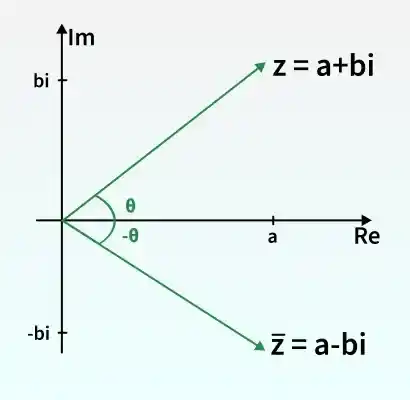
The complex conjugate of z is denoted by \bar{z}
**What's the use of a complex conjugate?
\frac{1 + 2i}{4-5i} this can be written as \frac{1 + 2i}{4-5i}*\frac{4 + 5i}{4+5i} \\ \ \\ = \frac{(1 + 2i)*(4 + 5i)}{(4-5i)*(4 + 5i)} \\ \ \\ = \frac{(4-10)+(8+5)i}{(16+25)+(20 - 20)i} \\ \ \\ = \frac{-6+13i}{16+25} \\ \ \\ = \frac{-6}{41} + \frac{13}{41}i
Thus we can observe that multiplying a complex number with its conjugate gives us a real number. Thus the division of complex numbers is possible by multiplying both numerator and denominator with the complex conjugate of the denominator.
**Examples of Complex Conjugates
**1. \ \overline {4 + 7i} = 4 - 7i
**2. \overline {-6 + 12i} = -6 - 12i
**3. \overline {34 - 7i} = 34 + 7i
**4. \overline {-15 - 7i} = - 15 + 7i
**Properties of Complex Conjugates
**Property 1: {\bar z} = z
Proof: Let z = a + ib. Then by definition, (conjugate of z) = a - ib.
Therefore, the conjugate of \bar{z} is = _a + _ib = _z.
**Property 2: \overline {z1+z2} = \overline {z1} + \overline {z2}
Proof: If z1 = a + ib and z2 = c + id then \overline {z1} = a - ib and \overline {z2} = c - id
Now, z1 + z2 = a + ib + c + id = (a + c) + i(b + d)
Therefore, \overline {z1+z2} = a + c - i(b + d) = a - ib + c - id
= \overline {z1} + \overline {z2}
**Property 3: \overline {z1-z2} = \overline {z1} - \overline {z2}
Proof: If z1 = a + ib and z2 = c + id then \overline {z1} = a - ib and \overline {z2} = c - id
Now, z1 + z2 = a + ib - (c + id) = (a- c) + i(b - d)
Therefore, \overline {z1-z2} = a - c - i(b - d)
= (a - ib) - (c - id)
= \overline {z1} - \overline {z2}
****Property 4:**\overline {z1*z2} = \overline {z1}*\overline {z2}
Proof: If z1 = a + ib and z2 = c + id then \overline {z1} = a - ib and \overline {z2} = c - id
Now, z1 * z2 = a + ib - (c + id) = (ac-bd) + i(bc + ad)
Therefore, \overline {z1*z2} = (ac - bd) - i(bc+ ad)
Also, \overline {z1}*\overline {z2} = (a – ib)(c – id) = (ac – bd) – i(bc + ad)
**Property 5: \ \overline {(\frac{z1}{z2})} = \frac{\overline {z1}}{\overline {z2}} , provided z ≠ 0
Proof: According to the problem z2 ≠ 0 ⇒ \overline {z2} ≠ 0
Let, \frac{z1}{z2} = z3
z1 = z2*z3
⇒\overline {z1} = \overline {z2*z3}
⇒ \overline {z1} = \overline {z2}*\overline {z3}
⇒ \frac{\overline {z1}}{\overline {z2}} = \overline {z3}
⇒ \overline {(\frac{z1}{z2})} = \frac{\overline {z1}}{\overline {z2}}, [Since\ z3 = \frac{z1}{z2}]
**Related Articles:
Solved Examples
**Example 1: Simplify i35.
**Solution:
We know i4 = 1
So, i35 = i(4×8)+3 = (i4)8 × i3 = 18 × i3 = i3 = −i
**Example 2: Simplify and express in a + ib form: (3 + 2i) + (4 − 5i)
**Solution:
Add real parts and imaginary parts separately:
(3 + 4) + (2i - 5i) = 7 - 3i
**Example 3: Find the modulus and conjugate of z = 6 − 8i.
**Solution:
|z| = \sqrt{6^2 + (-8)^2} = \sqrt{36 + 64} = 10
Conjugate of ∣z∣ = 6 + 8i
|z| = 10, \quad \overline{z} = 6 + 8i
**Example 4: Simplify: \frac{3 - 4i}{1 + 2i}
**Solution:
Multiply numerator and denominator by conjugate of denominator:
\frac{3 - 4i}{1 + 2i} \times \frac{1 - 2i}{1 - 2i}= \frac{(3 - 4i)(1 - 2i)}{(1 + 2i)(1 - 2i)}
= \frac{3 - 6i - 4i + 8i^2}{1 - (2i)^2}= \frac{3 - 10i + 8(-1)}{1 - (-4)}
= \frac{3 - 10i - 8}{1 + 4}= \frac{-5 - 10i}{5}
= -1 - 2i
**Example 5: If z1 = 2 + 3i and z2 = 4−i, find \frac{|z_1|}{|z_2|}
**Solution:
|z_1| = \sqrt{2^2 + 3^2} = \sqrt{13}, \quad|z_2| = \sqrt{4^2 + (-1)^2} = \sqrt{17}
\frac{|z_1|}{|z_2|} = \frac{\sqrt{13}}{\sqrt{17}}
Unsolved Examples
**Example 1: Simplify and express in a + ib: (5 − 3i) − (2 + 7i).
**Example 2: Find the value of i94.
**Example 3: If z = 7 + 24i, find its modulus and argument.
**Example 4: Simplify and express in a + ib form: \frac{4 + 3i}{2 - 5i}.
**Example 5: If z = x + iy satisfies ∣z−6∣ = 2∣z + 3i∣, find the **locus of z in the complex plane.