Area Between Two Curves: Formula, Definition and Examples (original) (raw)
Last Updated : 23 Jul, 2025
Area Between Two Curvesin Calculus is one of the applications of Integration. It helps us calculate the area bounded between two or more curves using the integration. As we know Integration in calculus is defined as the continuous summation of very small units. The topic "Area Between Two Curves" has applications in the various fields of engineering, physics, and economics.
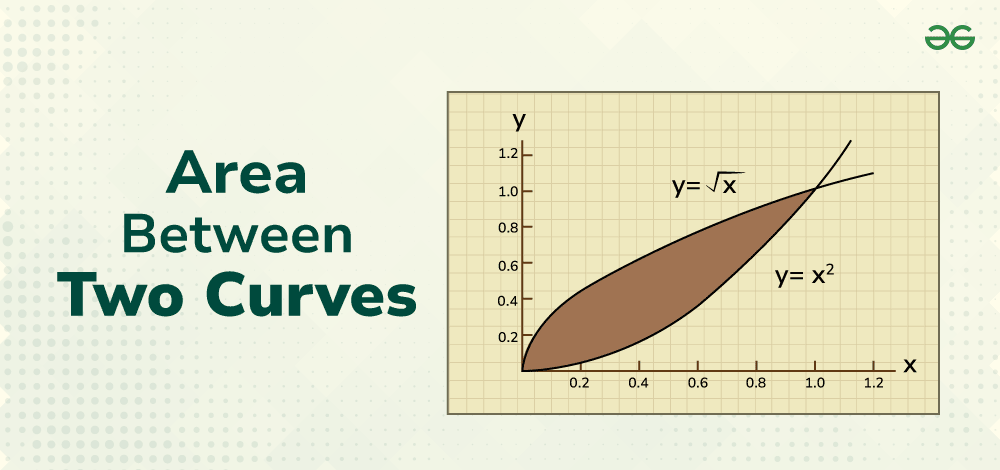
Area Between Two Curves: Formula, Definition and Examples
Let's know more about Area Between Two Curves in detail below.
Area Between Two Curves
The area between two curves is the area of the region that is bounded by two curves in a plane i.e., both curves are the boundaries of the area required. These two curves can be any function, including polynomials, trigonometric functions, exponential functions, or any other function.
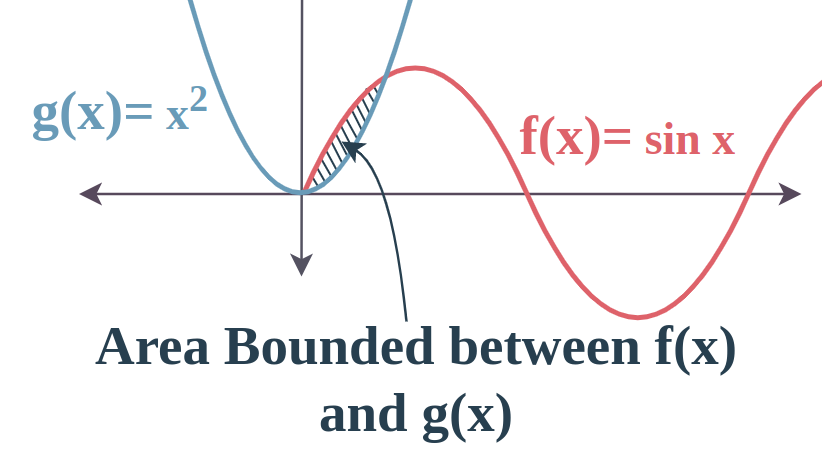
For example, let's consider two functions f(x) = sin x and g(x) = x+1. The area bounded between f(x) and g(x) is illustrated in the following diagram:
**Read More
Area between Two Curves Formula
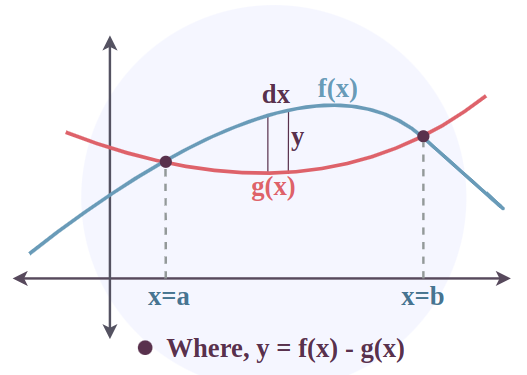
Let's assume the two curves for which we need to calculate the area between them are f(x) and g(x) and for the required domain f(x) ≥ g(x). Then the formula for finding the area between two curves is given by:
\bold{A = \int^{b}_a[f(x) - g(x)]dx}
Where,
- **a and **b are the limits of integration, which are the x-values where the curves intersect
- **A is the area between both curves
How to Find the Area Between Two Curves?
To calculate the area between two curves, use the following steps:
- **Step 1: Determine the points of intersection between the two curves by substituting value of one variable from one curve to another curve.
- **Step 2: Decide which curve has higher values in between the points of intersections if there are more than two points of intersection then check this for each possible interval.
- **Step 3: Set up the integral for the area between the two curves using the difference of both curves.
- **Step 4: Evaluate the integral using integration techniques such as u-substitution or integration by parts.
Thus, the area between two curves is calculated.
If both the curves are defined as x1 = f(y) and x2 = g(y) and all the other assumptions remain the same as above, then the area between them is given as
\bold{A = \int^{b}_a[f(y) - g(y)]dy}
Where,
- **a and **b are the limits of integration, which are the y-values where the curves intersect
- **A is the area between both curves
Area Between Two Compound Curves
In the previous formulation, we assumed that f(x) ≥ g(x) in the interval [a, b]. But it's not always the case, let's consider another case, **f(x) ≥ g(x) in [a, c] and **f(x) ≤ g(x) in [c, b], here a < c < b. So, the bounded area in this region is given in the figure below,
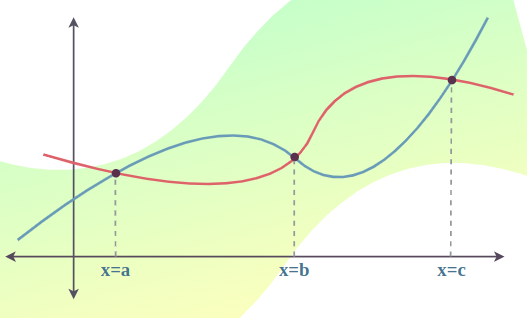
**Area Required = \bold{\int^{b}_{a}[f(x) - g(x)]dx + \int^{b}_{c}[g(x) - f(x)]dx}
Area Between Two Polar Curves
**Area between two polar curves can also be easily calculated using the same concept. The curve in polar coordinates is converted to a rectangle coordinate system.
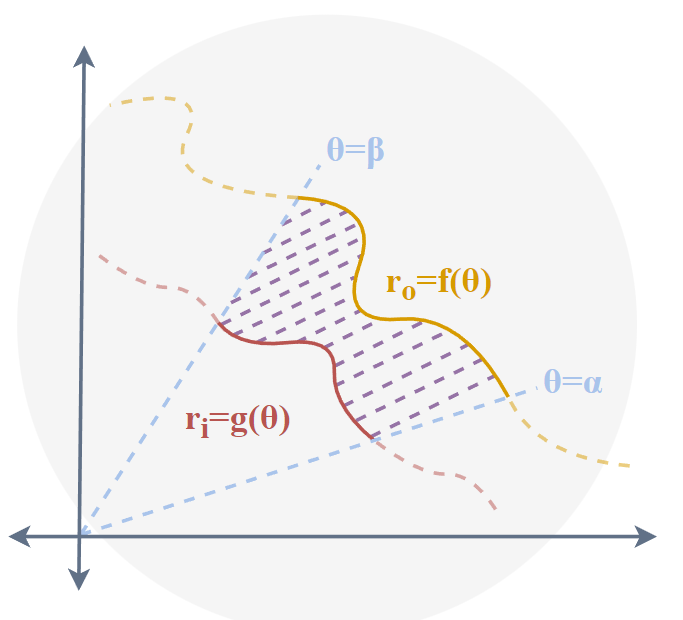
Let's take two polar curves r0 = f(θ) and ri = g(θ) as shown in the image added below, and the area enclosed between these two curves is found from α ≤ θ ≤ β where [α, β] is the bounded region. Now the area between the curves is given as,
**A = 1/2 ∫ α β {(r 0 ) 2 - (r i ****)** 2 }.dθ
**Must Read
Problems on Area Between Two Curves
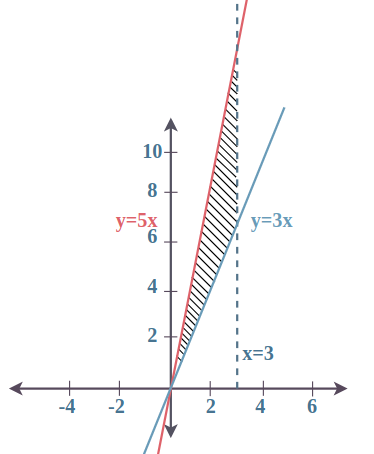
**Problem 1: Find the area bounded between two lines f(x) = 5x and g(x) = 3x from x =0 to x = 3.
**Solution:
The figure below shows both the lines,
From the figure, we know
Area = \int^{b}_a[f(x) - g(x)]dx
⇒ Area = \int^{3}_0[f(x) - g(x)]dx
⇒ Area = \int^{3}_0[5x - 3x]dx
⇒ Area = \int^{3}_0[2x]dx
⇒ Area = [x^2]^3_0
⇒ Area = 9 sq. units
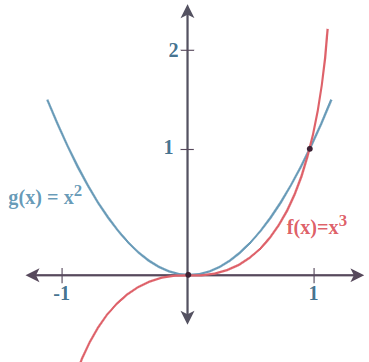
**Problem 2: Find the area bounded between two curves f(x) = x 3 and g(x) = x 2 **between 0 and 1.
**Solution:
The figure below shows both the curves, to find the bounded region, we first need to find the intersections.
f(x) = g(x)
⇒x3 = x2
⇒x2(x-1) = 0
⇒ x = 0 and 1
From the figure, we know
Area = \int^{b}_a[f(x) - g(x)]dx
⇒ Area = \int^{1}_0[f(x) - g(x)]dx
⇒ Area = \int^{3}_0[x^2 - x^3]dx
⇒ Area = \int^{1}_{0}x^2dx - \int^1_0x^3dx
⇒ Area = [\frac{x^3}{3}]^1_0 - [\frac{x^4}{4}]^1_0
⇒ Area = 1/3 - 1/4
⇒ Area = 1/12 sq. units
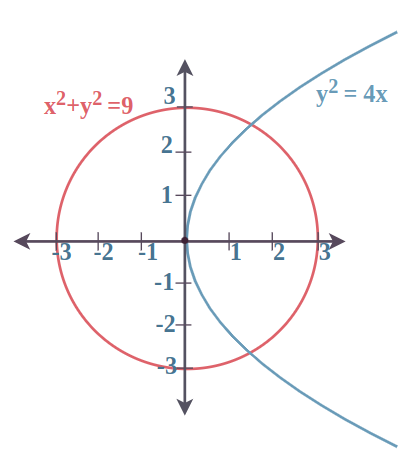
**Problem 3: Find the area bounded between the parabola y 2 = 4x and x 2 + y 2 = 9.
**Solution:
The figure below shows both the curves, to find the bounded region, we first need to find the intersections.
x2 + y2 = 12
Figure
Area = \int^{b}_a[f(x) - g(x)]dx
⇒ Area = \int^{1}_0[f(x) - g(x)]dx
⇒ Area = \int^{1}_0[x - x^2]dx
⇒ Area = \int^{1}_{0}xdx - \int^1_0x^2dx
⇒ Area = [\frac{x^2}{2}]^1_0 - [\frac{x^3}{3}]^1_0
⇒ Area = 1/2 - 1/3
⇒ Area = 1/6 sq. units
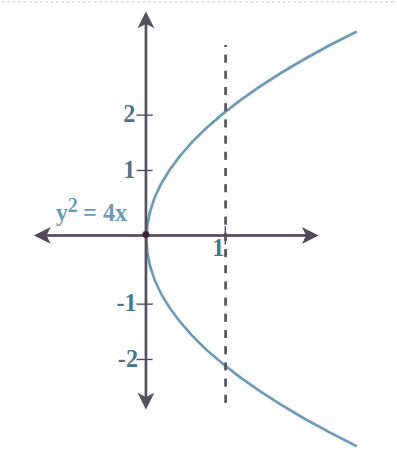
**Problem 4: Find the area bounded between the parabola y 2 = 4x and its latus rectum.
**Solution:
The figure below shows the parabola, and it's latus rectum. Latus rectum is the line x = 1. We need to find the intersections,
y2 = 4
y = 2 and -2
Area = 2(Area of the region bounded by the parabola and x = 1 and x-axis in the first quadrant)
⇒ Area = 2(\int^1_0ydx)
⇒ Area = 2\int^1_0\sqrt{4x}dx
⇒ Area = 4\int^1_0\sqrt{x}dx
⇒ Area = 4\int^1_0[\frac{x^{\frac{3}{2}}}{\frac{3}{2}}]dx
⇒ Area = \frac{8}{3}[x^{\frac{3}{2}}]^1_0
⇒ Area = 8/3 sq. units
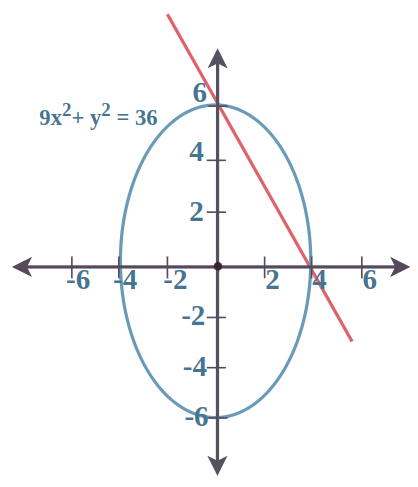
**Problem 5: The figure given below shows an ellipse 9x 2 + y 2 = 36 and a chord PQ. Find the area enclosed between the chord and the ellipse in the first quadrant.
**Solution:
The equation of ellipse is,
\frac{x^2}{4} + \frac{y^2}{36} = 1
⇒ \frac{x^2}{2^2} + \frac{y^2}{6^2} = 1
So, now the equation of the chord becomes,
⇒ \frac{x}{2} + \frac{y}{6} = 1
⇒ 3x + y = 6
⇒ y = 6 - 3x
So, now the required area will be.
A = 3\int^{2}_0 \sqrt{4 - x^2}dx - \int^{2}_{0}(6 - 3x)dx
⇒ A= 3[\frac{x}{2}\sqrt{4 - x^2} + 2sin^{-1}\frac{x}{2}]^2_0 - [6x - \frac{3x^2}{2}]^2_0
⇒ A= 6sin^{-1}(1) - 6
⇒ A = 3π - 6 sq. units