Area of Shapes (original) (raw)
Last Updated : 23 Jul, 2025
Area is the space occupied inside by the boundary of any figure. It is the total surface covered by the perimeter of the figure. It is measured in square units. It is generally calculated by multiplying the bases of the figure with its length. For example, the area of the room is its length multiplied by its breadth.
In this article we will be learning about, some figures and their areas like the square, rectangle, circle, triangle, and others.
What are Area Formulas?
Area formulas are essential tools used in mathematics to calculate the amount of space enclosed by different two-dimensional shapes. These formulas can be used to find the area of geometric figures such as squares, rectangles, circles, triangles, trapezoids, and ellipses. By using these formulas, we can accurately calculate the area of different shapes, enabling us to solve real-world problems and make important calculations.
Area Formula for Rectangle:
Rectangle is a 2-Dimensional figure which is a quadrilateral, i.e. it has four sides its opposite sides are parallel and equal. All the angles in the rectangle are equal and their measure is 90 degrees. The diagonals of the rectangle are equal and they are perpendicular bisectors of each other.
**Rectangle Formula:
The formula for calculating the area of a rectangle is,
- **Area of Rectangle (A) = l×b square units
where
**l is the length of the rectangle
**b is the breadth of the rectangle
Area Formula for Square:
Square is a 2-Dimensional figure which is a quadrilateral, i.e. it has four sides its opposite sides are parallel and all four sides in a square are equal. All the angles in the square are equal and their measure is 90 degrees. The diagonals of the square are equal and they are perpendicular bisectors of each other.
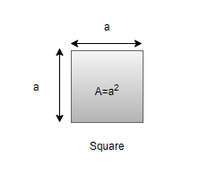
Area of Square
**Square Formula:
The formula for calculating the area of a square is,
- **Area of Square (A) = a 2 square units
where **a is the side of the square.
Area Formula for Triangle:
Triangle is the simplest polygon which is made by joining three straight lines. As the name suggests it is a polygon with three angles. The sum of the lengths of all sides of the triangle is the perimeter of the triangle and the space inside the perimeter of the triangle is the area of the triangle.
Triangle Formula:
The formula for calculating the area of a triangle is,
- **Area of Triangle (A) = 1/2×bh square units
where
**a, b and c are the sides of the square.
**h is the height of the square
Area Formula for Circle:
Circle is a geometrical figure with no straight line. It is the locus of the point that is always at a constant distance from the fixed point. The fixed point is called the centre of the circle and the fixed distance is the radius of the circle.
Circle Formula:
The formula for calculating the area of a circle is,
- **Area of Circle (A) = πr 2 units 2
- **Perimeter/Circumference of Circle (C) = 2πr units
where
**r is the radius of the circle
List of Formulas:
The list of formulas for the areas of the various figures are,
| **Figures | **Formula | **Variables |
|---|---|---|
| **Rectangle | Area = l×b | l is the lengthb is the breadth |
| **Square | Area = a2 | a is the side of the square |
| **Triangle | Area = 1/2×bh | b is the baseh is the height |
| **Circle | Area = πr2 | r is the radius of the circle |
| **Trapezoid | Area = 1/2×(a+b)h | a is the first baseb is the second base |
| **Ellipse | Area = πab | a is the radius of major axisb is the radius of minor axis |
Examples of Area Formulas Using Different Geometric Shapes
**Example 1: Find the area of a rectangle with a length of 5 cm and a breadth of 2 cm.
**Solution:
Given,
Length of the Rectangle (l) = 5 cm
Breadth of the rectangle (b) = 2 cmArea of Rectangle(A) = l × b
A = 5cm × 2cm
= 10cm2
**Example 2: Find the area of the square park whose side is 4 m.
**Solution:
Given,
Side of Square (a) = 4 m
Area of Square = a2
= (4)2 = 16 m2Thus, the area of the square park is 16 m2
**Example 3: Find the area of a triangular plate whose height is 6 cm and the base is 6 cm.
**Solution:
Given,
Height of Triangle (h) = 6 cm
Base of Triangle (b) = 8 cmArea of Triabgle(A) = 1/2(b × h)
A = 1/2(8 × 6)
= 48/2 = 24 cm2The area of the triangular plate is 24 cm2
**Example 4: Find the area of a circular disc with a radius of 1.4 cm.
**Solution:
Given,
Radius of Circle (r) = 1.4 cm
Area of Circle(A) = πr2
A = π(1.4)2
= 22/7(1.4)(1.4) = (4.4)(1.4)
= 6.16 cm2The area of the circular disc is 6.16 cm2