Axis of Symmetry of a Parabola (original) (raw)
Last Updated : 13 Apr, 2026
The axis of symmetry is an imaginary line that divides a shape into two perfect mirror-image halves. Different shapes have different numbers of symmetry axes: a square has four, a rectangle has two, a circle has infinitely many, and a parallelogram has none. In general, a regular polygon with _n sides has _n axes of symmetry.
The axes of symmetry of a pentagon are shown below:

**Parabola-Axis of Symmetry
- The axis of symmetry of a parabola is a line that divides the parabola into two mirror-image halves. This line passes through the vertex of the parabola and is perpendicular to the directrix.
- A parabola has just one symmetry line.
- Axis of symmetry of a parabola might be horizontal or vertical, and it can face left or right. The parabola's shape is determined by its symmetry axis. The parabola is vertical when its axis of symmetry is vertical and vice versa.
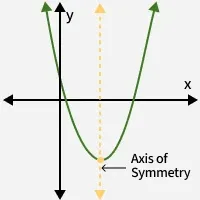
Axis of Symmetry of a Parabola
**Equation of Axis of Symmetry
For a parabola with an equation of the form ax²2 + bx + c, the axis of symmetry is
x = −b/2a
where a and b are the coefficients of x2 and x, respectively, and c is the constant.
**Derivation of Equation of Axis of Symmetry
The vertex of parabola is the only point from where the axis of symmetry passes. A vertical parabola's quadratic equation is y = ax2 + bx + c
The parabola is unaffected by the constant term 'c.'
Consider the equation y = ax2 + bx.
The axis of symmetry is the midpoint of its two x-intercepts. To find the x-intercept, substitute y = 0.
⇒ x(ax + b) = 0
⇒ x = 0 or, x = -b/a
Using the mid- point formula, we have:
⇒ x = \frac{0+[-\frac{b}{a}]}{2}
⇒ x = -b/2a
Hence proved.
**Sample Problems
**Question 1. Find the axis of symmetry of the parabola y = x²2 − 4x + 8.
**Solution:
Given****:** y = x2 − 4x + 8
Compare the given equation to the standard form ax2 + bx + c.
⇒ a = 1, b = −4, c = 8
Axis of symmetry = −b/2a
= −(−4)/2(1)
**⇒x = 2
**Question 2. Find the axis of symmetry of the parabola y = 4x2.
**Solution:
Given: y = 4x2
Compare the given equation to the standard form ax2 + bx + c.
⇒ a = 4, b = 0, c = 0
Axis of symmetry = −b/2a
= 0/2(4)
⇒ x = 0
**Question 3. Find the axis of symmetry of the parabola y = 7x2.
Solution:
Given: y = 7x2
Compare the given equation to the standard form ax2 + bx + c.
⇒ a = 7, b = 0, c = 0
Axis of symmetry = −b/2a
= 0/2(7)
⇒ x = 0
**Question 4. Find the axis of symmetry of a parabola y = x²2 + 8x − 3.
**Solution:
Given: y = x2 + 8x − 3
Compare the given equation to the standard form ax2 + bx + c.
⇒ a = 1, b = 8, c = –3
Axis of symmetry = −b/2a
= –8/2(1)
⇒ x = –4
**Question 5. Find the axis of symmetry of the parabola y = 2x2 + 12x.
**Solution:
Given: y = 2x2 + 12x
Compare the given equation to the standard form ax2 + bx + c.
⇒ a = 2, b = 12, c = 0Axis of symmetry = −b/2a
= −12/2(2)
⇒ x = −3
**Question 6. Find the axis of symmetry of the parabola y = 3x2 − 6x + 5.
**Solution:
Given: y = x2 − 6x + 5
Compare the given equation to the standard form ax2 + bx + c.
⇒ a = 1, b = −6, c = 5Axis of symmetry = −b/2a
= −(−6)/2(3)
⇒ x = 1
**Question 7. Find the axis of symmetry of the parabola y = 9x2.
**Solution:
Given: y = 9x2
Compare the given equation to the standard form ax2 + bx + c.
⇒ a = 9, b = 0, c = 0Axis of symmetry = −b/2a
= 0/2(9)
**⇒ x = 0
Practice Problems
**Problem 1: Find the axis of symmetry for the parabola given by the equation y = 2x + 4x + 1.
**Problem 2: Determine the axis of symmetry for the parabola described by y = −3x + 6x − 2.
**Problem 3: Identify the axis of symmetry for the quadratic function y = x² − 8x + 15.
**Problem 4: What is the axis of symmetry for the parabola y = −x + 10x − 25?
**Problem 5: Find the axis of symmetry for the equation y = 4x − 16x + 7.