Basis and Dimension in Vector Space (original) (raw)
Last Updated : 15 Jun, 2026
A basis and dimension are fundamental concepts in linear algebra that describe the structure of a **vector space or subspace. A basis provides a set of vectors from which every vector in the space can be generated, while the dimension indicates the number of vectors required in that basis. Together, they help determine the size and structure of a vector space.
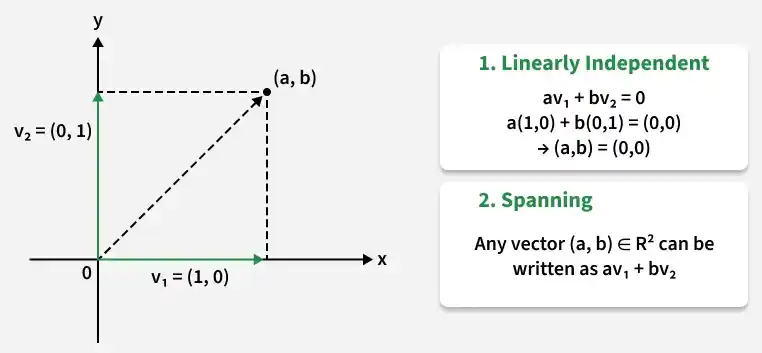
Basis of Vector Space
A basis is a set of vectors that serves as the "building blocks" of a vector space, allowing you to create any other vector in that space by scaling and combining these vectors.
**Conditions for a Basis
A set of vectors forms a basis if it satisfies the following two conditions:
- **Linear Independence: No vector in the basis can be formed by combining the others.
- **Spanning Property: Every vector in the vector space can be expressed as a linear combination of the vectors in the set.
Therefore, a basis is a linearly independent spanning set.
A subset S of a vector space V(F) is called a basis of V(F) if it satisfies two conditions:
- The set S is linearly independent.
- The set S generates V, which means every vector in V can be written as a linear combination of the vectors in S. In other words, V = ⟨S⟩, where S is the span of V.
V=Span(S) , where Span(S) = {a1v1 + a2v2 + .....anvn | ai ∈F }
The span of a set of vectors consists of all possible linear combinations of those vectors****.**
**Standard Basis
The standard basis consists of vectors having a single component equal to 1 and all other components equal to 0.
- For a 2-dimensional vector space V²(F): Standard Basis = {(1, 0), (0, 1)}
- For a 3-dimensional vector space V₃(F): Standard Basis = {(1, 0, 0), (0, 1, 0), (0, 0, 1)}
- For an n-dimensional vector space Vₙ(F): Standard Basis = {(1, 0, 0, . . . , 0), (0, 1, 0, . . . , 0), . . . , (0, 0, 0, . . . , 1)}
Dimension of Vector Space
The dimension of a vector space is the number of vectors in its basis, which represents the minimum number of independent directions needed to describe any vector in that space.
If a basis of a vector space contains n vectors, then the dimension of the space is n.
If B = {v1, v2, ..., vn} is a basis of a vector space V, then
dim(V) = n
**Example:
- In a 2D plane, two basis vectors (like [1, 0] and [0, 1]) are needed, so the dimension is 2.
- In 3D space, three basis vectors (like [1, 0, 0], [0, 1, 0], and [0, 0, 1]) are needed, so the dimension is 3.
Basis and Dimension of a Subspace
A subspace is itself a vector space. Therefore, it also has a basis and a dimension.
A basis of a subspace is a linearly independent set of vectors that spans the subspace.
The dimension of a subspace is the number of vectors in its basis.
**Example: Consider the subspace W={(x,y,z) ∈ R3 : z=0}.
Every vector in W can be written as
(x,y,0) = x(1,0,0) + y(0,1,0)
Hence, {(1,0,0),(0,1,0)} is a basis of W.
Therefore, dim(W)=2
Although W lies inside R3, it is a two-dimensional subspace.
Properties
- Every vector space has at least one basis.
- All bases of a vector space contain the same number of vectors.
- The dimension of a vector space is unique.
- A linearly independent set can be extended to form a basis.
- A spanning set can be reduced to a basis by removing dependent vectors
Solved Examples
**Example 1: Check whether the set S={(1,0),(0,1)} is a basis of R2.
To form a basis, the set must be:
- Linearly independent
- Span R2
For linear independence: a(1,0)+b(0,1) = (0,0) gives (a,b)=(0,0)
Therefore, the vectors are linearly independent.
For spanning: Any vector (x,y) ∈ R2 can be written as (x,y) = x(1,0) + y(0,1)
Hence, the set spans R2.
**Example 2: Find a basis and dimension of the subspace W={(x,y,z) ∈ R³: x+y+z=0}
From x+y+z = 0 ,we get z = −x−y
Thus, (x,y,z) = (x,y,−x−y) = (x,y,−x−y) = x(1,0,−1) + y(0,1,−1)
Therefore, W = Span{(1,0,−1),(0,1,−1)}
The two vectors are linearly independent.
Hence, {(1,0,−1),(0,1,−1)} is a basis of W.
Since the basis contains two vectors, dim(W)=2
Practice Problems
**Problem 1: Determine whether the set {(1,1), (2,2)} forms a basis of R2
**Problem 2: Find a basis and dimension of the subspace W = {(x,y,z) ∈ R3 : y=0}
**Problem 3: Find the dimension of the vector space whose basis is {(1,0,0,0),(0,1,0,0),(0,0,1,0),(0,0,0,1)}
**Problem 4: Determine whether the set {(1,0,0),(0,1,0),(0,0,1)} is a basis of R3.
**Problem 5: Find a basis and dimension of the subspace W = {(x, y, z) ∈ R3: x = y}