Calculation of Mean in Continuous Series | Formula of Mean (original) (raw)
Last Updated : 18 Jul, 2024
The mean, also known as the average, is a measure of central tendency that summarizes a set of data by identifying the central point. In a continuous series, data is grouped into class intervals, and the mean is calculated differently than in a discrete series. The mean provides a comprehensive overview of the dataset, making it useful for comparing different datasets and understanding the overall distribution
Table of Content
- What is Mean?
- Mean in Continuous Series
- Solved Examples on Calculation of Mean in Continuous Series
- Practice Problems on Calculation of Mean in Continuous Series
What is Mean?
Mean is the sum of a set of numbers divided by the total number of values. It is also referred to as the **average. **For instance, if there are four items in a series, i.e. 2, 5, 8, 3, and 9. The simple arithmetic mean is (2 + 5 + 8 + 3 + 9) / 5 = 5.4.
What is a Continuous Series?
In continuous series ****(grouped frequency distribution)**, the value of a variable is grouped into several class intervals (such as 0-5,5-10,10-15) along with the corresponding frequencies. The method used to determine the arithmetic average in a continuous series is the same as that used in a discrete series. The midpoints of several class intervals replace the class interval in a continuous series. When it is done, a continuous series and a discrete series are the same.
Example of Continuous Series
If 15 students of a class score marks between 50-60, 10 students score marks between 60-70, and 20 students score marks between 70-80, then this information will be shown as:

Mean in Continuous Series
The arithmetic mean in continuous series can be calculated by using:
- Direct Method;
- Shortcut Method; and
- Step Deviation Method
Solved Examples on Calculation of Mean in Continuous Series
Example 1
Calculate the mean of the following data using Direct Method and Short-Cut Method:
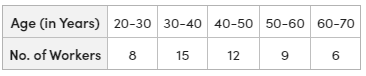
Solution:

**Direct Method:
\bar{X}=\frac{\sum{fm}}{\sum{f}}
\bar{X}=\frac{2,150}{50}
**Mean (\bar{X}) **= 43
**Short-Cut Method:
\bar{X}=A+\frac{\sum{fd}}{\sum{f}}
\bar{X}=45+\frac{(-100)}{50}
**Mean (\bar{X}) **= 43
Example 2
Find the missing frequency of the following series if the average marks is 30.5:

Solution:
Let us assume that the missing frequency is f.

\bar{X}=\frac{\sum{fm}}{\sum{f}}
30.5=\frac{920+25f}{28+f}
854 + 30.5f = 920 + 25f
5.5f = 66
f = 12
**Missing Frequency (f) = 12
Example 3:
Calculate average profit earned by 50 companies from the following data using Step Deviation Method:

Solution:

\bar{X}=A+\frac{\sum{fd'}}{\sum{f}}\times{C}
\bar{X}=50+\frac{(-15)}{50}\times{20}
\bar{X}=50-6
**Average Profit (\bar{X}) **= ₹44 Crores
Practice Problems on Calculation of Mean in Continuous Series
**1. Given the following continuous series, find the mean:
| Class Interval | Frequency (f) |
|---|---|
| 0 - 10 | 5 |
| 10 - 20 | 8 |
| 20 - 30 | 12 |
| 30 - 40 | 15 |
| 40 - 50 | 10 |
**2. Calculate the mean for the following data:
| Class Interval | Frequency (f) |
|---|---|
| 50 - 60 | 6 |
| 60 - 70 | 9 |
| 70 - 80 | 13 |
| 80 - 90 | 11 |
| 90 - 100 | 7 |
**3. Find the mean for this continuous series:
| Class Interval | Frequency (f) |
|---|---|
| 10 - 20 | 4 |
| 20 - 30 | 6 |
| 30 - 40 | 14 |
| 40 - 50 | 16 |
| 50 - 60 | 10 |
**4. Determine the mean for the following data set:
| Class Interval | Frequency (f) |
|---|---|
| 100 - 110 | 5 |
| 110 - 120 | 10 |
| 120 - 130 | 15 |
| 130 - 140 | 20 |
| 140 - 150 | 25 |