Card Probability (original) (raw)
Last Updated : 23 Jul, 2025
Card Probability is the probability of the events involving a deck of playing cards. As we know, probability is one of the important topics of mathematics which deals with the calculation of the possibility of any event. In simple words, card probability is one part of probability in which we find the probability of drawing a card from the deck of cards.
Table of Content
- What is Probability?
- What is Card Probability?
- Deck of Cards in Probability
- Types of Cards in a Deck
- Playing Card Probability
- How to Find the Probability of Cards?
- Sample Questions on Card Probability
What is Probability?
Probability is the branch of mathematics that studies the possibilities of any event happening or not. Mathematically is nothing but the ratio of the number of favorable outcomes to the total number of outcomes (sample space) for an event.
Some of the real-life examples of probability are:
- Playing card games, to find the probability of winning or losing the game.
- Weather forecasting, to predict the rain.
- Election results, to determine whether the candidate will win or lose.
- Exam results, to identify whether the candidate will pass or fail.
**Read More: Applications of Probability
Probability Formula
If E be an event with sample space S and the number of favorable outcomes are n(E) then the probability of event E i.e., P(E) is given by:
**P(E) = n(E) / n(S)
**Read More: Probability Formulas
What is Card Probability?
The probability of drawing a card or collection of cards from a deck is called Card Probability. In simple words, probability related to playing cards is called card probability. As this is the type of probability, it always lies between 0 and 1.
**For example, if we have to find the probability of drawing an ace from the deck of cards i.e., 4/52 = 1/13 [As there are 4 aces in the deck of 52 cards].
Deck of Cards in Probability
Deck of Cards is a collection of 52 cards that have been around for thousands of years. Deck of Cards or playing cards are considered to have originated either from India or China, first documented proof of these cards is found in 9th-century China during the Tang Dynasty. These cards were similar to modern-day cards and also divided into four suits but the names and symbols of those suits are different i.e., coins, strings of coins, myriads, and myriads of tens.
In the modern day, these cards come in various designs and are divided into four suits namely Spade (♠), Club (♣), Heart (\color{red}{\text{♥}}), and Diamond (\color{red}{\blacklozenge}). For a single chosen card, the sample space is 52 i.e., the total number of outcomes for a single chosen card from a deck is 52.
**n(S) for deck of cards = 52
Types of Cards in a Deck
Any deck of cards can be classified in many ways, some of the parameters on which cards can be classified are:
- Based on Colors
- Based on Suits
Let's understand this classification in detail as follows:
Based on Colors
Based on colors a deck of cards can be classified into two categories,
- Red Cards
- Black Cards
A total of 52 cards are divided equally into red and black cards which means there are 26 red cards and 26 black cards in the deck.
Based on Suits
Four suits in the deck of cards are:
- Hearts (\color{red}{\text{♥}})
- Diamonds (\color{red}{\blacklozenge})
- Clubs (♣)
- Spades (♠)
Other than these there is one more classification of cards, based on the rank of cards:
- Ace
- Number Cards
- Face Cards
Ace
Ace is one such card which either is the most important or least important based on the game. This card "A" written on it and each suit has one of such card i.e., four ace cards.
Number Cards
From 2 to 10, there are 9 cards per suit, thus there is a total of 36 such cards.
Face Cards
Face cards as the name suggests, contain a figure or face of the figure on the card. There are three cards of each suit i.e., Jack, Queen, King. Thus there are a total of 12 face cards.
All these classifications can be seen in the following table.
| **Deck Of Cards (52 cards) | ||||
|---|---|---|---|---|
| Colored Cards | Black Cards (26 cards) | Red Cards (26 cards) | ||
| Suits | Spade (13 cards) | Club (13 cards) | Heart (13 cards) | Diamond (13 cards) |
| Face Cards (12 cards in a deck and 3 cards in each suit) | K (King) | K (King) | K (King) | K (King) |
| Q (Queen) | Q (Queen) | Q (Queen) | Q (Queen) | |
| J (Jack) | J (Jack) | J (Jack) | J (Jack) | |
| Number Cards (36 cards in a deck and 9 cards in a suit) | 10 | 10 | 10 | 10 |
| 9 | 9 | 9 | 9 | |
| 8 | 8 | 8 | 8 | |
| 7 | 7 | 7 | 7 | |
| 6 | 6 | 6 | 6 | |
| 5 | 5 | 5 | 5 | |
| 4 | 4 | 4 | 4 | |
| 3 | 3 | 3 | 3 | |
| 2 | 2 | 2 | 2 | |
| Ace Cards(4 cards in a deck and 1 card in a suit) | A (Ace) | A (Ace) | A (Ace) | A (Ace) |
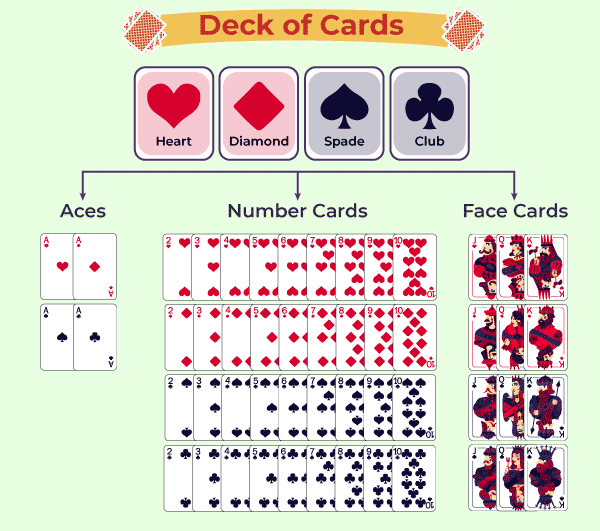
Deck of Cards Chart
The following chart represents the classification of the deck of playing cards:
Playing Card Probability
Some of the common events in card probabilities are discussed in the following table:
| Event E for drawing card | Probability P(E) |
|---|---|
| An Ace | P(E) = 4 / 52 = 1 / 13 |
| A King | P(E) = 4 / 52 = 1 / 13 |
| A Number Card | P(E) = 36 / 52 = 9 / 13 |
| A Face Card | P(E) = 12 / 52 = 3 / 13 |
| A Spade Card | P(E) = 13 / 52 = 1 / 4 |
| A Red Card | P(E) = 26 / 52 = 1 / 2 |
How to Find the Probability of Cards?
The steps to find the probability of events involving cards are the same as all the other probabilities, which are given as follows:
**Step 1: First, find the number of favourable outcomes from the given question.
**Step 2: Then, find the total number of outcomes.
**Step 3: Apply the probability formula to find the card probability.
**Example: What is the probability of drawing an ace from a deck of cards?
**Answer:
Here, E is event of drawing an ace card
Total number of outcomes in a deck n(S) = 52
Number of favorable outcomes = n(E) = drawing an ace card from deck = 4 (There are 4 ace cards in 1 deck)
P(E) = n(E) / n(S) = 4 / 52
P(E) = 1 / 13
**Probability of drawing an ace card = 1 / 13
Sample Questions on Card Probability
**Problem 1: What is the probability of drawing the following cards from a deck of cards?
- **a spade
- **a black card
- **a number card
**Solution:
(i) Here, E is event of drawing a spade card
Total number of outcomes in a deck n(S) = 52
Number of favorable outcomes = n(E) /n(s) = drawing a spade card from deck/total number of Outcomes from the deck
P(E) = n(E) / n(S) = 13 / 52
P(E) = 1 / 4**Probability of drawing a spade = 1 / 4
(ii) Here, E is event of drawing a black card
Total number of outcomes in a deck n(S) = 52
Number of favorable outcomes = n(E) = drawing a black card from deck = 26 (There are 26 black cards in 1 deck)
P(E) = n(E) / n(S) = 26 / 52
P(E) = 1 / 2**Probability of drawing a black card = 1 / 2
(iii) Here, E is event of drawing a number card
Total number of outcomes in a deck n(S) = 52
Number of favorable outcomes = n(E) = drawing a number card from deck = 36 (There are 36 number cards in 1 deck)
P(E) = n(E) / n(S) = 36 / 52
P(E) = 9 / 13**Probability of drawing a number card = 9 / 13
**Problem 2: What is the probability of drawing the following cards from a deck of cards?
- **A king or a black card
- **A red and ace card
**Solution:
(i) Here, E is event of drawing a king or a black card
Total number of outcomes in a deck n(S) = 52
Number of favorable outcomes = n(E) = drawing a king or a black card from deck = 26 + 2 = 28 (There are 26 black cards in which 2 are king and remaining 2 kings of black in 1 deck)
P(E) = n(E) / n(S) = 28 / 52
P(E) = 7 / 13**Probability of drawing a king or a black card = 7 / 13
(ii)Here, E is event of drawing a red and ace card
Total number of outcomes in a deck n(S) = 52
Number of favorable outcomes = n(E) = drawing a red and ace card from deck = 2 (There are 26 red cards in which 2 are ace cards)
According to question drawn card should be red and ace both. Therefore, n(E) = 2
P(E) = n(E) / n(S) = 2 / 52
P(E) = 1 / 26**Probability of drawing a red and ace card= 1 / 26
**Problem 3: What is the probability of drawing the following cards from a deck of cards?
- **A non-club card
- **A non-face card
**Solution:
(i) Here, E is event of drawing a non-club card
Total number of outcomes in a deck n(S) = 52
Number of favorable outcomes = n(E) = drawing a non-club card from deck = 39 (There are 13 clubs in 1 deck, non- deck = 52 - 13 = 39)
P(E) = n(E) / n(S) = 39 / 52
P(E) = 3 / 4**Probability of drawing a non-club card = 3 / 4
(ii) Here, E is event of drawing a non-face card
Total number of outcomes in a deck n(S) = 52
Number of favorable outcomes = n(E) = drawing a non-face card from deck = 40 (There are 12 face cards in 1 deck, non- deck = 52 - 12 = 40)
P(E) = n(E) / n(S) = 40 / 52
P(E) = 10 / 13**Probability of drawing a non-club card = 10 / 13
**Problem 4: What is the probability of drawing a card that is neither red nor a face card?
**Solution:
Here, E is event of drawing a neither red nor a face card
Total number of outcomes in a deck n(S) = 52
Number of favorable outcomes = n(E) = drawing neither red nor a face card from deck.
Total red cards = 26
There is total 12 face cards in a deck, but 6 red face cards are already removed. So remaining face cards = 12 - 6 = 6
Total back cards = 26
Black Face cards = 6
Black non-face cards = 26 - 6 = 20
**Probability of drawing a neither red nor a face card= 20 / 52 = 5 / 13
**Problem 5: What is the probability of drawing two cards from a deck of cards without replacement when the first card is a heart and the second card is a diamond?
**Solution:
Probability of drawing first card as heart = 13 / 52
After drawing first card, the card is removed.
Probability of drawing second card as diamond = 13 / 51
Probability of drawing first card as heart and second as diamond = (13 / 52) × (13 / 51) = 169/2652
**Probability of drawing first card as heart and second as diamond = 13/204
**Related Reads:
**Practice Questions - Card Probability
**Question 1. What is the probability of drawing an Ace from a standard 52-card deck?
**Question 2. If you draw two cards without replacement, what is the probability of getting two Hearts?
**Question 3. What is the probability of drawing a face card (Jack, Queen, or King)?
**Question 4. If you're dealt a 5-card hand, what's the probability of getting a flush (all cards of the same suit)?
**Question 5. What's the probability of drawing a red card (Hearts or Diamonds)?
**Question 6. If you draw three cards without replacement, what's the probability of getting three different suits?
**Question 7. What's the probability of drawing a card that is either a Spade or a King?
**Question 8. If you're dealt two cards, what's the probability of getting a pair (two cards of the same rank)?
**Question 9. What's the probability of drawing a card that is both red and even-numbered?
**Question 10. If you draw five cards without replacement, what's the probability that at least one of them is an Ace?
Summary
- Card probability involves calculating the likelihood of specific outcomes when drawing cards from a standard 52-card deck.
- This deck consists of four suits (hearts, diamonds, clubs, spades) with 13 ranks each (Ace through King).
- Probability is typically expressed as a fraction or percentage, calculated by dividing the number of favorable outcomes by the total number of possible outcomes.
- Key concepts include independent events (where previous draws don't affect future probabilities) and dependent events (where probabilities change after each draw without replacement).
- Common calculations involve finding the probability of drawing specific ranks, suits, or combinations of cards.
- Understanding card probability is crucial for games of chance, strategic decision-making in card games, and as a foundation for more complex probability theory.