Class 10 NCERT Solutions Chapter 3 Pair of Linear Equations in Two Variables Exercise 3.6 (original) (raw)
Last Updated : 12 Aug, 2024
Question 1. Solve the following pairs of equations by reducing them to a pair of linear equations:
(i) \frac{1}{2x} + \frac{1}{3y} = 2
\frac{1}{3x} + \frac{1}{2y}= \frac{13}{6}
**Solution:
Lets, take 1/x = a and 1/y = b
Here, the two given equation will be as follows:
\frac{a}{2} + \frac{b}{3} = 2
Multiply it by 6, we get
3a + 2b = 12 -(1)
and,
\frac{a}{3} + \frac{b}{2} = \frac{13}{6}
Multiply it by 6, we get
2a + 3b = 13 -(2)
Now, by using Elimination method,
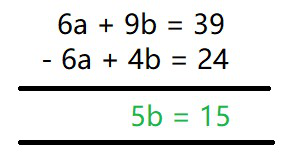
Multiply eq(1) by 2 and multiply eq(2) by 3, and then subtract them
5b = 15
b = 3
Now putting b = 3 in eq(1), we get
3a + 2(3) = 12
a = 6/3
a = 2
So, Now As
a = 1/x = 2
x = 1/2
b = 1/y = 3
y = 1/3
(ii) \frac{2}{√x} + \frac{3}{√y} = 2
\frac{4}{√x} - \frac{9}{√y} = -1
**Solution:
Lets, take 2/√x = a and 3/√y = b
Here, the two given equation will be as follows:
a + b = 2 -(1)
and,
2a - 3b =-1 -(2)
Now, by using Elimination method,
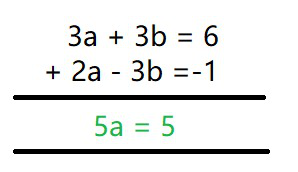
Multiply eq(1) by 3, and then add them
5a = 5
a = 1
Now putting a = 1 in eq(1), we get
1 + b = 2
b = 1
So, Now As
a = 2/√x = 1
√x = 2
x = 4
b = 3/√y = 1
√x = 3
y = 9
(iii) \frac{4}{x} + 3y = 14
\frac{3}{x} - 4y = 23
**Solution:
Lets, take 1/x = a
Here, the two given equation will be as follows:
4a + 3y = 14 -(1)
and,
3a - 4y = 23 -(2)
Now, by using Elimination method,
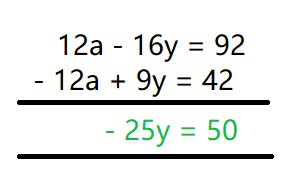
Multiply eq(1) by 3 and multiply eq(2) by 4, and then subtract them
-25y = 50
y = -2
Now putting y = -2 in eq(1), we get
4a + 3(-2) = 14
4a = 20
a = 5
So, Now As
a = 1/x = 5
x = 1/5
y = -2
(iv) \frac{5}{x-1} + \frac{1}{y-2} = 2
\frac{6}{x-1} - \frac{3}{y-2} = 1
**Solution:
Lets, take \frac{1}{x-1} = a and, \frac{1}{y-2} = b
Here, the two given equation will be as follows:
5a + b = 2 -(1)
and,
6a - 3b = 1 -(2)
Now, by using Elimination method,
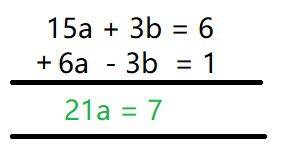
Multiply eq(1) by 3, and then add them
21a = 7
a = 1/3
Now putting a = 1/3 in eq(1), we get
5(1/3) + b = 2
b = 2 - 5/3
b = 1/3
So, Now As
a = \frac{1}{x-1} = \frac{1}{3}
x - 1 = 3
x = 4
b = \frac{1}{y-2} = \frac{1}{3}
y - 2 = 3
y = 5
(v) \frac{7x-2y}{xy} = 5
\frac{8x+7y}{xy}=15
**Solution:
\frac{7}{y} - \frac{2}{x} = 5
\frac{8}{y} + \frac{7}{x} = 15
Lets, take 1/x = a and 1/y = b
Here, the two given equation will be as follows:
7b - 2a = 5 -(1)
and,
8b + 7a = 15 -(2)
Now, by using Elimination method,
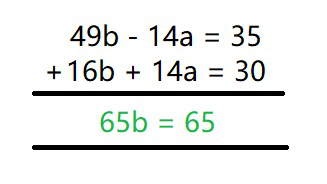
Multiply eq(1) by 7, multiply eq(2) by 2 and then add them
65b = 65
b = 1
Now putting b = 1 in eq(1), we get
7(1) - 2a = 5
2a = 7 - 5
a = 1
So, Now As
a = 1/x = 1
x = 1
b = 1/y = 1
y = 1
(vi) 6x + 3y = 6xy
2x + 4y = 5xy
**Solution:
Divide both the equations by xy, we get
\frac{6}{y} + \frac{3}{x} = 6
\frac{2}{y} + \frac{4}{x} = 5
Lets, take 1/x = a and, 1/y = b
Here, the two given equation will be as follows:
6b + 3a = 6
Divide the above equation by 2,
2b + a = 2 -(1)
and,
2b + 4a = 5 -(2)
Now, by using Elimination method,
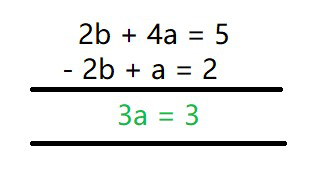
Subtract eq(1) from eq(2), we get
3a = 3
a = 1
Now putting a = 1 in eq(1), we get
2b + 1 = 2
b = 1/2
So, Now As
a = 1/x = 1
x = 1
b = 1/y = 1/2
y = 2
(vii) \frac{10}{x+y} + \frac{2}{x-y}=4
\frac{15}{x+y} - \frac{5}{x-y}=-2
**Solution:
Lets, take \frac{1}{x+y} = a and \frac{1}{x-y} = b
Here, the two given equation will be as follows:
10a + 2b = 4
Divide the above equation by 2,
5a + b = 2 -(1)
and,
15a - 5b = -2 -(2)
Now, by using Elimination method,
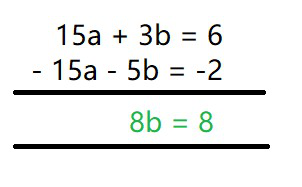
Multiply eq(1) by 3 and subtract them,
8b = 8
b = 1
Now putting b = 1 in eq(1), we get
5a + 1 = 2
a = 1/5
So, Now As
a = \frac{1}{x+y} = \frac{1}{5}
x + y = 5 -(3)
b = \frac{1}{x-y} = 1
x - y = 1 -(4)
By adding eq(3) and (4), we get
2x = 6
x = 3 and y = 2
(viii) \frac{1}{3x+y} + \frac{1}{3x-y}= \frac{3}{4}
\frac{1}{2(3x+y)} - \frac{1}{2(3x-y)} = \frac{-1}{8}
**Solution:
Lets, take \frac{1}{3x+y} = a
and, \frac{1}{3x-y} = b
Here, the two given equation will be as follows:
a + b = 3/4 -(1)
and,
\frac{a}{2} - \frac{b}{2} = \frac{-1}{8}
Multiply it by 2, we get
a - b = -1/4 -(2)
Now, by using Elimination method,
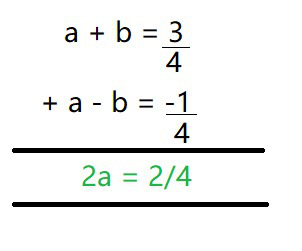
Add eq(1) and eq(1), we get
2a = 1/2
a = 1/4
Now putting a = 1/4 in eq(1), we get
\frac{1}{4} + b = \frac{3}{4}
b = 1/2
So, Now As
a = \frac{1}{3x+y} = \frac{1}{4}
3x + y = 4 -(3)
b = \frac{1}{3x-y} = \frac{1}{2}
3x - y = 2 -(4)
By adding eq(3) and eq(4), we get
6x = 6
x = 1 and y = 1
Question 2. Formulate the following problems as a pair of equations, and hence find their solutions:
(i) Ritu can row downstream 20 km in 2 hours, and upstream 4 km in 2 hours. Find her speed of rowing in still water and the speed of the current.
**Solution:
Let us consider,
Speed of Ritu in still water = x km/hr
Speed of Stream = y km/hr
Now, speed of Ritu during,
Downstream = (x + y) km/h
Upstream = (x – y) km/h
As Speed = \frac{Distance}{Time}
According to the given question,
x + y = 20/2
x + y = 10 -(1)
and,
x - y = 4/2
x - y = 2 -(2)
Add eq(1) and eq(2), we get
2x = 12
x = 6 and y = 4
Hence, speed of Ritu rowing in still water = 6 km/hr
Speed of Stream = 4 km/hr
(ii) 2 women and 5 men can together finish an embroidery work in 4 days, while 3 women and 6 men can finish it in 3 days. Find the time taken by 1 woman alone to finish the work, and also that taken by 1 man alone.
**Solution:
Let's take,
The total number of days taken by women to finish the work = x
The total number of days taken by men to finish the work = y
Work done by women in one day will be = 1/x
Work done by women in one day will be = 1/y
So, according to the question
4(\frac{2}{x} + \frac{5}{y}) = 1
And, 3(\frac{3}{x} + \frac{6}{y}) = 1
Lets, take 1/x = a and, 1/y = b
Here, the two given equation will be as follows:
4(2a + 5b) = 1
8a + 20b = 1 -(1)
and,
3(3a + 6b) = 1
9a + 18b = 1 -(2)
Now, by using Cross multiplication method,
\frac{a}{20-18} = \frac{b}{9-8} = \frac{1}{180-144}
\frac{a}{2} = \frac{b}{1} = \frac{1}{36}
a = \frac{2}{36} = \frac{1}{18}
b = 1/36
So, Now As
a = \frac{1}{x} = \frac{1}{18}
x = 18
b = \frac{1}{y} = \frac{1}{36}
y = 36
Hence, number of days taken by women to finish the work = 18 days
Number of days taken by men to finish the work = 36 days.
(iii) Roohi travels 300 km to her home partly by train and partly by bus. She takes 4 hours if she travels 60 km by train and the remaining by bus. If she travels 100 km by train and the remaining by bus, she takes 10 minutes longer. Find the speed of the train and the bus separately.
**Solution:
Lets, take
Speed of the train = x km/h
Speed of the bus = y km/h
According to the given question,
\frac{60}{x} + \frac{240}{y} = 4
\frac{100}{x} + \frac{200}{y} = \frac{25}{6}
Lets, take 1/x = a and 1/y = b
Here, the two given equation will be as follows:
60a + 240b = 4
Divide it by 4, we get
15a + 60b = 1 -(1)
and,
100a + 200b = 25/6
Divide it by 25/6, we get
24a + 48b = 1 -(2)
Now, by using Cross multiplication method,
\frac{a}{60-48} = \frac{b}{24-15} = \frac{1}{1440-720}
\frac{a}{12} = \frac{b}{9} = \frac{1}{720}
a = \frac{12}{720} = \frac{1}{60}
b = \frac{9}{720} = \frac{1}{80}
So, Now As
a = \frac{1}{x} = \frac{1}{60}
x = 60
b = \frac{1}{y} = \frac{1}{80}
y = 80
Hence, speed of the train = 60 km/h
Speed of the bus = 80 km/h
Summary
Exercise 3.6 focuses on solving pairs of linear equations using the cross-multiplication method, also known as the determinant method or Cramer's rule. This method involves expressing the solution in terms of determinants formed from the coefficients and constants of the equations. Students learn to apply this technique to solve various types of linear equation pairs, including those with fractional coefficients. The exercise reinforces the concept of determinants and provides an alternative method to substitution and elimination for solving linear equations.