Class 10 NCERT Solutions Chapter 7 Coordinate Geometry Exercise 7.3 (original) (raw)
Last Updated : 23 Jul, 2025
Chapter 7 of the Class 10 NCERT Mathematics textbook, titled "Coordinate Geometry," explores the concepts related to the coordinate plane. This chapter covers topics such as the distance formula, section formula, area of a triangle, and more. Exercise 7.3 focuses on finding the area of a triangle when the coordinates of its vertices are given. It is a crucial exercise for understanding the application of coordinate geometry in solving geometrical problems.
Class 10 NCERT Solutions - Chapter 7 Coordinate Geometry - Exercise 7.3
This section provides detailed solutions for Exercise 7.3 from Chapter 7 of the Class 10 NCERT Mathematics textbook. The solutions are designed to help students understand how to apply the formulas for finding the area of a triangle using the coordinates of its vertices.
Question 1. Find the area of the triangle whose vertices are:
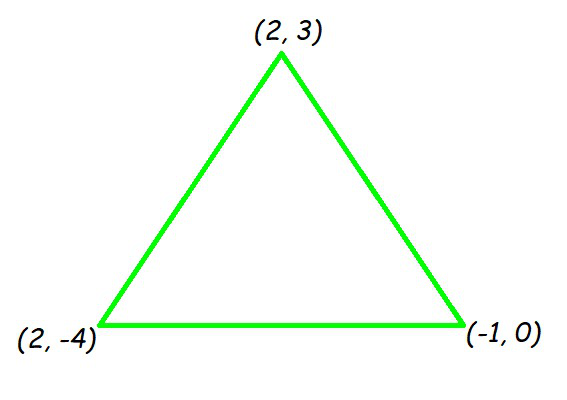
(i) (2, 3), (-1, 0), (2, -4)
**Solution:
Area = 1/2 [x1(y2 - y3) + x2(y3 - y1) + x3(y1 - y2)]
Now by putting all the values in the formula, we will get
Area of triangle = 1/2 [2(0 - (-4)) + (-1)((-4) - (3)) + 2(3 - 0)]
= 1/2 [8 + 7 + 6]
= 21/2
So, the area of triangle is 21/2 square units.
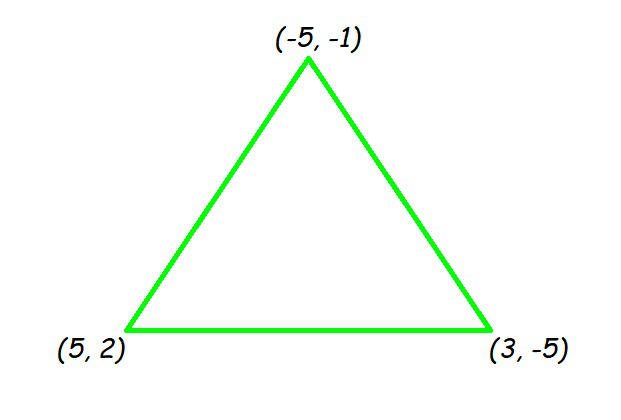
(ii) (-5, -1), (3, -5), (5, 2)
**Solution:
Area = 1/2 [x1(y2 - y3) + x2(y3 - y1) + x3(y1 - y2)]
Area of the triangle = 1/2 [(-5)((-5) - (2)) + 3(2 - (-1)) + 5((-1) - (-5))]
= 1/2[35 + 9 + 20]
= 32
So, the area of the triangle is 32 square units.
Question 2. In each of the following find the value of ‘k’, for which the points are collinear.
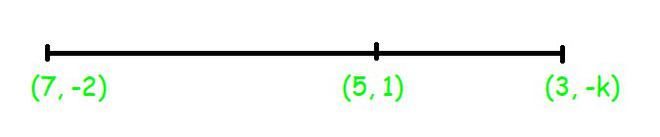
(i) (7, -2), (5, 1), (3, -k)
**Solution:
As we know the result, for collinear points, area of triangle formed by them is always zero.
Let points (7, -2) (5, 1), and (3, k) are vertices of a triangle. (As given in the question)
Area of triangle = 1/2 [7(1 - k) + 5(k - (-2)) + 3((-2) - 1)] = 0
7 - 7k + 5k +10 -9 = 0
-2k + 8 = 0
k = 4
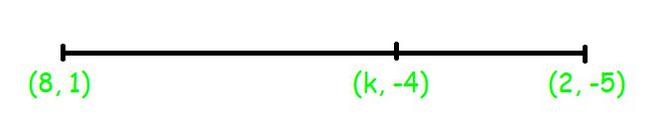
(ii) (8, 1), (k, -4), (2, -5)
**Solution:
As we know the result, for collinear points, area of triangle formed by them is zero.
So we can say that for points (8, 1), (k, - 4), and (2, - 5), area = 0
1/2 [8((-4) - (-5)) + k((-5) - (1)) + 2(1 -(-4))] = 0
8 - 6k + 10 = 0
6k = 18
k = 3
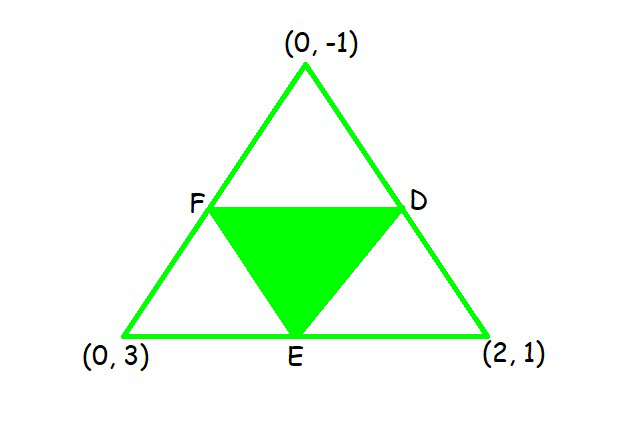
Question 3. Find the area of the triangle formed by joining the mid-points of the sides of the triangle whose vertices are (0, -1), (2, 1), and (0, 3). Find the ratio of this area to the area of the given triangle.
**Solution:
Let us assume that vertices of the triangle be A(0, -1), B(2, 1), C(0, 3).
Let us assume that D, E, F be the mid-points of the sides of triangle.
Coordinates of D, E, and F are
D = ((0 + 2)/2, (-1 + 1)/2) = (1, 0)
E = ((0+ 0)/2, (-1 + 3)/2) = (0, 1)
F = ((2+0)/2, (1 + 3)/2) = (1, 2)
Area(ΔDEF) = 1/2 [1(2 - 1) + 1(1 - 0) + 0(0 - 2)] = 1/2 (1+1) = 1
Area of ΔDEF is 1 square units
Area(ΔABC) = 1/2 [0(1 - 3) + 2(3 - (-1)) + 0((-1) - 1)] = 1/2 [8] = 4
Area of ΔABC is 4 square units
So, the required ratio is 1:4.
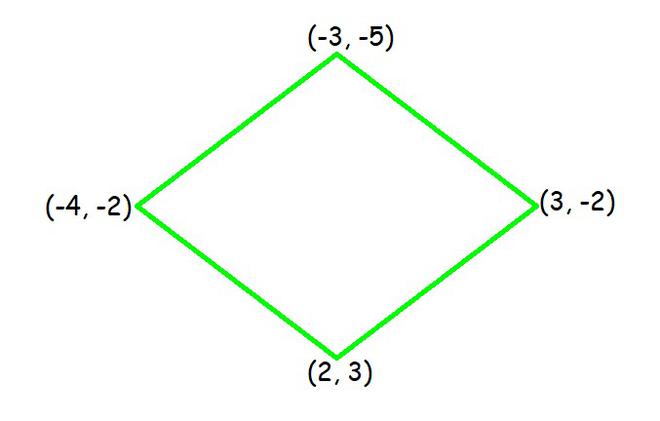
Question 4. Find the area of the quadrilateral whose vertices, taken in order, are (-4, -2), (-3, -5), (3, -2), and (2, 3).
**Solution:
Let the vertices of the quadrilateral be A(-4, -2), B(-3, -5), C(3, -2), and D(2, 3).
Here, AC divide quadrilateral into two triangles.
Now, we have two triangles ΔABC and ΔACD.
Area of ΔABC = 1/2 [(-4)((-5) - (-2)) + (-3)((-2) - (-2)) + 3((-2) - (-5))]
= 1/2 [12 + 0 + 9]
= 21/2 square units
Area of ΔACD = 1/2 [(-4)((-2) - (3)) + 3((3) - (-2)) + 2((-2) - (-2))]
= 1/2 [20 + 15 + 0]
= 35/2 square units
Now we will add area of both triangle and resultant will give area of quadrilateral
Area of quadrilateral ABCD = Area of ΔABC + Area of ΔACD
= (21/2 + 35/2) square units = 28 square units
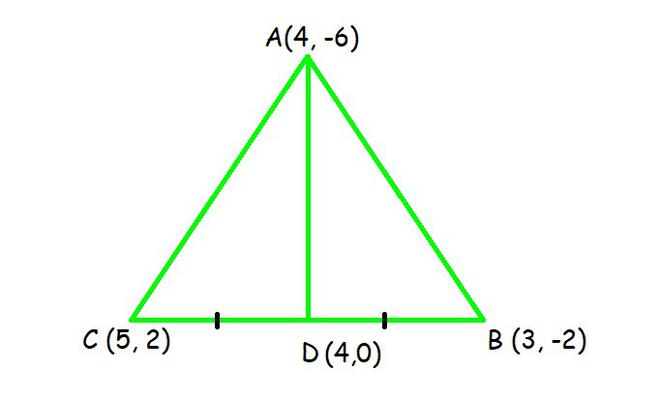
Question 5. You have studied in Class IX that a median of a triangle divides it into two triangles of equal areas. Verify this result for ΔABC whose vertices are A (4, -6), B (3, -2), and C (5, 2).
**Solution:
Let the vertices of the triangle be A(4, -6), B(3, -2), and C(5, 2).
Let us assume that D be the mid-point of side BC of ΔABC. So, AD is the median in ΔABC.
Coordinates of point D = Midpoint of BC = (4, 0)
Formula: Area = 1/2 [x1(y2 - y3) + x2(y3 - y1) + x3(y1 - y2)]
Now,
Area of ΔABD = 1/2 [(4)((-2) - (0)) + 3((0) - (-6)) + (4)((-6) - (-2))]
= 1/2 [-8 + 18 - 16]
= -3 square units
As we know that, area cannot be negative. So, the area of ΔABD is 3 square units.
Area of ΔACD = 1/2 [(4)(0 - (2)) + 4((2) - (-6)) + (5)((-6) - (0))]
= 1/2 [-8 + 32 - 30]
= -3 square units
As we know that, area cannot be negative. So, the area of ΔACD is 3 square units.
The area of both sides is same.
So we can say that, median AD has divided ΔABC in two triangles of equal areas.