Class 10 RD Sharma Solutions Chapter 10 Circles Exercise 10.2 | Set 2 (original) (raw)
Last Updated : 23 Jul, 2025
In Chapter 10 of RD Sharma's Class 10 Mathematics textbook, titled "Circles," Exercise 10.2 | Set 2 focuses on the advanced problems related to circles. This exercise challenges students to apply their understanding of the circle properties and theorems in solving the geometric problems. Mastery of this chapter is crucial for the solving more complex geometrical problems and for the standardized tests.
Trigonometric Functions - Miscellaneous
The Trigonometric functions are crucial in understanding the various geometric and physical phenomena. They involve the study of the relationships between the angles and sides of the triangles. For circle-related problems, trigonometric functions help in solving the problems involving angles arc lengths and segment areas. Common functions include the sine, cosine and tangent which are used to the derive and prove theorems related to the angles and distances in circles.
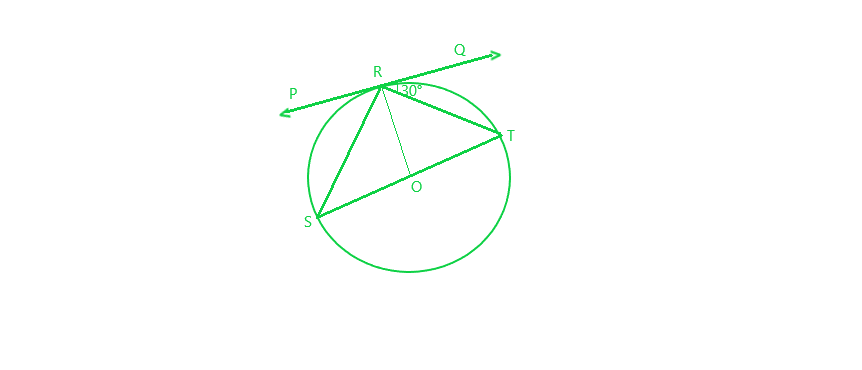
Question 11. In the figure, PQ is tangent at a point R of the circle with centre O. If ∠TRQ = 30°, find m ∠PRS
**Solution:
∠TRQ = 30° and PQ is tangent at point R
To Find: ∠PRS
Now ∠SRT = 90° (angle in a semicircle)
Also, ∠TRQ + ∠SRT + ∠PRS = 180° (Angles of a line)
=> 30° + 90° + ∠PRS = 180°
=> ∠PRS = 180° - 120°
=> ∠PRS = 60°
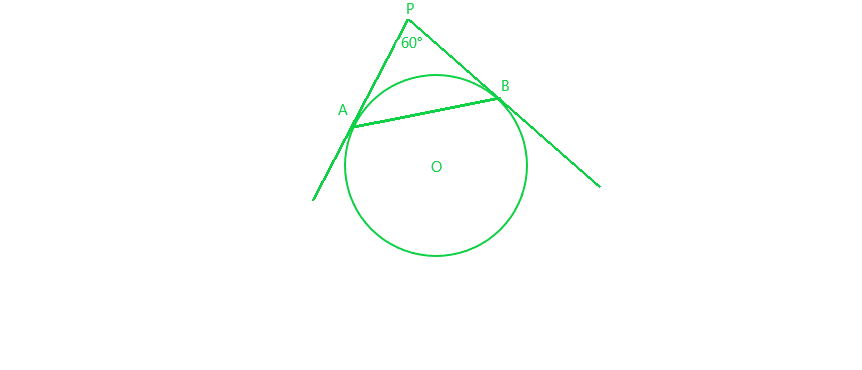
Question 12. If PA and PB are tangents from an outside point P, such that PA = 10 cm and ∠APB = 60°. Find the length of chord AB.
**Solution:
PA = 10 cm and ∠APB = 60°
We also know that
PA = PB = 10 cm (Tangents drawn from a point outside the circle are equal)
=> ∠PAB = ∠PBA
Now, In ∆APB, we have:
∠APB + ∠PAB + ∠PBA = 180° (Angles of a triangle)
=> 60° + ∠PAB + ∠PAB = 180°
=> 2 ∠PAB = 180° – 60° = 120°
=> ∠PAB = 60°
∠PBA = ∠PAB = 60°
Hence. PA = PB = AB = 10 cm
Thus, length of chord AB = 10 cm
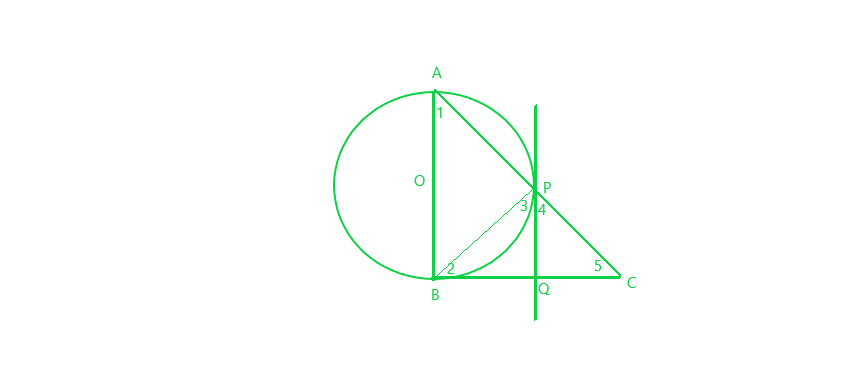
Question 13. In a right triangle ABC in which ∠B = 90°, a circle is drawn with AB as diameter intersecting the hypotenuse AC at P. Prove that the tangent to the circle at P bisects BC.
**Solution:
Given: Let O be the centre of the circle with diameter AB.
Tangents to the circle at P meets BC at Q.
To Prove: PQ bisects BC, i.e., BQ = QC
Proof:
∠ABC = 90°
In ∆ABC, ∠1 + ∠5 = 90° [angle sum property, ∠ABC = 90°]
∠3 = ∠1 [angle between tangent and the chord equals angle made by the chord in alternate segment]
=> ∠3 + ∠5 = 90° (1)
And, ∠APB = 90° [angle in semi-circle]
=> ∠3 + ∠4 = 90° (2) [∠APB + ∠BPC = 180°, linear pair]
From Equation (1) and (2), we get
∠3 + ∠5 = ∠3 + ∠4
∠5 = ∠4
=> PQ = QC (3) [sides opposite to equal angles are equal]
Also, QP = QB (4) [tangents drawn from an internal point to a circle are equal]
From equation (3) and (4), we get:
=> QB = QC
Thus, PQ bisects BC is proved
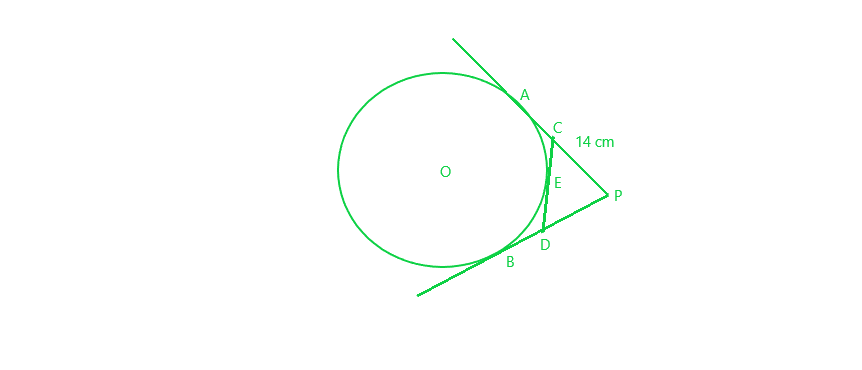
Question 14. From an external point P, tangents PA and PB are drawn to a circle with centre O. If CD is the tangent to the circle at a point E and PA = 14 cm, find the perimeter of ∆PCD.
**Solution:
PA = 14 cm
PA = PB = 14 cm (PA and PB are the tangents to the circle from P)
Also,
CA = CE (1) (CA and CE are the tangents from C)
DB = DE (2) (DB and DE are the tangents from D)
So, perimeter of ∆PCD:
= PC + PD + CD
=> PC + PD + CE + DE
=> PC + CE + PD + DE
=> PC + CA + PD = DB (From (1) and (2))
=> PA + PB
=> 14 cm + 14 cm
= 28 cm
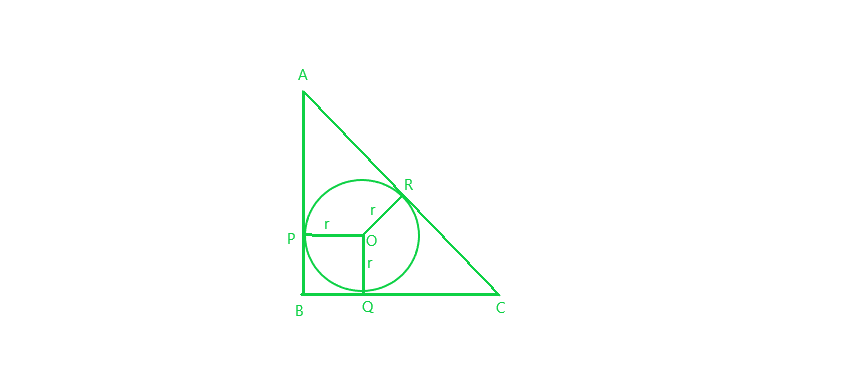
Question 15. In the figure, ABC is a right triangle right-angled at B such that BC = 6 cm and AB = 8 cm. Find the radius of its incircle.
**Solution:
∠B = 90°, BC = 6 cm, AB = 8 cm and r be the radius of incircle with centre O
Applying Pythagoras Theorem in right-angled ∆ABC:
AC² = AB² + BC²
=> AC² = (8)² + (6)² = 64 + 36 = 100
=> AC = 10 cm
=> AR + CR = 10 cm (1)
Now, AP = AR (AP and AR are the tangents to the circle from A)
Similarly, CR = CQ and BQ = BP
OP and OQ are radii of the circle = r (2)
OP ⊥ AB and OQ ⊥ BC (3) (angle between the radius to the point of contact of tangent is 90°)
and ∠B = 90° (4)
From equation (2), (3) and (4):
BPOQ is a square
=> BP = BQ = r
=> AR = AP = AB – BD = 8 – r (5)
and CR = CQ = BC – BQ = 6 – r (6)
From equation (1), (5) and (6), we get:
AR + CR = 10
=> 8 – r + 6 – r = 10 (from (5) and (6))
=> 14 – 2r = 10
=> 2r = 14 – 10 = 4
=> r = 2
Radius of the incircle = 2 cm
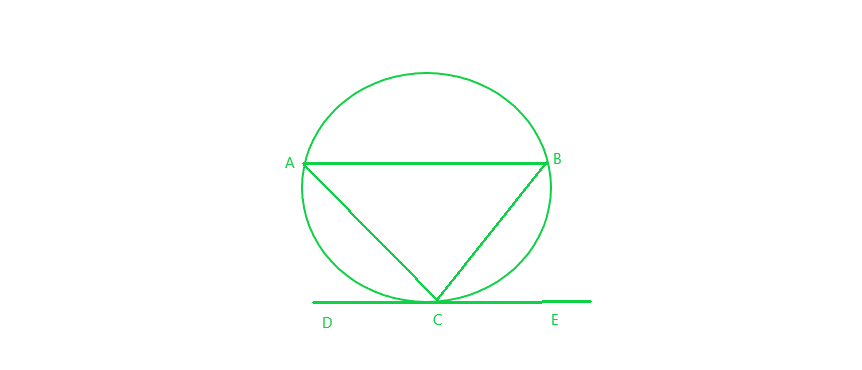
Question 16. Prove that the tangent drawn at the mid-point of an arc of a circle is parallel to the chord joining the endpoints of the arc.
**Solution:
Given: Let mid-point of arc ACB be C and, DCE be the tangent to it
To prove: AB || DCE
Proof:
Arc AC = Arc BC
=> Chord AC = Chord BC
Now, In ∆ABC,
AC = BC
=> ∠CAB = ∠CBA (1) (equal sides corresponding to the equal angle)
Since, DCE is a tangent line.
∠ACD = ∠CBA (angle in alternate segment are equal)
=> ∠ACD = ∠CAB (from Eq. (1))
=> ∠ACD and ∠CAB are alternate angles
Which is only possible only when AB || CDE
Hence, the tangent drawn at the mid-point of an arc of a circle is parallel to the chord joining the end points of the arc.
Question 17. From a point P, two tangents PA and PB are drawn to a circle with centre O. If OP = diameter of the circle show that ∆APB is equilateral.
**Solution:
Given : Two tangents PA and PB are drawn to the circle and OP is diameter
To prove: ∆APB is equilateral
Proof: OP = 2r (let r be the radius of the circle)
=> OQ + QP = 2r
=> OQ = QP = r (OQ is the radius)
Now in right ∆OAP,
OP is the hypotenuse and Q is the mid point of it
=> OA = AQ = OQ (mid-point of hypotenuse of a right triangle is equidistant from its vertices)
Thus, ∆OAQ is equilateral triangle
=> ∠AOQ = 60°
Also, ∠APO = 90° – 60° = 30° (Sum of all the angles of triangle is 180° )
=> ∠APB = 2 ∠APO = 2 x 30° = 60° (1)
We also know that, PA = PB (Tangents from P to the circle)
=> ∠PAB = ∠PBA (2)
Now, in ∆APB:
∠PBA + PAB + ∠APB = 180° (Sum of all angles)
=> 2∠PBA = 120° (from (1) and (2))
=> ∠PAB = ∠PBA = 60°
Hence, ∆APB is an equilateral triangle.

Question 18. Two tangents segments PA and PB are drawn to a circle with centre O such that ∠APB = 120°. Prove that OP = 2 AP.
Solution:
Given : Two tangents to the circle from a point P and ∠APB = 120°
To prove : OP = 2 AP
Proof : In right ∆OAP,
∠OPA = (1/2)∠APB = 60°
=> ∠AOP = 90° – 60° = 30°
Let, Q be mid point of hypotenuse OP of ∆OAP
=> QO = QA = QP
=> ∠OAQ = ∠AOQ = 30°
=> ∠PAQ = 90° – 30° = 60°
So, ∆AQP is an equilateral triangle
=> QA = QP = AP (1)
Also, Q is mid point of OP
=> OP = 2 QP = 2 AP (from (1))
Hence, proved.

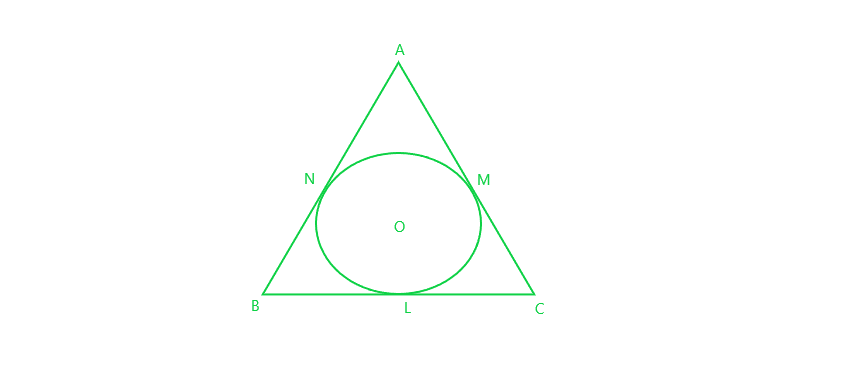
Question 19. If ∆ABC is isosceles with AB = AC and C (0, r) is the incircle of the ∆ABC touching BC at L. Prove that L bisects BC.
**Solution:
Given: ∆ABC isosceles with AB = AC and incircle with centre O and radius r touches the side BC of ∆ABC at L.
To prove : L is mid point of BC.
Proof : AM and AN are the tangents to the circle from A
=> AP = AQ
But AB = AC (given)
=> AB – AQ = AC – AP
=> BQ = CP (1)
Now BL and BQ are the tangents from B
=> BL = BQ (2)
Similarly, CL and CP are tangents
=> CL = CP (3)
Also, BQ = CP (from (1))
=> BL = CL (from (2) and (3))
Hence, proved that L is mid point of BC.