Class 10 RD Sharma Solutions Chapter 14 Coordinate Geometry Exercise 14.1 (original) (raw)
Last Updated : 24 Sep, 2024
Exercise 14.1 focuses on the distance formula in coordinate geometry. Students learn to calculate the distance between two points on a coordinate plane using the Pythagorean theorem. This exercise lays the foundation for more complex concepts in coordinate geometry and has practical applications in various fields.
Coordinate Geometry is a mathematical approach that uses algebraic equations to describe geometric shapes and relationships on a coordinate plane. It allows us to represent geometric figures as sets of points on a grid and analyze their properties using algebraic methods.
Key aspects of Coordinate Geometry include:
- Coordinate system: It uses a system of perpendicular lines (usually x and y axes) to create a grid on which points can be located.
- Points: Each point on the plane is represented by an ordered pair of numbers (x, y).
- Distance formula: It provides a way to calculate the distance between any two points on the plane.
- Midpoint formula: This allows for finding the coordinates of the point halfway between two given points.
- Slope: It measures the steepness of a line and can be calculated using coordinates.
- Equations of lines and curves: Geometric shapes are represented by algebraic equations.
- Transformations: These include methods for rotating, translating, or scaling shapes on the coordinate plane.
Coordinate Geometry provides a powerful framework for solving geometric problems algebraically and for visualizing algebraic relationships geometrically. It's widely used in various fields including physics, engineering, computer graphics, and navigation systems.
**Problem 1: On which axis do the following points lie?
****(i) P (5, 0)**
**Solution:
As its ordinate is 0. So, it lies on x-axis.
****(ii) Q (0, -2)**
**Solution:
As its abscissa is 0. So, it lies on y-axis (negative half).
****(iii) R (-4, 0)**
**Solution:
As its ordinate is 0. So, it lies on x-axis (negative half).
****(iv) S (0, 5)**
**Solution:
As its abscissa is 0. So, it lies on y-axis.
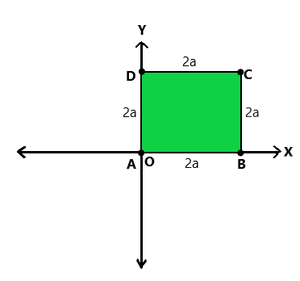
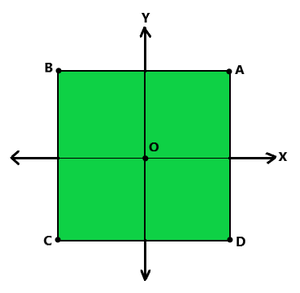
**Problem 2: Let ABCD be a square of side 2a. Find the coordinates of the vertices of this square when -
****(i) A coincides with the origin and AB and AB and coordinate axes are parallel to the sides AB and AD respectively.**
****(ii) The centre of the square is at the origin and coordinate axes are parallel to the sides AB and AD respectively.**
**Solution:
(I)
(II)
****(i)** Coordinate of the vertices of the square ABCD of side 2a will be - A(0, 0), B(2a, 0), C(2a, 2a) and D(0, 2a)
****(ii)** Coordinate of the vertices of the square ABCD of side 2a will be - A(a, a), B(-a, a), C(-a, -a) and D(a, -a)
**Problem 3: The base PQ of two equilateral triangles PQR and PQR’ with side 2a lies along y- axis such that the mid-point of PQ is at the origin. Find the coordinates of the vertices R and R’ of the triangles.
**Solution:
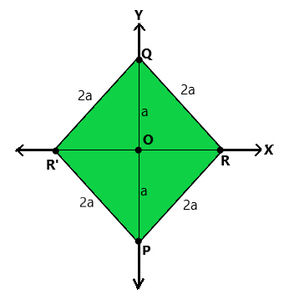
Here, We have two equilateral triangles PQR and PQR' with side 2a lying along y-axis.
O is the mid-point of PQ.
Now, in ∆QOR, ∠QOR = 90°
Now, By using Pythagoras theorem -
OR2 + OQ2 = QR2
OR2 = (2a)2 – (a)2
OR2 = 3a2
OR = (√3)a
Thus, the coordinate of vertex R is (√3 a, 0) and coordinate of vertex R' is (-√3 a, 0
Summary
Exercise 14.1 from RD Sharma's Class 10 Coordinate Geometry chapter introduces students to the fundamental concept of distance calculation in a coordinate plane. Through a series of problems, students apply the distance formula derived from the Pythagorean theorem to find distances between points, determine the nature of triangles, verify if points lie on specific geometric shapes, and solve real-world application problems. This exercise builds a strong foundation for more advanced topics in coordinate geometry, such as finding midpoints, calculating areas of polygons, and understanding the equations of lines and circles. By mastering these concepts, students develop spatial reasoning skills and prepare for more complex mathematical analyses in higher studies and various practical applications in fields like physics, engineering, and computer graphics.