Class 10 RD Sharma Solutions Chapter 5 Trigonometric Ratios Exercise 5.1 | Set 3 (original) (raw)
Last Updated : 23 Jul, 2025
**Trigonometry is a fundamental branch of mathematics that deals with the relationships between the angles and sides of triangles. Chapter 5 of RD Sharma's Class 10 textbook focuses on the Trigonometric Ratios which are the foundation of trigonometry. In this chapter, students will learn to apply these ratios to solve various problems involving the right-angled triangles. This exercise provides the practice problems that will help solidify the understanding of the trigonometric concepts.
Trigonometric Ratios
The Trigonometric Ratios are the ratios of the sides of a right-angled triangle with the respect to its angles. The primary ratios are sine, cosine, and tangent which are defined as the ratio of the opposite side to the hypotenuse adjacent side to the hypotenuse and opposite side to the adjacent side respectively. These ratios are essential in****,** solving problems related to angles and distances.
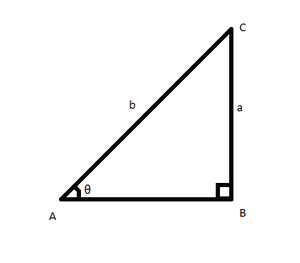
Question 22. If sinθ = a/b, find secθ + tanθ in terms of a and b.
**Solution:
Given:
**sinθ = a/b
From Pythagoras theorem,
AC2 = BC2 + AB2
b2 = a2 + AB2
AB2=\sqrt{(b^2-a^2)}
Now,
= secθ + tanθ
=\frac{b}{\sqrt(b^2-a^2)}+\frac{a}{\sqrt(b^2-a^2)}
=\frac{b+a}{\sqrt(b^2-a^2)}
=\frac{(\sqrt(b+a))^2}{\sqrt(b-a)\sqrt(b+a)}
=\frac{\sqrt(b+a)}{\sqrt(b-a)}
=\sqrt\frac{b+a}{b-a}
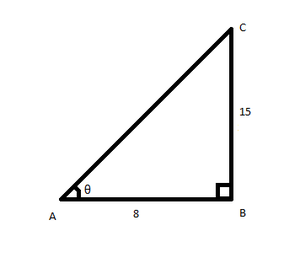
Question 23. If 8tanA = 15, find sin A − cos A.
**Solution:
Given:
8tanA = 15
tanA = 15/8
From pythagoras theorem,
AC2 = BC2 + AB2
AC2 = 152 + 82
AC2 = 225 + 64 = 289
AC = 17
Now,
= sin A − cos A
= 15/17 - 8/17
= (15 - 8)/17
= 7/17
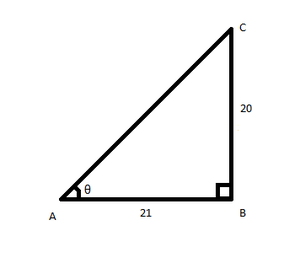
Question 24. If tanθ = 20/21, show that \frac{1−sinθ+cosθ}{1+sinθ+cosθ}=\frac{3}{7} .
**Solution:
Given: tanθ = 20/21
From Pythagoras theorem,
AC2 = BC2 + AB2
AC2 = 202 + 212
AC2 = 400 + 441 = 841
AC = 29
Now, taking LHS
=\frac{1−sinθ+cosθ}{1+sinθ+cosθ}
=\frac{1−\frac{20}{29}+\frac{21}{29}}{1+\frac{20}{29}+\frac{21}{29}}
=\frac{29-20+21}{29+20+21}
= 30/70
= 3/7
Question 25. If cosec A = 2, find the value of \frac{1}{tanA}+\frac{sinA}{1+cosA} .
**Solution:
Given:
cosec A = 2
We know
sin A = 1/cosecA = 1/2
And, sin 30° = 1/2
A = 30°
tan30° = 1/√3 and cos30° = √3/2
Now,
= \frac{1}{tanA}+\frac{sinA}{1+cosA}
= \frac{1}{\frac{1}{\sqrt3}}+\frac{\frac{1}{2}}{1+\frac{\sqrt3}{2}}
= \sqrt3+\frac{\frac{1}{2}}{\frac{2+\sqrt3}{2}}
= \sqrt3+\frac{1}{2+\sqrt3}
= \frac{2\sqrt3+3+1}{2+\sqrt3}
= \frac{2\sqrt3+4}{2+\sqrt3}= 2
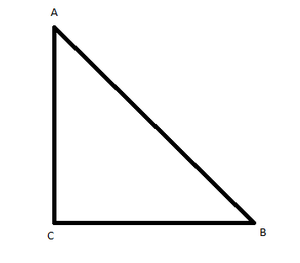
Question 26. If ∠A and ∠B are acute angles such that cos A = cos B, then show that ∠A = ∠B.
**Solution:
Let us consider a △ABC
From the figure,
Given,
cos A = cos B
AC/AB = BC/AB
Multiplying both side by AB
(AC/AB) × AB = (BC/AB) × AB
AC = BC
In △ABC, AC = BC So we can say that the triangle is an isosceles triangle,
and in an isosceles triangle we know that if two sides of a triangle are equal,
then the angle opposite to the sides are equal.
Therefore, ∠A =∠B
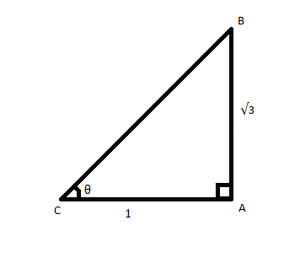
Question 27. In a Δ ABC, right angled at A, if tanC = √3, find the value of sin B cos C + cos B sin C.
**Solution:
In right angled Δ ABC,
Given: tan C = √3
∴AB = √3 and AC = 1
From pythagoras theorem,
BC2 = AB2 + AC2
BC2 = (√3)2 + 12
BC2 = 3 + 1 = 4
BC = 2
Therefore,
sin B cos C + cos B sin C
= (1/2)(√3/2) + (√3/2)(√3/2)
= 1/4 + 3/4
= 4/4
= 1
Question 28. State whether the following are true or false. Justify your answer.
(i) The value of tan A is always less than 1.
**Solution:
**FALSE. The value of tan A is not always less than 1.
Consider the Pythagorean triplet, 13, 12, and 5
where, 13 is the hypotenuse
We know
tan A = Perpendicular/Base
Let Perpendicular = 12 and Base = 5
then, tanA = 12/5 = 2.4 which is greater than 1.
(ii) sec A = 12/5 for some value of angle A.
**Solution:
**TRUE
We have sec A = 12/5 for some value of ∠A
secθ = Hypotenuse/Base
In a right angled triangle, hypotenuse is the greatest side.
So secθ > 1 is valid
Here, secθ = 12/5
(iii) cos A is the abbreviation used for the cosecant of angle A.
**Solution:
**FALSE
cos A means cosine of ∠A
cos A = Base/Hypotenuse
However,
cosec A = Hypotenuse/Perpendicular
(iv) cot A is the product of cot and A.
**Solution:
**FALSE
cot A means Cotangent of ∠A
cot A = 1/tanA
Only "cot" doesn't defines anything.
Hence, cot A is not the product of cot and A.
(v) sinθ = 4/3 for some angle θ.
**Solution:
**FALSE
sinθ = 4/3 for some value of ∠θ
We have,
sinθ = Perpendicular/Hypotenuse
In a right angled triangle, hypotenuse is the greatest side.
So sinθ is always less than 1.
Here, sinθ = 4/3 = 1.3 which is greater than 1
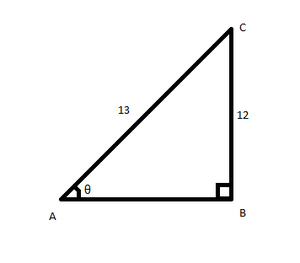
Question 29. If sinθ = 12/13, find the value of \frac{sin^2θ-cos^2θ}{2sinθcosθ}×\frac{1}{tan^2θ} .
**Solution:
Given:
sinθ = 12/13
Using Pythagoras theorem,
AC2 = BC2 + AB2
132 = 122 + AB2
AB2 = 169 − 144 = 25
AB = 5
= \frac{sin^2θ-cos^2θ}{2sinθcosθ}×\frac{1}{tan^2θ}
= \frac{(\frac{12}{13})^2-(\frac{5}{13})^2}{2(\frac{12}{13})(\frac{5}{13})}×\frac{1}{(\frac{12}{5})^2}
= \frac{\frac{144}{169}-\frac{25}{169}}{\frac{120}{169}}×\frac{25}{144}
= \frac{\frac{144-25}{169}}{\frac{120}{169}}×\frac{25}{144}
= \frac{119}{120}×\frac{25}{144}
= 595/3456
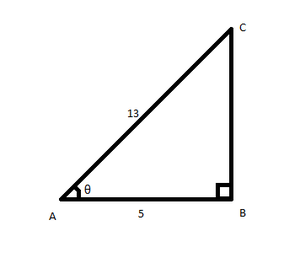
Question 30. If cosθ = 5/13, find the value of \frac{sinθ-cos^2θ}{2sinθcosθ}×\frac{1}{tan^2θ} .
**Solution:
Given:
cosθ = 5/13
Using Pythagoras theorem,
AC2 = BC2 + AB2
132 = BC2 + 52
BC2 = 169 − 25 = 144
BC = 12
= \frac{sinθ-cos^2θ}{2sinθcosθ}×\frac{1}{tan^2θ}
= \frac{(\frac{12}{13})-(\frac{5}{13})^2}{2(\frac{12}{13})(\frac{5}{13})}×\frac{1}{(\frac{12}{5})^2}
= \frac{\frac{144}{169}-\frac{25}{169}}{\frac{120}{169}}×\frac{25}{144}
= \frac{\frac{144-25}{169}}{\frac{120}{169}}×\frac{25}{144}
= \frac{119}{120}×\frac{25}{144}
= 595/3456
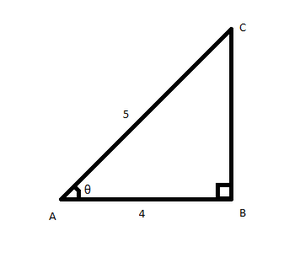
Question 31. If secA = 5/4, verify that \frac{3sinA−4sin^3A }{4cos^3A−3cosA}=\frac{3tanA−tan^3A}{1−3tan^2A} .
**Solution:
Given:
secA = 5/4
From pythagoras theorem,
AC2 = BC2 + AB2
52 = BC2 + 42
BC2 = 25 − 16 = 9
BC = 3
Now
=\frac{3sinA−4sin^3A }{4cos^3A−3cosA}=\frac{3tanA−tan^3A}{1−3tan^2A}
=\frac{3(\frac{3}{5})−4(\frac{3}{5})^3 }{4(\frac{4}{5})^3−3(\frac{4}{5})}=\frac{3(\frac{3}{4})−(\frac{3}{4})^3}{1−3(\frac{3}{4})^2}
=\frac{(\frac{9}{5})−(\frac{108}{125}) }{(\frac{256}{125})−(\frac{12}{5})}=\frac{(\frac{9}{4})−(\frac{27}{64})}{1−(\frac{27}{16})}
=\frac{(\frac{225-108}{125}) }{(\frac{256-300}{125})}=\frac{(\frac{144-27}{64})}{(\frac{16-27}{16})}
=\frac{(\frac{117}{125}) }{(\frac{-44}{125})}=\frac{(\frac{117}{64})}{(\frac{-11}{16})}
= 117/-44 = 117/(11(4))
= 117/-44 = 117/-44
Hence Proved
Question 32. If sinθ = 3/4, prove that \sqrt\frac{cosec^2θ−cot^2θ}{sec^2θ−1}=\frac{\sqrt 7}{3} .
**Solution:
Given: sinθ = 3/4
From Pythagoras theorem,
AC2 = BC2 + AB2
42 = AB2 + 32
AB2 = 16 - 9 = 7
AB =√7
We have,
\sqrt\frac{cosec^2θ−cot^2θ}{sec^2θ−1}=\frac{\sqrt 7}{3}
Now squaring both side
=(\sqrt\frac{cosec^2θ−cot^2θ}{sec^2θ−1})^2=(\frac{\sqrt 7}{3})^2
=\frac{cosec^2θ−cot^2θ}{sec^2θ−1}
= 7/9
We know
1 + cot2θ = cosec2θ
1 + tan2θ = sec2θ
= 1/tan2θ = 7/9
=\frac{1}{(\frac{3}{\sqrt7})^2}=\frac{7}{9}
= 7/9 = 7/9
Hence Proved
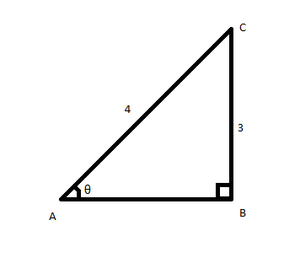
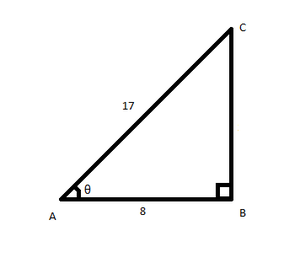
Question 33. If secA = 17/8, verify that \frac{3−4sin^2A}{4cos^2A−3}=\frac{3−tan^2A}{1−3tan^2A} .
**Solution:
Given: secA = 17/8
From Pythagoras theorem,
AC2 = BC2 + AB2
172 = BC2 + 82
BC2 = 289 − 64 = 225
BC = 15\frac{(\frac{-33}{289})}{(\frac{-611}{289})}=\frac{(\frac{-33}{64})}{(\frac{-611}{64})}
We have
\frac{3−4sin^2A}{4cos^2A−3}=\frac{3−tan^2A}{1−3tan^2A}
Putting the values of sinA, cosA and tanA in the above equation
=\frac{3−4\frac{15}{17}^2}{4\frac{8}{17}^2−3}=\frac{3−\frac{15}{8}^2}{1−3\frac{15}{8}^2}
=\frac{3−(\frac{900}{289})}{(\frac{256}{289})−3}=\frac{3−(\frac{225}{64})}{1−(\frac{675}{64})}
=\frac{(\frac{867-900}{289})}{(\frac{256-867}{289})}=\frac{(\frac{192-225}{64})}{(\frac{64-675}{64})}
=\frac{(\frac{-33}{289})}{(\frac{-611}{289})}=\frac{(\frac{-33}{64})}{(\frac{-611}{64})}
= 33/611 = 33/611
Hence Proved
Question 34. If cotθ = 3/4, prove that \sqrt\frac{secθ−cosecθ}{secθ+cosecθ}=\frac{1}{\sqrt 7} .
**Solution:
Given: cotθ = 3/4
tanθ = 4/3
Using the pythagoras theorem
sinθ = 4/5, cosθ = 3/5
cosecθ = 5/4, secθ = 5/3
Now, taking LHS
=\sqrt\frac{secθ−cosecθ}{secθ+cosecθ}
=\sqrt\frac{\frac{5}{3}−\frac{5}{4}}{\frac{5}{3}+\frac{5}{4}}
=\sqrt\frac{\frac{5}{12}}{\frac{35}{12}}
=\sqrt\frac{5}{35}
= 1/√7
Question 35. If 3cosθ − 4sinθ = 2cosθ + sinθ, then find tanθ.
**Solution:
Given: 3cosθ − 4sinθ = 2cosθ + sinθ
Dividing both equation by cosθ we get,
3\frac{cosθ}{cosθ}−4\frac{sinθ}{cosθ}=2\frac{cosθ}{cosθ}+\frac{sinθ}{cosθ}
3 - 4tanθ = 2 + tanθ
3 - 2 = 4tanθ + tanθ
tanθ = 1/5
Question 36. If ∠A and ∠B are acute angles such that tan A = tan B, then show that ∠A = ∠B.
**Solution:
Let us consider a △ABC
From the figure,
Given:
tan A = tan B
BC/AC = AC/BC
AC2 = BC2
AC = BC
In △ABC, AC = BC So we can say that the triangle is an isosceles triangle, √3
and in an isosceles triangle we know that if two sides of a triangle are equal,
then the angle opposite to the sides are equal.
Therefore ∠A =∠B
Read more :