Class 11 NCERT Solutions Chapter 2 Relation And Functions Exercise 2.2 (original) (raw)
Last Updated : 23 Jul, 2025
Chapter 2 of the Class 11 NCERT Mathematics textbook, "Relations and Functions," delves into the fundamental concepts of relations and functions, which are essential building blocks in higher mathematics. This chapter covers the definition and types of relations, along with an introduction to functions and their types, including injective, surjective, and bijective functions. Understanding these concepts is crucial for solving more complex problems in calculus and other areas of mathematics.
NCERT Solutions for Class 11 - Mathematics - Chapter 2 Relations and Functions - Exercise 2.2
This section provides detailed solutions to the problems in Exercise 2.2 of Chapter 2, "Relations and Functions," from the Class 11 NCERT Mathematics textbook. The exercise focuses on different types of functions, including one-to-one, onto, and bijective functions, as well as the methods to determine and prove these properties.
**Problem 1: Let A = {1, 2, 3,...,14}. Define a relation R from A to A by R = {(x, y) : 3x – y = 0, where x, y ∈ A}. Write down its domain, codomain, and range.
**Solution:
Given, A = {1, 2, 3,...,14}.
Here, the relation R from A to A is given by, R = {(x, y): 3x – y = 0, where x, y ∈ A}
So, relation R = {(1,3), (2,6), (3,9), (4,12)}Now, We know that, the domain of a relation R is the set of all the first elements of the ordered pairs in the relation.
So, Domain of R = {1, 2, 3, 4}Now, Here the complete set A is the Codomain of relation R.
So, Co-Domain of R = {1, 2, 3, 4,....,14}Now, We know that, the range of a relation R is the set of all the second elements of the ordered pairs in the relation.
So, Range of R = {3, 6, 9, 12}
**Problem 2: Define a relation R on the set N of natural numbers by R = {(x, y) : y = x + 5, x is a natural number less than 4; x, y ∈N}. Depict this relationship using roster form. Write down the domain and the range.
**Solution:
Here, the relation R is given by, R = {(x, y): y = x + 5, x is a natural number less than 4; x, y ∈N}
Now, As we know that the natural numbers less than 4 are 1, 2 and 3.
So, relation R = {(1,6), (2,7), (3,8)}Now, We know that, the domain of a relation R is the set of all the first elements of the ordered pairs in the relation.
So, Domain of R = {1, 2, 3}Now, We know that, the range of a relation R is the set of all the second elements of the ordered pairs in the relation.
So, Range of R = {6, 7, 8}
**Problem 3: A = {1, 2, 3, 5} and B = {4, 6, 9}. Define a relation R from A to B by R = {(x, y): the difference between x and y is odd; x ∈ A, y ∈ B}. Write R in roster form.
**Solution:
Given, A = {1, 2, 3, 5} and B = {4, 6, 9}
Here, the relation from A to B is given by, R = {(x, y): the difference between x and y is odd; x ∈ A, y ∈ B}
So, relation R = {(1,4), (1,6), (2,9), (3,4), (3,6), (5,4), (5,6)}
**Problem 4: Fig.2.7 shows a relationship between the sets P and Q. Write this relation -
****(i) in set-builder form**
****(ii) roster form.**
**What is its domain and range?
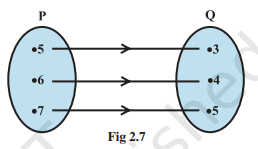
**Solution:
From the given figure, we can see that -
P = {5, 6, 7} and Q = {3, 4, 5}
Now, The relation between sets P and Q -****(i) In set-builder form**
R = {(x, y): y = x – 2; x ∈ P} 'or' R = {(x, y): y = x – 2 for x = 5, 6, 7}
****(ii) In roster form**
R = {(5,3), (6,4), (7,5)}
Now, We know that, the domain of a relation R is the set of all the first elements of the ordered pairs in the relation.
So, Domain of R = {5, 6, 7} = P.Now, We know that, the range of a relation R is the set of all the second elements of the ordered pairs in the relation.
So, Range of R = {3, 4, 5} = Q.
**Problem 5: Let A = {1, 2, 3, 4, 6}. Let R be the relation on A defined by -
****{(a, b): a, b ∈ A, b is exactly divisible by a}.**
****(i) Write R in roster form.**
****(ii) Find the domain of R.**
****(iii) Find the range of R.**
**Solution:
Given, A = {1, 2, 3, 4, 6}
Here, the relation R on A is given by, R = {(a, b): a , b ∈ A, b is exactly divisible by a}****(i)** The relation R in roster form will be -
R = {(1,1), (1,2), (1,3), (1,4), (1,6), (2,2), (2,4), (2,6), (3,3), (3,6), (4,4), (6,6)}****(ii)** We know that, the domain of a relation R is the set of all the first elements of the ordered pairs in the relation.
So, Domain of R = {1, 2, 3, 4, 6}****(iii)** We know that, the range of a relation R is the set of all the second elements of the ordered pairs in the relation.
So, Range of R = {1, 2, 3, 4, 6}
**Problem 6: Determine the domain and range of the relation R defined by R = {(x, x + 5) : x ∈ {0, 1, 2, 3, 4, 5}}.
**Solution:
Here, the relation R is given by, R = {(x, x + 5) : x ∈ {0, 1, 2, 3, 4, 5}}.
So, relation R = {(0,5), (1,6), (2,7), (3,8), (4,9), (5,10)}Now, We know that, the domain of a relation R is the set of all the first elements of the ordered pairs in the relation.
So, Domain of R = {0, 1, 2, 3, 4, 5}Now, We know that, the range of a relation R is the set of all the second elements of the ordered pairs in the relation.
So, Range of R = {5, 6, 7, 8, 9, 10}
**Problem 7: Write the relation R = {(x, x 3 ) : x is a prime number less than 10} in roster form.
**Solution:
Here, the relation R is given by, R = {(x, x3) : x is a prime number less than 10}
Now, As we know that the prime numbers less than 10 are 2, 3, 5 and 7.
So, relation R = {(2,8), (3,27), (5,125), (7,343)}
**Problem 8: Let A = {x, y, z} and B = {1, 2}. Find the number of relations from A to B.
**Solution:
Given, A = {x, y, z} and B = {1, 2}.
Now, number of elements in set A, n(A) = 3
and number of elements in set B, n(B) = 2
So, n(A × B) = n(A) × n(B) = 6.
We know that, the number of relations from A to B = 2n(A × B) = 26 = 64.'OR'
Given, A = {x, y, z} and B = {1, 2}.
Now, A × B = {(x,1), (x,2), (y,1), (y,2), (z,1), (z,2)}
Here, number of elements in A × B, n(A × B) = 6
So, the number of subsets of A × B = 26 = 64
Thus, the number of relations from A to B are 64.
**Problem 9: Let R be the relation on Z defined by R = {(a,b): a, b ∈ Z, a – b is an integer}. Find the domain and range of R.
**Solution:
Here, the relation R is given by, R = {(a, b): a, b ∈ Z, a – b is an integer}
As we know that the difference between any two integers is always an integer.
So, Domain of R = Z and Range of R = Z.
Related Articles:
- Class 11 NCERT Solutions- Chapter 2 Relation And Functions - Exercise 2.1
- Class 11 NCERT Solutions- Chapter 2 Relation And Functions - Exercise 2.3
Conclusion
Exercise 2.2 of Chapter 2 "Relations and Functions" in the Class 11 NCERT Mathematics textbook explores the concepts of different types of functions, including injective (one-to-one), surjective (onto), and bijective functions. The exercise provides practice problems that help students understand how to determine and prove these properties. It emphasizes the importance of understanding these fundamental concepts, which are essential for higher-level mathematics and real-world applications. Through this exercise, students learn to analyze functions and their properties, building a strong foundation for advanced topics in mathematics.