Class 12 RD Sharma Solutions Chapter 10 Differentiability Exercise 10.2 (original) (raw)
Last Updated : 23 Aug, 2024
**Question 1. If f is defined by f(x) = x 2 , find f'(2).
**Solution:
f'(2) = lim_{h\to0}\frac{f(2+h)-f(2)}{h}
= lim_{h\to0}\frac{(2+h)^2-2^2}{h}
= lim_{h\to0}\frac{4+h^2+4h-4}{h}
= lim_{h\to0}(4+h)
**Hence, f'(2) = 4.
**Question 2. If f is defined by f(x) = x 2 **– 4x + 7, show that f'(5) = 2f'(7/2).
**Solution:
f'(5) = lim_{h\to0}\frac{f(5+h)-f(5)}{h}
= lim_{h\to0}\frac{((5+h^2)-4(5+h)+7)-(25-20+7)}{h}
= lim_{h\to0}\frac{h^2+25+10h-20-4h+7-12}{h}
= lim_{h\to0}\frac{h^2+6h}{h}
f'(5) = 6 .......(1)
f'(7/2) = lim_{h\to0}\frac{f(7/2+h)-f(7/2)}{h}
= lim_{h\to0}\frac{h^2+7h-14-4h+7+14-7}{h}
= lim_{h\to0}\frac{h^2+3h}{h}
= lim_{h\to0}(h+3)
f'(7/2) = 3
⇒ 2f'(7/2) = 6 ......(2)
From (1) and (2)
f'(5) = 2f'(7/2).
**Question 3. Show that the derivative of the function f given by f(x) = 2x 3 – 9x 2 +12x + 9 at x = 1 and x = 2 are equal.
**Solution:
f'(1) = lim_{h\to0}\frac{f(1+h)-f(1)}{h}
= lim_{h\to0}\frac{[2(1+h)^2-9(1+h)^2+12(1+h)+9]-[2-9+12-9]}{h}
= lim_{h\to0}\frac{2+2h^3+6h^2+6h-9-9h^2-18h+12+12h+9-14}{h}
= lim_{h\to0}\frac{2h^3-3h^2}{h}
= lim_{h\to0}h(2h-3)
⇒ f'(1) = 0
Now, f'(2) = lim_{h\to0}\frac{f(2+h)-f(2)}{h}
= lim_{h\to0}\frac{[2(2+h)^3-9(2+h)^2+12(2+h)+9]-[16-36+24+9]}{h}
= lim_{h\to0}\frac{2h^3-3h^2}{h}
= lim_{h\to0}h(2h-3)
⇒ f'(2) = 0
**Hence f'(1) = f'(2) = 0.
**Question 4. If for the function f(x) = ax 2 + 7x – 4, f'(5) = 97, find a.
**Solution:
f'(5) = lim_{h\to0}\frac{f(5+h)-f(5)}{h}
⇒ 97 = lim_{h\to0}\frac{a(25+h^2+10h)+35+7h-4-25a-35+4}{h}
= lim_{h\to0}\frac{25a+ah^2+10ah-25a+7h}{h}
= lim_{h\to0}\frac{ah^2+h(10a+7)}{h}
⇒ 97 = 10a +7
⇒ 10a = 90
**⇒ a = 9
**Question 5. If f(x) = x 3 **+ 7x 2 + 8x – 9, find f'(4).
**Solution:
f'(4) = lim_{h\to0}\frac{f(4+h)-f(4)}{h}
= lim_{h\to0}\frac{[(4+h)^3+7(4+h)^2+8(4+h)-9]-[64+112+32-9]}{h}
= lim_{h\to0}\frac{64+h^3+48h+12h^2+112+7h^2+56h+32+8h-9]-[210-9]}{h}
= lim_{h\to0}\frac{h^3+19h^2+112h}{h}
= lim_{h\to0}\frac{h(h^2+19h+112)}{h}
**⇒ f'(4) = 112
**Question 6. Find the derivative of f(x) = mx + c at x = 0.
**Solution:
f'(0) = lim_{h\to0}\frac{f(0+h)-f(0)}{h}
= lim_{h\to0}\frac{f(h)-h(0)}{h}
= lim_{h\to0}\frac{(mh+c)-(c)}{h}
= lim_{h\to0}\frac{mh+c-c}{h}
= lim_{h\to0}\frac{mh}{h}
**⇒ f'(0) = m.
**Question 7. Examine the differentiability of f(x) = \begin{cases}2x+3\ \ \ \ \ \ \ ,-3≤x<-2\\x+1\ \ \ \ \ \ \ \ \ ,-2≤x<0\\x+2\ \ \ \ \ \ \ \ \ ,0≤x1\end{cases}.
**Solution:
Since f(x) is a polynomial function, it is continuous and differentiable everywhere.
Differentiability at x = –2
(LHD at x = –2) = lim_{h\to–2^-}\frac{f(x)-f(–2)}{x-(-2)}
= lim_{h\to–2^-}\frac{2x+3+1}{x+2}
= lim_{h\to–2^-}\frac{2(x+2)}{x+2}
= 2
(RHD at x = –2) = lim_{h\to–2^+}\frac{f(x)-f(-2)}{x-(-2)}
= lim_{h\to–2^-}\frac{x+1+1}{x+2}
= lim_{h\to–2^-}\frac{x+2}{x+2}
= 1
Since, LHD at x = –2 ≠ RHD at x = –2
**Hence f(x) is not differentiable at x = –2.
Now, Differentiability at x = 0
(LHD at x = 0) = lim_{h\to0}\frac{f(x)-f(0)}{x-0}
= lim_{h\to0}\frac{x+1-2}{x}
= lim_{h\to0}\frac{x-1}{x}
= ∞
(RHD at x = 0) = lim_{h\to0}\frac{f(x)-f(0)}{x-0}
= lim_{h\to0}\frac{x+2-2}{x}
= lim_{h\to0}\frac{x}{x}
= 1
Since, LHD at x = –2 ≠ RHD at x = 0
**Hence f(x) is not differentiable at x = 0.
**Question 8. Write an example of a function which is everywhere continuous but fails to be differentiable at exactly five points.
**Solution:
We know the modulus function f(x) = |x| is continuous but not differentiable at x = 0.
**Hence, f(x) = |x| + |x – 1| + |x – 2| + |x – 3| + |x – 4| is continuous but not fails to be differentiable at x = 0,1,2,3,4.
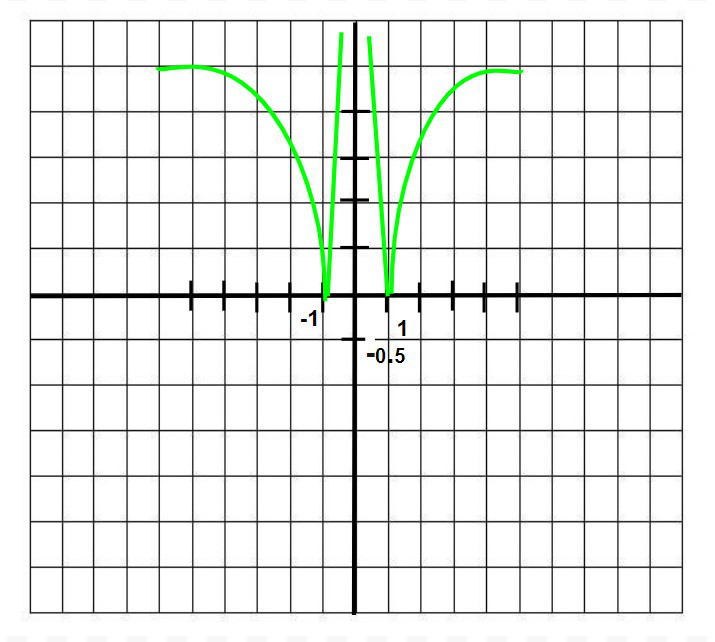
**Question 9. Discuss the continuity and differentiability of f(x) = |log|x||.
**Solution:
Graph of f(x) = |log|x||:
**From the graph above, it is clear that f(x) is continuous everywhere, but not differentiable at 1 and -1.
**Question 10. **Discuss the continuity and differentiability of f(x) = e |x| .
**Solution:
f(x) = e|x| = \begin{cases}e^{-x} \ \ \ \ \ \ \ \ ,x<0\\e^x\ \ \ \ \ \ \ \ \ \ ,x≥0\end{cases}
For continuity:
(LHL at x = 0) = lim_{x\to0^-}f(x)
= lim_{h\to0}f(0-h)
= lim_{h\to0}e^{0-h}
= lim_{h\to0}e^{-h}
= e0
= 1
(RHL at x = 0) = lim_{x\to0^+}f(x)
= lim_{h\to0}f(0+h)
= lim_{h\to0}e^{0+h}
= lim_{h\to0}e^h
= e0
= 1
**Hence f(x) is continuous at x = 0.
For Differentiability:
(LHD at x = 0) = lim_{x\to0^-}\frac{f(x)-f(0)}{x-0}
= lim_{h\to0}\frac{f(x)-f(0)}{x-0}
= lim_{h\to0}\frac{e^h-1}{-h}
= –1
(RHD at x = 0) = lim_{x\to0^+}\frac{f(x)-f(0)}{x-0}
= lim_{h\to0}\frac{e^h-1}{h}
= 1
**Thus, f(x) is not differentiable at x = 0.
**Question 11. Discuss the differentiability of f(x) = \begin{cases}(x-c)cos\frac{1}{x-c}\ \ \ \ \ \ ,x≠c\\0\ \ \ \ \ \ \ \ \ \ \ \ \ \ \ \ \ \ \ \ \ \ \ \ \ \ \ \ ,x=c\end{cases}.
**Solution:
(LHD at x = c) = lim_{x\to c^-}\frac{f(c-h)-f(c)}{-h}
= lim_{h\to0}\frac{cos(-1/h)}{h}
= lim_{h\to0}\frac{cos(1/h)}{h}
= k
(RHD at x = c) = lim_{x\to c^+}\frac{f(c+h)-f(c)}{h}
= lim_{h\to0}\frac{cos(1/h)}{h}
= k
Clearly (LHD at x = c) = (RHD at x = c)
**f(x) is differentiable at x = c.
**Question 12. Is |sinx| differentiable? What about cos|x|?
**Solution:
f(x) = |sinx| = \begin{cases}-sinx \ \ \ \ \ \ \ \ , x<nπ\\sinx \ \ \ \ \ \ \ \ \ \ \ ,x>nπ\end{cases}
(LHD at x = nπ) = lim_{x\to nπ^-}\frac{f(x)-f(nπ)}{x-nπ}
= lim_{h\to0}\frac{-sin(nπ-h)-sinnπ}{nπ-h-nπ}
= lim_{h\to0}\frac{sinh}{-h}
= –1
(RHD at x = nπ) = lim_{h\to0}\frac{sin(nπ+h)-sinnπ}{h}
= lim_{h\to0}\frac{sinh}{-h}
= 1
Since, LHD at x = nπ ≠ RHD at x = nπ
**Hence f(x) = |sinx| is not differentiable at x = nπ.
Now, f(x) = cos|x|
Since, cos(–x) = cosx
Thus, f(x) = cos x
**Hence f(x) = cos|x| is differentiable everywhere.
Summary
Exercise 10.2 focuses on applying the concepts of differentiability to more complex scenarios. It includes problems involving composite functions, implicit functions, and parametric equations. Students are required to use various differentiation rules, including the chain rule, product rule, and quotient rule. The exercise also covers topics such as higher-order derivatives, logarithmic differentiation, and finding equations of tangent and normal lines.