Class 12 RD Sharma Solutions Chapter 32 Mean and Variance of a Random Variable Exercise 32.2 | Set 2 (original) (raw)
Last Updated : 26 Aug, 2024
Question 13: Two cards are selected at random from a box which contains five cards numbered 1,1,2,2, and 3. Let X denote the sum and Y the maximum of the two numbers drawn. Find the probability distribution, mean and variance of X and Y.
**Solution:
As box contains cards numbered as 1,1,2,2 and 3
∴ possible sums of card numbers are 2,3,4 and 5
Hence, X can take values 2,3,4 and 5
X=2 [ when drawn cards are (1,1)]
X=3 [when drawn cards are (1,2) or (2,1)]
X=4 [when drawn cards are (2,2) or (3,1) or (1,3)]
X=5 [when drawn cards are (2,3) or (3,2)]
As Y is a random variable representing maximum of the two numbers drawn
∴ Y can take values 1,2 and 3.
Y=1 [when drawn cards are 1 and 1]
Y=2 [when drawn cards are (1,2) or (2,2) or (2,1)]
Y=3 [when drawn cards are (1,3) or (3,1) or (2,3) or (3,2)]
Note : P(1) represents probability of drawing card numbered as 1, similarly P(2) and P(3)
∴ P(X=2) = P(1)P(1) = 2/5 x 1/4 = 0.1
[For drawing first card we had 2 favourable outcomes as 1,1 out of total 5 ,in second time of drawing ,as we drew a card numbered as 1 we are having 1 favourable outcome out of total remaining of 4]
Similarly,
P(X=3) = P(2)P(1) + P(1)P(2) = 2/5 x 2/4 + 2/5 x 2/4 = 0.4
P(X=4) = P(2)P(2)+P(3)P(1)+P(1)P(3) = 2/5 x 1/4 + 2/5 x 1/4 + 1/5 x 2/4 = 0.3
P(X=5) = P(2)P(3)+P(3)P(2) = 2/5 x 1/4 + 2/5 x 1/4 = 0.2
Similarly,
P(Y=1) = P(1)P(1) = 2/5 x 1/4 = 0.1
P(Y=2) = P(1)P(2)+P(2)P(1)+P(2)P(2) = 2/5 x 2/4 + 2/5 x 2/4 + 2/5 x 1/4 = 0.5
P(Y=3) = P(2)P(3)+P(3)P(2)+ P(1)P(3)+P(3)P(1)
= 2/5 x 1/4 + 2/5 x 1/4 + 2/5 x 1/4 +2/5 x 1/5 + 1/5 x 2/4 = 0.4
Now we have pi and xi.
Let’s proceed to find mean and variance.
Mean of any probability distribution is given by Mean = ∑xipi
Variance is given by:
Variance = ∑ xi2pi – (∑xipi)2
∴ first we need to find the products i.e. pixi and pixi2 and add them to get mean and apply the above formula to get the variance.
Following table representing probability distribution gives the required products :
**xi **pi **xipi **xi 2 pi 0 1/16 0 0 1 7/16 7/16 7/16 2 5/16 10/16 20/16 3 2/16 6/16 18/16 ∴ Mean for(X) = 0.2+1.2+1.2+1 = 3.6
Variance for(X) = 0.4+3.6+4.8+5.0-3.62 = 13.8-3.62 = 0.84
Similarly probability distribution for Y is given below:
**yi **pi **yipi **yi 2 pi 1 0.1 0.1 0.1 2 0.5 1.0 2.0 3 0.4 1.2 3.6 ∴ Mean for(Y) = 0.1+1.0+1.2 = 2.3
Variance for(Y) = 0.1+2.0+3.6-2.32 = 5.7-2.32 = 0.41
Question 14: A die is tossed twice. A ‘success’ is getting an odd number on a toss. Find the variance of the number of successes.
**Solution:
As success is considered when we get an odd number when we roll a die.
As die is rolled twice , so we can get no success or a single success or we can get odd both the times an odd number.
If X is the random variable denoting the success then X can take value 0,1 or 2
∵ P(getting an odd number in a single rolling of die) = 3/6 = 1/2
As rolling a die is an independent event:
∴ P(getting an odd on first roll and probability of getting odd on second roll)=P(getting an odd on first roll) x P(getting an odd on second roll)
Note: P(AՈB) = P(A)P(B) where A and B are independent events.
∴ P(X=0) = P(even number on first throw) x P(even on second throw) = 1/2 x 1/2 = 1/4
P(X=1) = P(even number on first throw) x P(odd on second throw) +
P(odd number on first throw) x P(even on second throw) = 1/2 x 1/2 + 1/2 x 1/2 = 1/2
P(X=2) = P(odd number on first throw) x P(odd on second throw) = 1/2 x 1/2 = 1/4
Now we have pi and xi.
Let’s proceed to find mean and variance.
Mean of any probability distribution is given by Mean = ∑xipi
Variance is given by:
Variance = ∑ xi2pi – (∑xipi)2
∴ first we need to find the products i.e. pixi and pixi2 and add them to get mean and apply the above formula to get the variance.
Following table representing probability distribution gives the required products :
**xi **pi **xipi **xi 2 pi 0 1/4 0 0 1 1/2 1/2 1/2 2 1/4 1/2 1 ∵ Variance = ∑ xi2pi – (∑xipi)2
∴ Variance = 0 + 1/2 + 1 - (0 + 1/2 + 1/2)2 = 0.5
Question 15: A box contains 14 bulbs, out of which 5 are defective. 3 bulbs are randomly drawn, one by one without replacement, from the box. Find the probability distribution of the number of defective bulbs.
**Solution:
Let X be the random variable denoting the number of defective bulbs drawn in each draw. Since we are drawing a maximum of 3 bulbs at a time, So we can get at max 3 defective bulbs as total defective bulbs are 5.
∴ X can take values 0,1,2 and 3
P(X=0) = P(drawing no defective bulbs)
As we are finding probability for 0 defective bulbs ,so we will select all 3 bulbs
from 9 good bulbs.
n(s) = total possible ways = 14C3
∴ P(X=0) = 9C3/14C3 = 3/13
P(X=1) = P(drawing 1 defective bulbs and 2 good bulbs)
As we are finding probability for 1 defective bulbs ,so we will select 2 bulbs
from 9 good bulbs and 1 from 5 defective ones
∴ P(X=1) = (9C2 x 5C1)/ 14C3 = 45/91
Similarly,
P(X=2) = (9C1 x 5C2)/14C3 = 45/182
P(X=3) = 5C3 /14C3 = 5/182
So, Probability distribution is given below:
**xi **pi 0 3/13 1 45/91 2 45/182 3 5/182
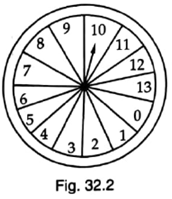
Question 16: In roulette, Fig. 32.2, the wheel has 13 numbers 0,1,2,….,12 marked on equally spaced slots. A player sets ₹10 on a given number. He receives ₹100 from the organizer of the game if the ball comes to rest in this slot; otherwise, he gets nothing. If X denotes the player’s net gain/loss, find E (X).
**Solution:
As player sets Rs 10 on a number ,if he wins he get Rs 100
∴ his profit is Rs 90.
If he loses, he suffers a loss of Rs 10
He gets a profit when ball comes to rest in his selected slot.
Total possible outcome = 13
Favourable outcomes = 1
∴ probability of getting profit = 1/13
And probability of loss = 12/13
If X is the random variable denoting gain and loss of player
∴ X can take values 90 and -10
P(X=90) = 1/13
And P(X=-10) = 12/13
Now we have pi and xi.
Let’s proceed to find mean
Mean of any probability distribution is given by Mean = ∑xipi
∴ first we need to find the products i.e. pixi and add them to get mean
Following table representing probability distribution gives the required products :
**xi **pi **xipi 90 1/13 90/13 -10 12/13 -120/13 E(X) = Mean = 90/13 + (-120/13) = 90/13 - 120/13 = -30/13
Question 17: Three cards are drawn at random (without replacement) from a well shuffled pack of 52 cards. Find the probability distribution of number of red cards. Hence find the mean of the distribution.
**Solution:
We have total 26 red cards in a deck of 52 cards.
As we are drawing maximum 3 cards at a time so we can get maximum 3 red cards.
If X denotes the number of red cards ,then X can take values from 0,1,2 and 3
P(X=0) = probability of drawing no red cards
We need to select all 3 cards from remaining 26 cards
Total possible ways of selecting 3 cards = 52C3
∴ P(X=0) = 26C3 / 52C3 = 2/17
P(X=1) = P(selecting one red and 2 black cards) = (26C1 x 26C2 ) / 52C3 = 13/34
P(X=2) = P(selecting 2 red and 1 black cards) = (26C2 x 26C1) / 52C3 = 13/34
P(X=3) = 26C3/52C3 = 2/17
So, Probability distribution is given below:
**xi **pi **xipi 0 2/17 0 1 13/34 13/34 2 13/34 26/34 3 2/17 6/17 Mean = 0 + 13/34 + 26/34 + 6/17 = 1.5
Question 18: An urn contains 5 red 2 black balls. Two balls are randomly drawn, without replacement. Let X represent the number of black balls drawn. What are the possible values of X? Is X a random variable? If yes, find the mean and variance of X.
**Solution:
X represents the number of black balls drawn.
∴ X can take values 0,1 and 2
∵ there are total 7 balls
n(S) = total possible ways of selecting 2 balls = 7C2
P(X=0) = P(selecting no black balls) = 5C2/7C2 = 10/21
P(X=1) = P(selecting 1 black ball and 1 red ball)
= (5C1 x 2C1) / 7C2 = 10/21
P(X=2) = P(selecting 2 black ball and 0 red ball) = (5C0 x 2C2) / 7C2 = 1/21
X is said to be a random variable if some of the probabilities associated with each value of X is 1
Here,
P(X=0) + P(X=1) + P(X=2) = 20/42 + 20/42 + 2/42 = 1
∴ X is a random variable.
Now we have pi and xi.
Let’s proceed to find mean and variance.
Mean of any probability distribution is given by Mean = ∑xipi
Variance is given by:
Variance = ∑ xi2pi – (∑xipi)2
∴ first we need to find the products i.e. pixi and pixi2 and add them to get mean and apply the above formula to get the variance.
Following table representing probability distribution gives the required products :
**xi **pi **xipi **xi 2 pi 0 10/21 0 0 1 10/21 10/21 10/21 2 1/21 2/21 4/21 ∴ Mean = 10/21 + 2/21 = 4/7
∴ Variance = 0 + 10/21 + 4/21 - (4/7)2 = 50/147
Question 19: Two numbers are selected at random (without replacement) from positive integers 2,3,4,5,6 and 7. Let X denote the larger of the two numbers obtained. Find the mean and variance of the probability distribution of X.
**Solution:
∵ two numbers are selected at random like {(2,3) or (5,4) or (4,5)..etc}
Total ways of selecting two numbers without replacement = 6 x 5 =30
As X denote the larger of two numbers selected
∴ X can take values 3,4,5,6 and 7
P(X=3) = P(larger number is 3) = (2/30)[{2,3},{3,2}]
P(X=4) = P(larger number is 4) = (4/30)[{2,4},{4,2},{3,4},{4,3}]
P(X=5) = P(larger number is 5) = (6/30)[{2,5},{3,5},{4,5} and their reverse order]
P(X=6) = P(larger number is 6) = (8/30)[{2,6},{3,6},{4,6},{5,6} and their reverse order]
P(X=7) = P(larger number is 7) = (10/30)[{2,7},{3,7},{4,7},{5,7},{6,7} and their reverse order]
Now we have pi and xi.
Let’s proceed to find mean and variance.
Mean of any probability distribution is given by Mean = ∑xipi
Variance is given by:
Variance = ∑ xi2pi – (∑xipi)2
∴ first we need to find the products i.e. pixi and pixi2 and add them to get mean and apply the above formula to get the variance.
Following table representing probability distribution gives the required products:
**xi **pi **xipi **xi 2 pi 3 2/30 6/30 18/30 4 4/30 16/30 64/30 5 6/30 30/30 150/30 6 8/30 48/30 288/30 7 10/30 70/30 490/30 ∴ Mean = 6/30 + 16/30 + 30/30 + 48/30 + 70/30 = 17/3
∴ Variance = 18/30 + 64/30 + 150/30 + 288/30 + 490/30 - (17/3)2 = 14/9
Question 20: In a game, a man wins ₹5 for getting a number greater than 4 and loses ₹1 otherwise, when a fair die is thrown. The man decided to throw a die thrice but to quits as and when he gets a number than 4. Find the expected value of amount he wins/lose.
**Solution:
We are asked to find the expected amount he wins or lose i.e we have to find the mean of probability distribution of random variable X denoting the win/loss.
As he decided to throw the dice thrice but to quit at the instant he loses
∴ if he wins in all throw he can make earning of Rs 15
If he wins in first two throw and lose in last, he earns Rs (10-1) = Rs 9
If he wins in first throw and then loses ,he earns = Rs 4
If he loses in first throw itself, he earns Rs = -1
Thus X can take values -1,4,9 and 15
P(getting a number greater than 4 in a throw of die) = 2/6 = 1/3
P(getting a number not greater than 4 in a throw of die) = 4/6 = 2/3
P(X=-1) = P(getting number less than or equal to 4) = 2/3
P(X=4) = P(getting > 4) x P(getting ≤ 4) = 1/3 x 2/3 = 2/9
P(X=9) = P(getting > 4) x P(getting > 4) x P(getting ≤ 4) = 1/3 x 1/3 x 2/3 = 2/27
P(X=15) = P(getting > 4) x P(getting > 4) x P(getting > 4) = 1/3 x 1/3 x 1/3 = 1/27
So, Probability distribution is given below:
**xi **pi **xipi -1 2/3 -2/3 4 2/9 8/9 9 2/27 18/27 15 1/27 15/27 ∵ Mean = ∑xipi
Mean = -2/3 + 8/9 + 18/27 + 15/27 = 39/27 = 1.44
He can win around Rs 1.45
Summary
Exercise 32.2 (Set 2) in Chapter 32 (Mean and Variance of a Random Variable) of RD Sharma's Class 12 mathematics textbook focuses on finding the mean and variance of random variables, including discrete and continuous probability distributions. The exercise covers topics such as calculating the expected value and standard deviation of random variables, applying the properties of mean and variance, and solving real-world problems involving random variables. This set of problems helps students develop a comprehensive understanding of the concepts of mean and variance and their applications in probability and statistics.
Practice Questions
**1. A random variable X has the following probability distribution: P(X = 2) = 0.3, P(X = 4) = 0.4, P(X = 6) = 0.2, and P(X = 8) = 0.1. Find the expected value and variance of X.
**2. The weights of a certain product follow a normal distribution with a mean of 15 grams and a standard deviation of 3 grams. Find the probability that a randomly selected product weighs less than 12 grams.
**3. The number of defective items in a batch of 80 items follows a Poisson distribution with a mean of 4. Find the probability that the number of defective items is greater than 6.
**4. The lifetime of a certain type of light bulb is a random variable with a mean of 900 hours and a standard deviation of 40 hours. Find the probability that a randomly selected light bulb lasts less than 850 hours.
**5. The number of customers arriving at a bank follows a Poisson distribution with a mean of 8 customers per hour. Find the probability that the number of customers arriving in a 45-minute period is at least 5.
**6. The length of time a student spends on homework follows an exponential distribution with a mean of 1.5 hours. Find the probability that a student spends more than 2 hours on homework.
**7. The number of typos in a document follows a Poisson distribution with a mean of 3 typos per page. Find the probability that a randomly selected page has exactly 2 typos.
**8. The heights of adults in a certain population follow a normal distribution with a mean of 165 cm and a standard deviation of 8 cm. Find the probability that a randomly selected adult is between 160 cm and 170 cm tall.
**9. The number of accidents at a certain intersection follows a Poisson distribution with a mean of 5 accidents per month. Find the probability that the number of accidents in a given month is at most 3.
**10. The lifetime of a certain type of battery follows an exponential distribution with a mean of 400 hours. Find the probability that a randomly selected battery lasts less than 300 hours.