Class 8 NCERT Mathematics Solutions Chapter 11 Mensuration Exercise 11.1 (original) (raw)
Last Updated : 23 Jul, 2025
Chapter 11 of the Class 8 NCERT Mathematics textbook, "Mensuration," deals with the measurement of geometric figures. This chapter introduces students to the formulas and concepts required to calculate the area, perimeter, and volume of various shapes like rectangles, squares, triangles, circles, and cuboids. The chapter builds a foundation for understanding how to measure the size and space occupied by different geometric figures in two-dimensional and three-dimensional forms.
NCERT Solutions for Class 8 - Mathematics - Chapter 11 Mensuration - Exercise 11.1
Mensuration is one of the most important chapters in Class 8 NCERT Math. It carries good weightage in Class 8 Mathematics. GeeksforGeeks has compiled the NCERT Solutions for Class 8 Maths Chapter 11 Mensuration Exercise 11.1 for you in this article below. This Class 8 NCERT Solutions for Chapter 11 Mensuration - Exercise 11.1 are meticulously designed to help students grasp the fundamental principles of measuring various geometrical shapes and figures.
Mensuration
The Mensuration is the branch of mathematics that deals with the measurement of the geometric figures and shapes. It involves calculating the area, perimeter, volume, and surface area of the various two-dimensional and three-dimensional objects. Understanding these concepts is crucial for solving real-world problems related to space and dimensions.
Important Formulas for Mensuration
Area Formulas:
- **Area of Rectangle = Length × Breadth=l × b
- **Area of Square =Side × Side =a2
- **Area of Triangle = 1/2 × Base × Height =1/2 × b × h
- **Heron’s Formula: Area of triangle = \sqrt{s(s-a)(s-b)(s-c)}, (s=(a+b+c)/2)
- **Area of Circle = πr2
- **Area of Parallelogram = Base × Height = b × h
- **Area of Trapezium = 1/2×(Sum of parallel sides) × Height = 1/2 × (a + b) × h
Perimeter Formulas:
- **Perimeter of Rectangle =2 × (Length + Breadth)=2 × (l + b)
- **Perimeter of Square = 4 × Side = 4a
- **Perimeter of Triangle = Sum of all sides = a + b + c
- **Circumference of Circle = 2πr
Class 8 NCERT Mathematics Solutions - Exercise 11.1
Below is the question wise solution of Chapter 11 Mensuration - Exercise 11.1.
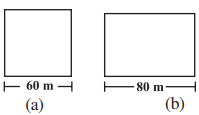
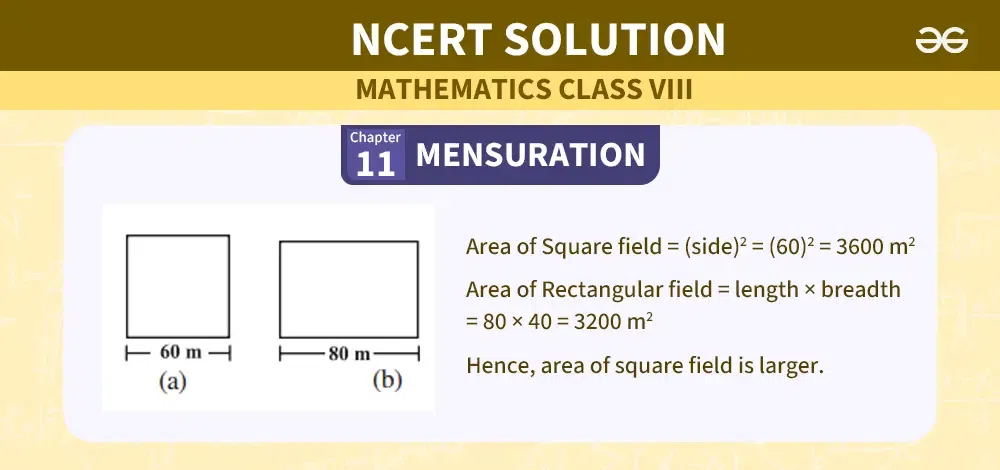
**Question 1. A square and a rectangular field with measurements as given in the figure have the same perimeter. Which field has a larger area?
**Solution:
Given,
Side of a square = 60 m
Length, l = 80 m
According to question,
Perimeter of rectangular field = Perimeter of square field
According to formula,
2(l + b) = 4 × Side
2(80 + b) = 4 × 60
160 + 2b = 240
b = 40
Therefore, Breadth of the rectangle is 40 m.
Now, Area of Square field = (side)2 = (60)2 = 3600 m2
And Area of Rectangular field = length × breadth = 80 × 40 = 3200 m2
Hence, area of square field is larger.
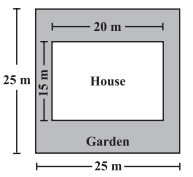
**Question 2. Mrs. Kaushik has a square plot with the measurement as shown in the figure. She wants to construct a house in the middle of the plot. A garden is developed around the house. Find the total cost of developing a garden around the house at the rate of Rs. 55 per m 2 .
**Solution:
Given,
Side of a square = 25 m
According to formula,
Area of square plot = square of a side = (side)2 = (25)2 = 625
Therefore, the area of a square plot is 625 m2
Length of the house = 20 m and
Breadth of the house = 15 m
Area of the house = length × breadth = 20 × 15 = 300 m2
Area of garden = Area of square plot - Area of house = 625 - 300 = 325 m2
Therefore, per unit cost of making garden is Rs. 55
Total Cost of developing the garden of 325 sq. m = Rs. 55 × 325 = Rs. 17,875
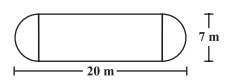
**Question 3. The shape of a garden is rectangular in the middle and semi-circular at the ends as shown in the diagram. Find the area and the perimeter of this garden [Length of rectangle is 20 - (3.5 + 3.5 meters)]
**Solution:
Given,
Total length = 20 m
Diameter of semi circle = 7 m
Therefore, Radius of semi circle = 7/2 = 3.5 m
Length of rectangular field = 20 - (3.5 + 3.5) = 20 - 7 = 13 m
Breadth of the rectangular field = 7 m
Area of rectangular field = l × b = 13 × 7= 91m2
Area of two semi circles = 2 × (1/2) × pi × r2
= 2 × (1/2) × 22/7 × 3.5 × 3.5
= 38.5 m2
Area of garden = 91 + 38.5 = 129.5 m2
Now Perimeter of two semi circles = 2.pi.r = 2 × (22/7) × 3.5 = 22 m
Therefore, Perimeter of garden = 22 + 13 + 13 = 48 m
**Question 4. A flooring tile has the shape of a parallelogram whose base is 24 cm and the corresponding height is 10 cm. How many such tiles are required to cover a floor of area 1080 m 2 ? [If required you can split the tiles in whatever way you want to fill up the corners]
**Solution:
Given,
Base of flooring tile = 24 cm = 0.24 m
Corresponding height of a flooring tile = 10 cm = 0.10 m
Now Area of flooring tile = Base × Altitude = 0.24 × 0.10 = 0.024
Area of flooring tile is 0.024m2
Number of tiles required to cover the floor = Area of floor/Area of one tile = 1080/0.024 = 45000 tiles
Hence 45000 tiles are required to cover the floor.
**Question 5. An ant is moving around a few food pieces of different shapes scattered on the floor. For which food-piece would the ant have to take a longer round? Remember, the **circumference of a circle can be obtained by using the expression C = 2.pi.r, **where **r is the radius of the circle.
**Solution:
****(a)**
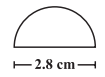
Radius = Diameter/2 = 2.8/2 cm = 1.4 cm
Circumference of semi-circle = pi.r = (22/7)×1.4 = 4.4
Circumference of semi-circle is 4.4 cm
Total distance covered by the ant = Circumference of semi - circle + Diameter = 4.4 + 2.8 = 7.2 cm
****(b)**
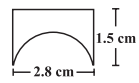
Diameter of semi-circle = 2.8 cm
Radius = Diameter/2 = 2.8/2 = 1.4 cm
Circumference of semi-circle = r = (22/7) × 1.4 = 4.4 cm
Total distance covered by the ant= 1.5 + 2.8 + 1.5 + 4.4 = 10.2 cm
****(c)**
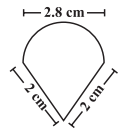
Diameter of semi-circle = 2.8 cm
Radius = Diameter/2 = 2.8/2 = 1.4 cm
Circumference of semi-circle = pi.r = (22/7) × 1.4 = 4.4 cm
Total distance covered by the ant = 2 + 2 + 4.4 = 8.4 cm
After analyzing results of three figures, we concluded that for figure (b) food piece, the ant would take a longer round.
**Also Read
Conclusion
In Chapter 11 - Mensuration of the Class 8 NCERT Mathematics textbook, students learn about the measurement of geometric figures, focusing on calculating the area, perimeter, and volume of different shapes. Exercise 11.1 deals specifically with finding the perimeter and area of basic 2D shapes like rectangles, squares, and triangles. The chapter provides foundational knowledge for measuring the size and space occupied by various geometric figures.