Class 8 NCERT Solutions Chapter 3 Understanding Quadrilaterals Exercise 3.1 (original) (raw)
Last Updated : 23 Jul, 2025
In this section, we explore Chapter 3 of the Class 8 NCERT Mathematics textbook, which focuses on Understanding Quadrilaterals. This chapter introduces students to different types of quadrilaterals, their properties, and their classifications. Exercise 3.1 is designed to help students identify and analyze various quadrilaterals, laying the groundwork for more advanced geometric concepts.
Class 8 NCERT Solutions - Chapter 3 Understanding Quadrilaterals - Exercise 3.1
This section provides detailed solutions for Exercise 3.1 from Chapter 3 of the Class 8 NCERT Mathematics textbook. These solutions aim to guide students in recognizing different types of quadrilaterals and understanding their fundamental properties, ensuring a solid grasp of the topic.
Question 1. Given here are some figures:
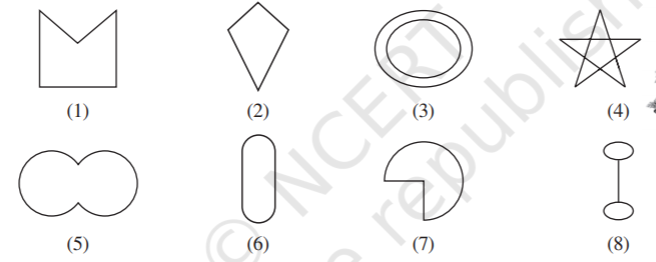
Classify each of them on the basis of the following.
(a) Simple curve (b) Simple closed curve (c) Polygon (d) Convex polygon (e) Concave polygon
Solution:
**a) 1, 2, 5, 6, 7
**b) 1, 2, 5, 6, 7
**c) 1, 2
**d) 2
**e) 1
Question 2. How many diagonals does each of the following have?
(a) A convex quadrilateral
Solution:
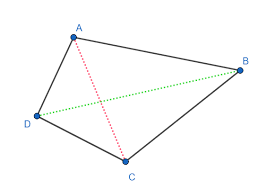
Here we can see that only two diagonals are possible for the convex quadrilateral.
Answer: 2
(b) A regular hexagon
Solution:
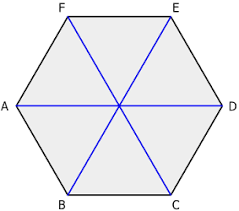
Here we can see that only three diagonals are possible for the convex quadrilateral.
Answer: 3
(c) A triangle
Solution:

In case of a triangle no diagonal is possible.
Answer: 0
Question 3. What is the sum of the measures of the angles of a convex quadrilateral? Will this property hold if the quadrilateral is not convex?
Solution:
Sum of the angles of a quadrilateral is always 180°. It doesn't depend on whether the quadrilateral is a convex or a concave.
Question 4. Examine the table. (Each figure is divided into triangles and the sum of the angles deduced from that).
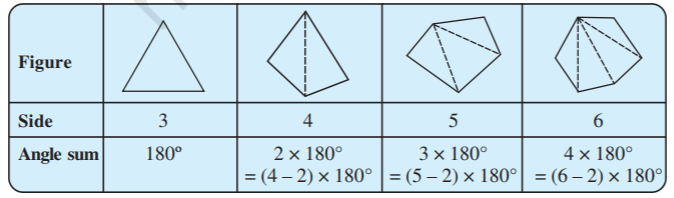
What can you say about the angle sum of a convex polygon with number of sides?
Solution:
From the above given table we can deduce that for a given number of sides **n the sum of the angles of a convex polygon is ****(n - 2) × 180** ° .
**a) 7
Ans: (7 - 2) × 180° = 5 × 180° = 900°
**b) 8
Ans: (8 - 2) × 180° = 6 × 180° = 1080°
**c) 10
Ans: (10 - 2) × 180° = 8 × 180° = 1440°
**d) n
Ans: (n - 2) x 180°
Question 5. What is a regular polygon? State the name of a regular polygon of : (i) 3 sides (ii) 4 sides (iii) 6 sides
Solution:
Regular Polygon is a polygon with equal sides and equal angles.
****(i)** 3 sides : Equilateral triangle
****(ii)** 4 sides : Square
****(iii)** 6 sides : Regular Hexagon
Question 6. Find the angle measure x in the following figures.
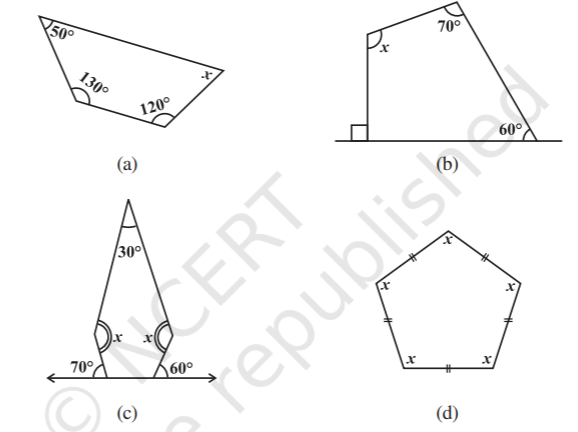
Solution:
**a) Total sum of the angles of the quadrilateral = 360°
Therefore, 50° + 130° + 120° + x = 360° ⇒ 300° + x = 360° ⇒ x = 60°
**b) Total sum of the angles of the quadrilateral = 360°
Therefore, 60° + 70° + 90° + x = 360° ⇒ 220° + x = 360° ⇒ x = 140°
**c) Total sum of the angles of the polygon = 540°
Angles adjacent to 60° = 180° - 60° = 120°
Angles adjacent to 70° = 180° - 70° = 110°
Therefore, 110° + 30° + 120° + x + x= 540° ⇒ 260° + 2x = 540° ⇒ 2x = 280° ⇒ x = 140°
**d) Total sum of the angles of the polygon = 540°
Therefore, x° + x° + x° + x° + x°= 540° ⇒ 5x = 540° ⇒ x = 108°
Question 7. (a) Find x + y + z (b) Find x + y + z + w
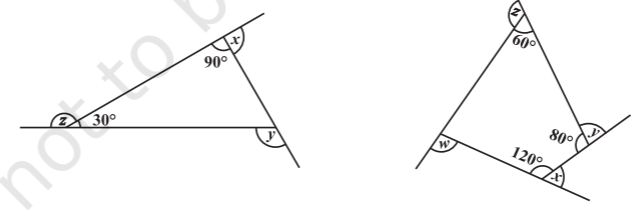
Solution:
****(a)** By exterior angle property, y = 90° + 30° = 120°
x = 180° - 90° = 90°
z = 180° - 30° = 150°
So, the answer x + y + z = 360°
****(b)** Angle adjacent to w = 360° - ( 60° + 80° + 120° ) = 100°
By Adjacent Angle property,
w = 180° - 100° = 80°
x = 180° - 120° = 60°
y = 180° - 80° = 100°
z = 180° - 60° = 120°
So, the answer w + x + y + z = 360°