Class 8 RD Sharma Solutions Chapter 16 Understanding Shapes Quadrilaterals Exercise 16.1 | Set 2 (original) (raw)
Last Updated : 20 Sep, 2024
Chapter 16 of RD Sharma’s Class 8 Mathematics textbook delves into the fascinating world of the quadrilaterals. This chapter explores the properties, types, and applications of the quadrilaterals in geometry. Understanding quadrilaterals is crucial for grasping more complex geometric concepts and solving practical problems involving shapes with four sides.
Shapes: Quadrilaterals
The Quadrilaterals are four-sided polygons with various properties depending on their type. The primary types of quadrilaterals include squares, rectangles, parallelograms, rhombuses, and trapezoids. Each type has unique properties related to the angles, sides, and symmetry making quadrilaterals a fundamental aspect of the geometry.
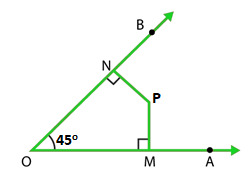
**Question 13. In Figure, find the measure of ∠MPN.
**Solution:
As we know that Sum of angles of a quadrilateral is = 360°
In the quadrilateral MPNO
∠NOP = 45°, ∠OMP = ∠PNO = 90° ****(Given)**
Let us assume that angle ∠MPN is x°
∠NOP + ∠OMP + ∠PNO + ∠MPN = 360°
45° + 90° + 90° + x° = 360°
x° = 360° – 225°
x° = **135°
**Hence, Measure of ∠MPN is 135°
**Question 14. The sides of a quadrilateral are produced in order. What is the sum of the four exterior angles?
**Solution:
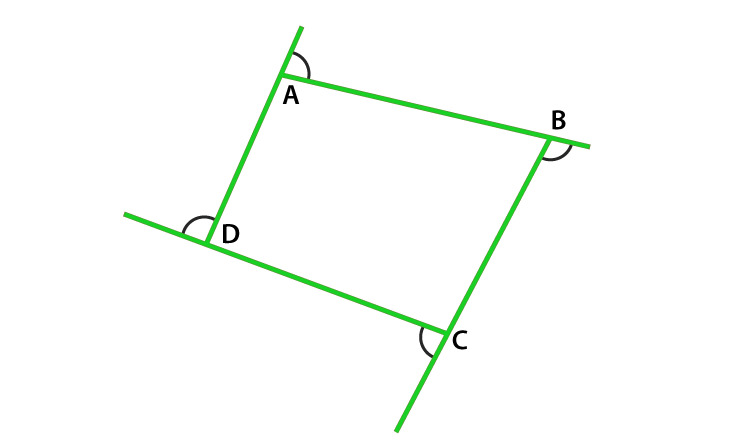
As we know that, exterior angle + interior adjacent angle = 180° ****(Linear pair)**
Applying relation for polygon having n sides
Sum of all exterior angles + Sum of all interior angles = n × 180°
Sum of all exterior angles = n × 180° – Sum of all interior angles
= n × 180° – (n -2) × 180° ****(Sum of interior angles is = (n – 2) x 180°)**
= n × 180° – n × 180° + 2 × 180°
= 180°n – 180°n + 360° = **360°
**Hence, Sum of four exterior angles is 360 o
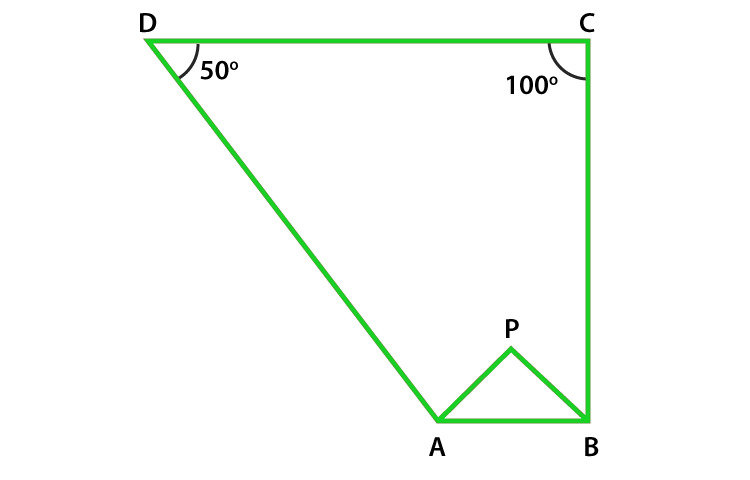
**Question 15. In Figure, the bisectors of ∠A and ∠B meet at a point P. If ∠C =100° and ∠D = 50°, find the measure of ∠APB.
**Solution:
As we know that Sum of angles of a quadrilateral is = 360°
In the quadrilateral ABCD
Given that,
∠C =100° and ∠D = 50°
∠A + ∠B + ∠C + ∠D = 360o
∠A + ∠B + 100o + 50o = 360o
∠A + ∠B = 360o – 150o
∠A + ∠B = 210o ****(Equation 1)**
Now in Δ APB
½ ∠A + ½ ∠B + ∠APB = 180o ****(sum of triangle is 180** o )
∠APB = 180o – ½ (∠A + ∠B) ****(Equation 2)**
On substituting value of ∠A + ∠B = 210 from equation (1) in equation (2)
∠APB = 180o – ½ (210o)
= 180o – 105o = 75o
**Hence, the measure of ∠APB is 75 o .
**Question 16. In a quadrilateral ABCD, the angles A, B, C and D are in the ratio 1:2:4:5. Find the measure of each angle of the quadrilateral.
**Solution:
As we know that Sum of angles of a quadrilateral is = 360°
Let each angle be xo
Therefore,
xo + 2xo + 4xo + 5xo = 360o
12xo = 360o
xo = 360o/12 = 30o
Value of angles are as x = 30o,
2x = 2 × 30 = 60o
4x = 4 × 30 = 120o
5x = 5 × 30 = 150o
**Hence, Value of angles are 30 o , 60 o , 120 o , 150 o .
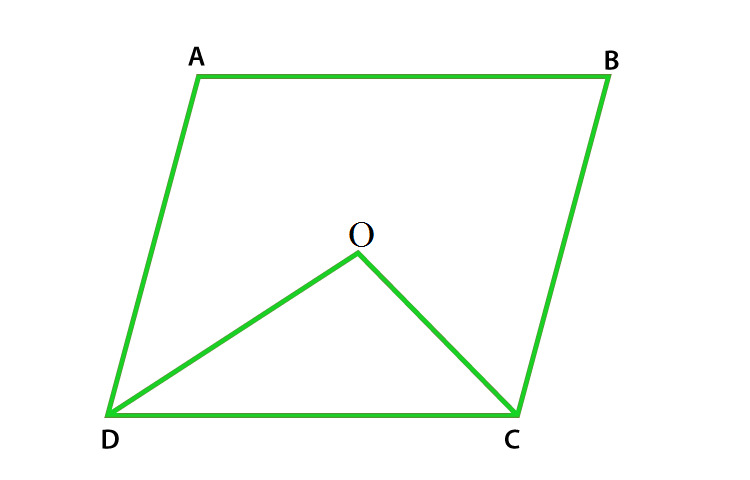
**Question 17. In a quadrilateral ABCD, CO and DO are the bisectors of ∠C and ∠D respectively. Prove that ∠COD = 1/2 (∠A +∠B).
**Solution:
As we know that sum of angles of a quadrilateral is 360°
In the quadrilateral ABCD
Therefore,
∠A + ∠B + ∠C + ∠D = 360o
∠A + ∠B = 360o – (∠C + ∠D)
½ (∠A + ∠B) = ½ [360o – (∠C + ∠D)]
= 180o – ½ (∠C + ∠D) ****(Equation 1)**
Now in Δ DOC
½ ∠D + ½ ∠C + ∠COD = 180o ****(We know that sum of triangle = 180o)**
½ (∠C + ∠D) + ∠COD = 180o
∠COD = 180o – ½ (∠C + ∠D) ****(Equation 2)**
In equations (1) and (2) RHS is equal then LHS will also equal.
**Hence, ∠COD = ½ (∠A + ∠B) is proved.
**Question 18. Find the number of sides of a regular polygon, when each of its angles has a measure of
****(i) 160°**
****(ii) 135°**
****(iii) 175°**
****(iv) 162°**
****(v) 150°**
**Solution:
The sum of interior angle A of a polygon of n sides is given by A = [(n-2) ×180o] /n
****(i) 160** o
Angle of quadrilateral is 160° ****(Given)**
160o = [(n-2) ×180o]/n
160on = (n-2) ×180o
160on = 180on – 360o
180on – 160on = 360o
20on = 360o
n = 360o/20 = 18
**Hence Number of sides are 18
****(ii)** **135 o
Angle of quadrilateral is 135° ****(Given)**
135o = [(n-2) ×180o]/n
135on = (n-2) ×180o
135on = 180on – 360o
180on – 135on = 360o
45on = 360o
n = 360o / 45 = 8
**Hence Number of sides are 8
****(iii) 175** o
Angle of quadrilateral is 175° ****(Given)**
175o = [(n-2) ×180o]/n
175on = (n-2) ×180o
175on = 180on – 360o
180on – 175on = 360o
5on = 360o
n = 360o/5 = 72
**Hence Number of sides are 72
****(iv)** **162 o
Angle of quadrilateral is 162° ****(Given)**
162o = [(n-2) ×180o]/n
162on = (n-2) ×180o
162on = 180on – 360o
180on – 162on = 360o
18on = 360o
n = 360o/18 = 20
**Hence Number of sides are 20
****(v) 150** o
Angle of quadrilateral is 160° ****(Given)**
150o = [(n-2) ×180o]/n
150on = (n-2) ×180o
150on = 180on – 360o
180on – 150on = 360o
30on = 360o
n = 360o/30 = 12
**Hence Number of sides are 12
**Question 19. Find the numbers of degrees in each exterior angle of a regular pentagon.
**Solution:
As we know that the sum of exterior angles of a polygon is 360°
Sum of each exterior angle of a polygon = 360o/n ****(n is the number of sides)**
As we know that number of sides in a pentagon is 5
Sum of each exterior angle of a pentagon = 360o/5 = 72o
**Hence Measure of each exterior angle of a pentagon is 72 o
**Question 20. The measure of angles of a hexagon are x°, (x-5)°, (x-5)°, (2x-5)°, (2x-5)°, (2x+20)°. Find value of x.
**Solution:
As we know that the sum of interior angles of a polygon = (n – 2) × 180° ****(n = number of sides of polygon)**
As we know that hexagon has 6 sides therefore,
The sum of interior angles of a hexagon = (6 – 2) × 180° = 4 × 180° = 720°
x°+ (x-5)°+ (x-5)°+ (2x-5)°+ (2x-5)°+ (2x+20)° = 720°
x°+ x°- 5°+ x° – 5°+ 2x° – 5°+ 2x° – 5°+ 2x° + 20° = 720°
9x° = 720°
x = 720o/9 = 80o
**Hence Value of x is 80 o
**Question 21. In a convex hexagon, prove that the sum of all interior angle is equal to twice the sum of its exterior angles formed by producing the sides in the same order.
**Solution:
As we know that the sum of interior angles of a polygon = (n – 2) × 180°
The sum of interior angles of a hexagon = (6 – 2) × 180° = 4 × 180° = 720°
Sum of exterior angle of a polygon is 360°
Hence Sum of interior angles of a hexagon = Twice the sum of interior angles.
**Hence proved.
**Question 22. The sum of the interior angles of a polygon is three times the sum of its exterior angles. Determine the number of sides of the polygon.
**Solution:
As we know that the sum of interior angles of a polygon = (n – 2) × 180° ****(i)**
The Sum of exterior angle of a polygon is 360°
therefore,
Sum of Interior Angles = 3 × sum of exterior angles
= 3 × 360° = 1080° ****(ii)**
Now by equating (i) and (ii) we get,
(n – 2) × 180° = 1080°
n – 2 = 1080o/180o
n – 2 = 6
n = 6 + 2 = 8
**Hence Number of sides of a polygon is 8.
**Question 23. Determine the number of sides of a polygon whose exterior and interior angles are in the ratio 1 : 5.
**Solution:
As we know that the sum of interior angles of a polygon = (n – 2) × 180° ****(i)**
The Sum of exterior angle of a polygon is 360°
As we know that Sum of exterior angles / Sum of interior angles = 1/5 ****(ii)**
By equating (i) and (ii) we get,
360o/(n – 2) × 180° = 1/5
(n – 2) × 180° = 360o × 5
(n – 2) × 180° = 1800o
(n – 2) = 1800o/180o
(n – 2) = 10
n = 10 + 2 = 12
**Hence Numbers of sides of a polygon is 12.
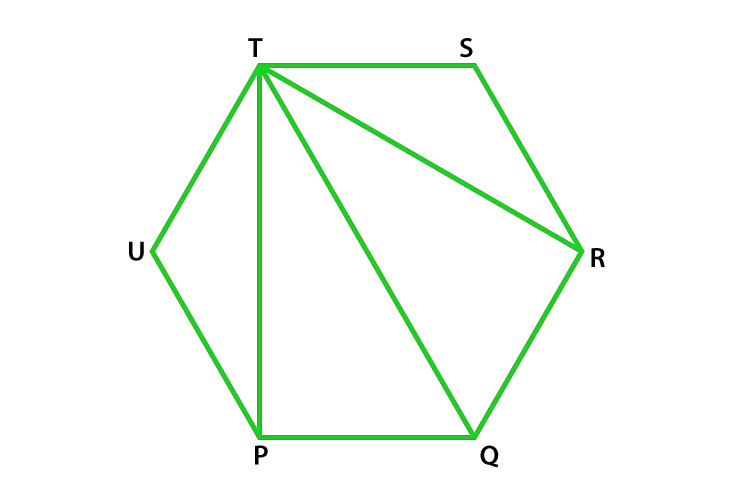
**Question 24. PQRSTU is a regular hexagon, determine each angle of ΔPQT.
**Solution:
As we know that the sum of interior angles of a polygon = (n – 2) × 180°
The sum of interior angles of a hexagon = (6 – 2) × 180° = 4 × 180° = 720°
Sum of each angle of hexagon = 720o/6 = 120o
∠PUT = 120o Proved.
In Δ PUT
∠PUT + ∠UTP + ∠TPU = 180o ****(sum of triangles)**
120o + 2∠UTP = 180o ****(Since Δ PUT is an isosceles triangle )**
2∠UTP = 180o – 120o
2∠UTP = 60o
∠UTP = 60o/2 = 30o
∠UTP = ∠TPU = 30o similarly ∠RTS = 30o
therefore ∠PTR = ∠UTS – ∠UTP – ∠RTS
= 120o – 30o – 30o = 60o
∠TPQ = ∠UPQ – ∠UPT
= 120o – 30o = 90o
∠TQP = 180o – 150o = 30o ****(By using angle sum property of triangle in ΔPQT)**
**Hence ∠P = 90 o , ∠Q = 60 o , ∠T = 30 o
Summary
Exercise 16.1 in Chapter 16 of RD Sharma's Class 8 textbook provides a comprehensive introduction to quadrilaterals. It covers fundamental concepts such as the definition of a quadrilateral, the sum of interior angles, types of quadrilaterals (convex and concave), and properties related to sides and angles. The questions range from basic definitions to more complex problems involving angle calculations and geometric reasoning. This exercise helps students develop their understanding of two-dimensional shapes, particularly four-sided figures, and lays the groundwork for more advanced geometric concepts. By working through these problems, students enhance their spatial visualization skills, learn to apply angle sum properties, and begin to recognize the relationships between different types of quadrilaterals. Mastery of these concepts is crucial for success in higher-level geometry and provides a strong foundation for understanding more complex shapes and their properties in future mathematics courses.