Class 8 RD Sharma Solutions Chapter 18 Practical Geometry Exercise 18.1 (original) (raw)
Last Updated : 20 Sep, 2024
Chapter 18 of RD Sharma's Class 8 Mathematics textbook, focusing on Practical Geometry, introduces students to the fascinating world of geometric constructions, with Exercise 18.1 specifically dealing with the construction of quadrilaterals.
This chapter serves as a crucial bridge between theoretical geometry and its practical applications, teaching students to use tools like compasses, rulers, and protractors to bring geometric concepts to life on paper. By learning to construct various quadrilaterals based on given measurements, students develop essential skills such as spatial reasoning, precision in measurement, and the ability to translate abstract geometric ideas into concrete figures.
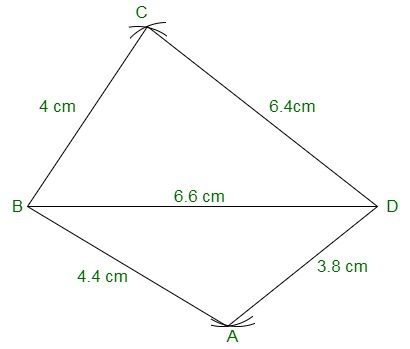
**Question 1: Construct a quadrilateral ABCD in which AB = 4.4 cm, BC = 4 cm, CD = 6.4 cm, DA = 3.8 cm, and BD = 6.6 cm.
**Solution:
Given: AB = 4.4 cm, BC = 4 cm, CD = 6.4 cm, DA = 3.8 cm and BD = 6.6 cm.
Let's divide the quadrilateral into two triangles,
i.e., ΔABD and ΔBCD
**Steps for the construction of a quadrilateral:
**Step 1: Applying SSS congruency rule, Draw line BD of length 6.6 cm.
**Step 2: Now, cut an arc with B as the centre and radius BC = 4 cm. Similarly by taking D as centre and radius CD = 6.4 cm.
**Step 3: Join the intersection point from B and D and mark it as C.
**Step 4: Now for vertex A, cut an arc by taking B as the centre and radius BA = 4.4 cm. Similarly by taking D as centre and radius DA = 3.8 cm.
**Step 5: Join the intersection point from B and D and mark it as A.
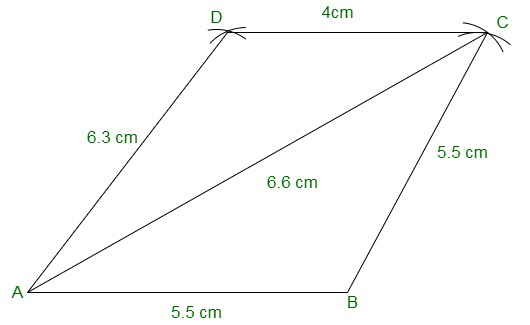
**Question 2: Construct a quadrilateral ABCD in which AB = BC = 5.5 cm, CD = 4 cm, DA = 6.3 cm, AC = 9.4 cm Measure BD?
**Solution:
Given: AB = BC = 5.5 cm, CD = 4 cm, DA = 6.3 cm, AC = 9.4 cm
We have to measure BD.
**Steps for construction of the quadrilateral:
**Step 1: Draw a line segment AB = 5.5 cm
**Step 2: With B as centre and radius BC = 5.5 cm cut an arc. Mark the intersection point as C.
**Step 3: With A as centre and radius AC = 9.4 cm cut an arc to intersect at point C.
**Step 4: With C as centre and radius CD = 4 cm cut an arc. Mark the intersection point as D.
**Step 5: With A as centre and radius AD = 6.3 cm cut an arc to intersect at point D.
**Step 6: Now join BC, CD, and AD
Hence, the Measure of BD is 5.1 cm.
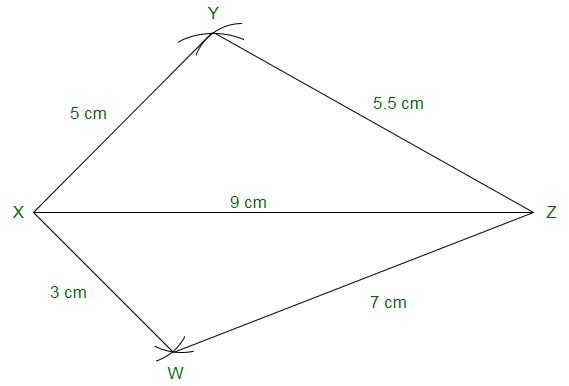
**Question 3: Construct a quadrilateral XYZW in which XY = 5 cm, YZ = 6 cm, ZW = 7 cm, WX = 3 cm and XZ = 9 cm?
**Solution:
We have, XY = 5cm, YZ = 6cm, ZW = 7cm, WX = 3cm and XZ = 9cm.
**Steps to construct a quadrilateral:
**Step 1: Draw a line segment XZ with length = 9 cm.
**Step 2: Taking X as the centre mark an arc of radius XY = 5 cm. Taking Z as centre and radius ZY = 6 cm, repeat the procedure.
**Step 3: Mark the intersection point of X and Z as Y.
**Step 4: For vertex W, taking X as the centre mark an arc of radius XW = 3 cm. Taking Z as centre and radius ZW = 7 cm, repeat the procedure.
**Step 5: Mark the intersection point of X and Z as W.
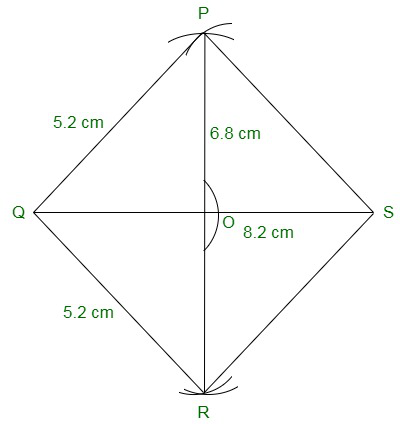
**Question 4: Construct a parallelogram PQRS such that PQ = 5.2 cm, PR = 6.8 cm, and QS = 8.2 cm?
**Solution:
We have, PQ = 5.2 cm, PR = 6.8 cm, and QS = 8.2 cm.
**Steps to construct a parallelogram:
**Step 1: Draw a line segment QS of length = 8.2 cm.
**Step 2: Divide the line segment QS into two equal parts such that each one is = 4.1 cm. Mark the midpoint as O.
**Step 3: Taking O as the centre, draw arcs of length 3.4 cm each on both the sides of the points O. Mark these points as P and R respectively
**Step 4: Taking Q as a centre and radius QR = 5.2cm, draw an arc that intersects point R.
**Step 5: Also, taking Q as a centre and radius QP = 5.2cm, again draw an arc that intersects point P.
**Step 6: Join sides PQ, PS, QR, and RS to form a parallelogram.
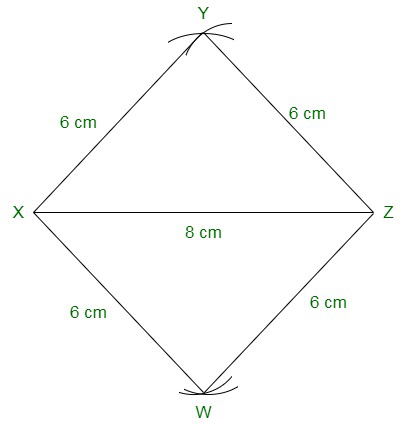
**Question 5: Construct a rhombus with a **side of **6 cm and one diagonal of **8 cm. Measure the other diagonal?
**Solution:
**In a rhombus, all the sides of a rhombus are equal and diagonals bisect each other.
We have a side 6 cm and one diagonal 8 cm.
**Steps to construct a rhombus:
**Step 1: Draw a line segment XZ of length 8 cm.
**Step 2: Taking a radius = 6 cm, cut an arc with X as the centre. Repeat the procedure with Z as the centre and radius = 6 cm.
**Step 3: Mark the intersection point of X and Z as Y.
**Step 4: Taking a radius = 6 cm, cut an arc with W as the centre. Repeat the procedure with Z as the centre and radius = 6 cm.
**Step 5: Mark the intersection point of X and Z as W.
**Step 6: Join the line segments XY, XW, XZ, and ZY to form a rhombus.
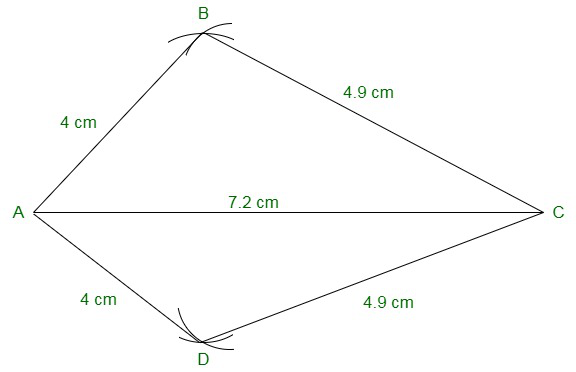
**Question 6: Construct a kite ABCD in which AB = 4 cm, BC = 4.9 cm, AC = 7.2 cm?
**Solution:
We have, AB = 4 cm, BC = 4.9 cm, AC = 7.2 cm.
**Steps to construct a kite:
**Step 1: Draw a line segment AC with length = 7.2 cm.
**Step 2: Taking a radius of 4 cm and cut an arc by taking A as the centre. Also, taking C as the centre, repeat the procedure with radius = 4.9 cm.
**Step 3: Label the intersection point of A and C and mark it as B.
**Step 4: Considering vertex D, draw an arc with A as the centre. Also, taking C as the centre, repeat the procedure with radius = 4.9 cm.
**Step 5: Label the intersection point of A and C and mark it as D.
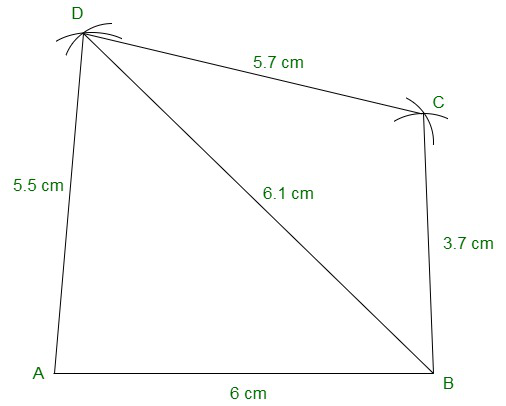
**Question 7: Construct, if possible, a quadrilateral ABCD given AB = 6 cm, BC = 3.7 cm, CD = 5.7 cm, AD = 5.5 cm and BD = 6.1 cm. Give reasons for not being able to construct it, if you cannot?
**Solution:
We have, AB = 6 cm, BC = 3.7 cm, CD = 5.7 cm, AD = 5.5 cm and BD = 6.1 cm.
**Steps to construct a quadrilateral:
**Step 1: Draw a line segment AB with length = 6 cm.
**Step 2: Taking A as the centre, draw an arc of a radius of 5.5 cm. Mark this point as D.
**Step 3: Taking B as a centre, draw an arc of a radius of 6.1 cm intersecting point D.
**Step 4: Also, with B as a centre, draw another arc of a radius of 3.7 cm. Mark this point as C.
**Step 5: Taking D as a centre, draw an arc of a radius of 5.7 cm intersecting point C.
**Step 6: Join the line segments, AD, BD, BC, and DC
**Question 8: Construct, if possible, a quadrilateral ABCD in which AB = 6 cm, BC = 7 cm, CD = 3 cm, AD = 5.5 cm and AC = 11 cm. Give reasons for not being able to construct, if you cannot. (Not possible, because in triangle ACD, AD + CD<AC)?
**Solution:
We have, AB = 6 cm, BC = 7 cm, CD = 3 cm, AD = 5.5 cm and AC = 11 cm.
Since, we know, In any triangle the sum of the length of its two sides must be greater than that of the third side, therefore a quadrilateral with such dimensions cannot be constructed.
Considering in triangle ACD,
AD + CD = 5.5 + 3 = 8.5 cm
Given, AC = 11 cm
Now, AD + CD < AC which is not possible.
Hence, the construction cannot be performed.
Summary
Exercise 18.1 of Chapter 18 provides students with invaluable hands-on experience in constructing various types of quadrilaterals, deepening their understanding of geometric properties and relationships between different elements such as sides, angles, and diagonals. Through these practical constructions, students not only reinforce their theoretical knowledge but also develop crucial skills like precision, spatial reasoning, and the ability to follow step-by-step procedures. This practical approach to geometry lays a strong foundation for more advanced mathematical concepts and problem-solving techniques, while also offering direct applications in fields such as engineering, architecture, and design, thus bridging the gap between abstract mathematical principles and real-world applications.