Class 8 RD Sharma Solutions Chapter 18 Practical Geometry Exercise 18.5 (original) (raw)
Last Updated : 13 Sep, 2024
Chapter 18 of RD Sharma's Class 8 Mathematics textbook focuses on Practical Geometry. Exercise 18.5 specifically deals with the construction of quadrilaterals. This exercise is crucial as it helps students apply theoretical knowledge of quadrilaterals to practical constructions using geometric tools.
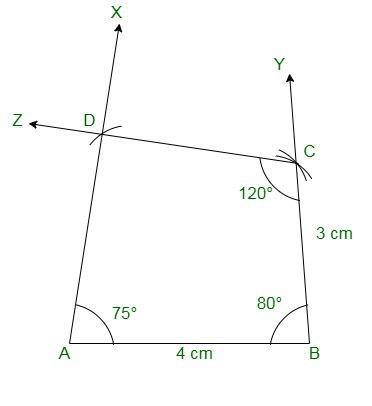
**Question 1: Construct a quadrilateral ABCD given that AB = 4 cm, BC = 3 cm, ∠A = 75°, ∠B = 80° and ∠C = 120°?
**Solution:
We have, AB = 4 cm, BC = 3 cm, ∠A = 75°, ∠B = 80° and ∠C = 120°.
**Steps to construct a quadrilateral:
**Step 1: Draw a line segment AB = 4cm
**Step 2: Construct an angle of 75° at A.
**Step 3: Construct an angle of 80° at B.
**Step 4: Taking B as the centre, draw an arc radius of 3 cm. Mark this point as C.
**Step 5: Construct an angle of 120° at C such that it intersects the line segment AX. Mark that point as D.
**Step 6: Now join BC, CD, and DA to form a quadrilateral.
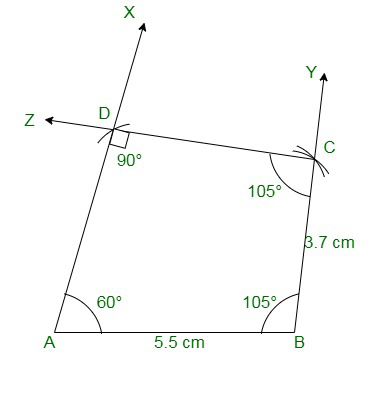
**Question 2: Construct a quadrilateral ABCD where AB = 5.5 cm, BC = 3.7 cm, ∠A = 60°, ∠B = 105° and ∠D = 90°?
**Solution:
We have, AB = 5.5 cm, BC = 3.7 cm, ∠A = 60°, ∠B = 105° and ∠D = 90°.
We know that ∠A + ∠B + ∠C + ∠D = 360°.
∴ ∠C = 105°
**Steps to construct a quadrilateral:
**Step 1: Draw a line segment AB = 5.5cm
**Step 2: Construct an angle of 60° at A.
**Step 3: Construct an angle of 105° at B.
**Step 4: Taking B as the centre, draw an arc radius of 3.7 cm. Mark this point as C.
**Step 5: Construct and angle of 105° at C such that it intersects the line segment AX. Mark that point as D.
**Step 6: Now join BC, CD, and DA to form a quadrilateral.
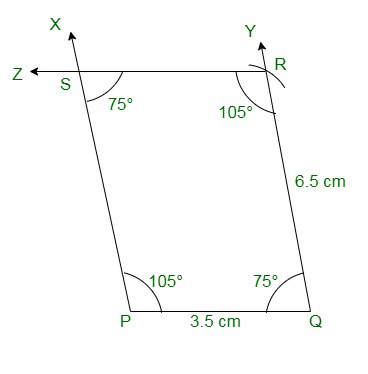
**Question 3: Construct a quadrilateral PQRS where PQ = 3.5 cm, QR = 6.5 cm, ∠P = ∠R = 105° and ∠S = 75°?
**Solution:
We have, PQ = 3.5 cm, QR = 6.5 cm, ∠P = ∠R = 105° and ∠S = 75°.
We know that ∠P + ∠Q + ∠R + ∠S = 360°
∴ ∠Q = 75°
**Steps to construct a quadrilateral:
**Step 1: Draw a line segment PQ = 3.5cm
**Step 2: Construct an angle of 105° at P.
**Step 3: Construct an angle of 75° at Q.
**Step 4: Taking Q as the centre, draw an arc radius of 6.5 cm. Mark this point as R.
**Step 5: Construct an angle of 105° at R such that it intersects the line segment PX. Mark the point as S.
**Step 6: Now join QR, RS, and PS to form a quadrilateral.
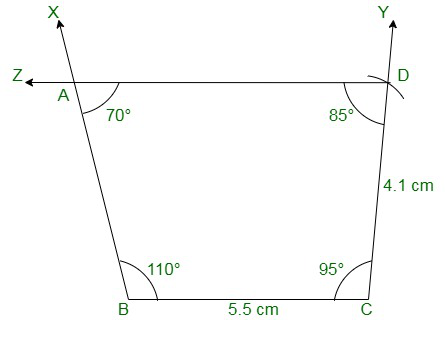
**Question 4: Construct a quadrilateral ABCD when BC = 5.5 cm, CD = 4.1 cm, ∠A = 70°, ∠B = 110° and ∠D = 85°?
**Solution:
We have, BC = 5.5 cm, CD = 4.1 cm, ∠A = 70°, ∠B = 110° and ∠D = 85°.
We know that ∠A + ∠B + ∠C + ∠D = 360°
∴ ∠C = 95°
**Steps to construct a quadrilateral:
**Step 1: Draw a line segment BC = 5.5cm
**Step 2: Construct an angle of 110° at B.
**Step 3: Construct an angle of 95° at C.
**Step 4: Taking C as the centre, draw an arc radius of 4.1 cm. Mark this point as D.
**Step 5: Construct an angle of 85° at D such that it intersects the line segment BX. Mark that point as A.
**Step 6: Now join CD, DA, and BA to form a quadrilateral.
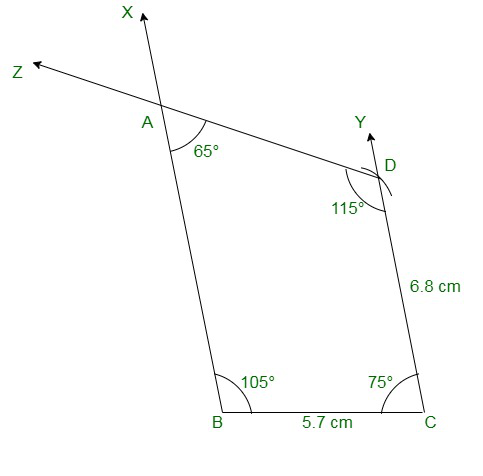
**Question 5: Construct a quadrilateral ABCD ∠A = 65°, ∠B = 105°, ∠C = 75°, BC = 5.7 cm and CD = 6.8 cm?
**Solution:
We have, ∠A = 65°, ∠B = 105°, ∠C = 75°, BC = 5.7 cm and CD = 6.8 cm.
We know that ∠A + ∠B + ∠C + ∠D = 360°
∴ ∠D = 115°
**Steps to construct a quadrilateral:
**Step 1: Draw a line segment BC = 5.7cm
**Step 2: Construct an angle of 105° at B.
**Step 3: Construct an angle of 75° at C.
**Step 4: Taking C as the centre, draw an arc radius of 6.8 cm. Mark this point as D.
**Step 5: Construct an angle of 115° at D such that it intersects the line segment BX. Mark that point as A.
**Step 6: Now join CD, DA, and BA to form a quadrilateral.
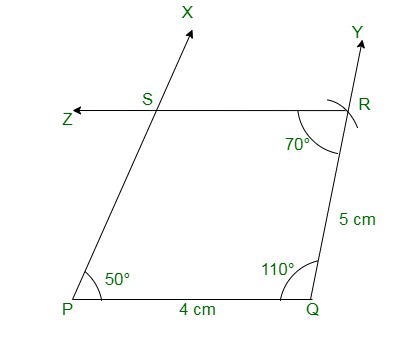
**Question 6: Construct a quadrilateral PQRS in which PQ = 4 cm, QR = 5 cm ∠P = 50°, ∠Q = 110° and ∠R = 70°?
**Solution:
We have, PQ = 4 cm, QR = 5 cm ∠P = 50°, ∠Q = 110° and ∠R = 70°.
**Steps to construct a quadrilateral:
**Step 1: Draw a line segment PQ = 4cm
**Step 2: Construct an angle of 50° at P.
**Step 3: Construct an angle of 110° at Q.
**Step 4: Taking Q as the centre, draw an arc radius of 5 cm. Mark this point as R.
**Step 5: Construct an angle of 70° at R such that it intersects the line segment PX. Mark that point as S.
**Step 6: Now join QR, RS, and PS to form a quadrilateral.
Summary
Exercise 18.5 of Chapter 18 focuses on the practical application of geometric principles in constructing quadrilaterals. Students learn to use compass, ruler, and protractor to accurately draw quadrilaterals based on given measurements of sides, angles, and diagonals. This exercise enhances spatial reasoning, precision in measurement, and understanding of quadrilateral properties.