Class 8 RD Sharma Solutions Chapter 3 Squares and Square Roots Exercise 3.3 | Set 1 (original) (raw)
Last Updated : 11 Sep, 2024
Exercise 3.3 | Set 1 of Chapter 3 (Squares and Square Roots) in RD Sharma's Class 8 mathematics textbook focuses on applying squares and square roots to solve problems related to areas and perimeters. This exercise introduces students to real-world applications of these concepts, particularly in geometry. Students learn to calculate the areas and perimeters of squares and rectangles using the properties of squares and square roots and to solve word problems involving these shapes.
Squares and Square Roots
Squares and square roots are two essential mathematical concepts. A square of a number results from multiplying the number by itself. For example: the square of 4 is 42=16. Conversely, the square root of a number is a value that when multiplied by itself gives the original number. For instance, the square root of 16 is 4. These concepts are not only foundational in arithmetic but also crucial in the more advanced mathematical topics and real-world applications.
Question 1. Find the square of the following numbers using the column method. Verify the squares using the usual multiplication.
(i) 25
**Solution:
Here, we will break 25 in as between one's and ten's position as a = 2 and b = 5. Now,
Step 1: Make 3 columns and write the values of a², 2ab, b² in these columns.
**Column 1 **Column 2 **Column 3 a2 2ab b2 4 20 25 Step 2: Underline the unit digit of b² and add its ten's digit(if any) to 2ab.
**Column 1 **Column 2 **Column 3 a2 2ab b2 4 20 + 2 25 22 Step 3: Now Underline the unit digit of column 2 and add its ten's digit(if any) to a²
**Column 1 **Column 2 **Column 3 a2 2ab b2 4+2 20+2 25 6 22 Step 4: Now underline the number in column 1.
**Column 1 **Column 2 **Column 3 a2 2ab b2 4+2 20+2 25 6 22 Step 5: Now write the underlined digits respectively as the square.
252 = 625
Now using multiplication,
252 = 25 x 25 = 625
Because we have the same result in both the methods hence our result is verified.
(ii) 37
**Solution:
Here, a = 3, b = 7
**Column 1 **Column 2 **Column 3 a2 2ab b2 9 + 4 42 + 4 49 13 46 Now write the underlined digits respectively as the square.
372 = 1369
Now using multiplication,
372 = 37 x 37 = 1369
Because we have the same result in both the methods hence our result is verified.
(iii) 54
**Solution:
Here, a = 5, b = 4.
**Column 1 **Column 2 **Column 3 a2 2ab b2 25+4 40+1 16 29 41 Now write the underlined digits respectively as the square.
542 = 2916
Now using multiplication,
542 = 54 x 54 = 2916
Because we have the same result in both the methods hence our result is verified.
(iv) 71
**Solution:
Here, a = 7, b = 1.
**Column 1 **Column 2 **Column 3 a2 2ab b2 49 + 1 14 + 0 1 50 14 Now write the underlined digits respectively as the square.
712 = 5041
Now using multiplication,
712 = 71 x 71 = 5041
Because we have the same result in both the methods hence our result is verified.
(v) 96
**Solution:
Here, a = 9, b = 6.
**Column 1 **Column 2 **Column 3 a2 2ab b2 81 + 11 108 + 3 36 92 113 Now write the underlined digits respectively as the square.
962 = 9216
Now using multiplication,
962 = 96 x 96 = 9216.
Because we have the same result in both the methods hence our result is verified.
Question 2. Find the squares of the following numbers using the diagonal method:
(i) 98
**Solution:
Because, 98² = 9604
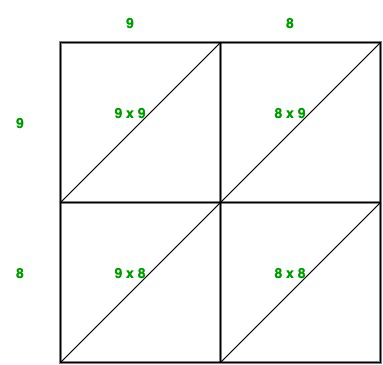
Draw a square table with equal no. of rows and columns as the no. of digits are.
Now divide each block in two parts.
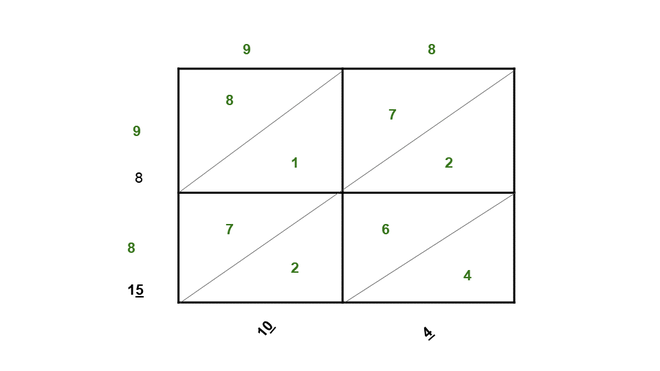
Now, write the digits as depicted, and we have to store the values as provided in each block
Now Store the values as shown and add them as per the subdivision we have made, i.e., 4, 2 + 6 + 2, 7 + 1 + 7, 8 and the previous carry(i.e., take only one unit's digit and transfer the other as carry).
Now, write the underlined(unit's digit), as the square of the number
982 = 9604
(ii) 273
**Solution:
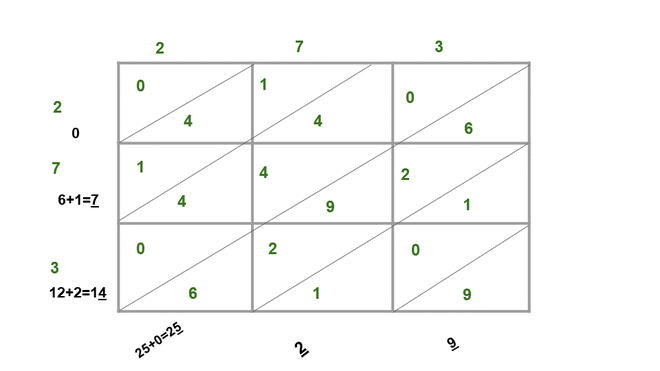
Because, 2732 = 74529
Now, write the underlined(unit's digit), as the square of the number
2732 = 74529
(iii) 348
**Solution:
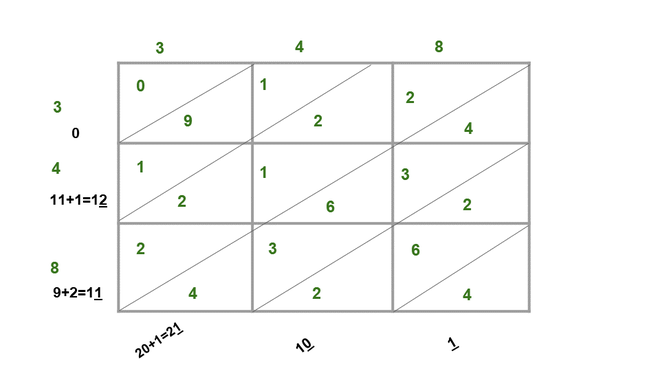
Because, 3482 = 121104
Now, write the unit's digit as the square of 348,
3482 = 121104
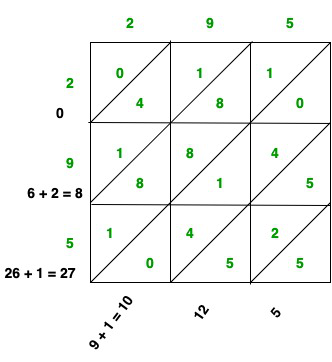
(iv) 295
**Solution:
Because, 2952 = 87025
Now, write each one's digit as the square of 295,
2952 = 87025
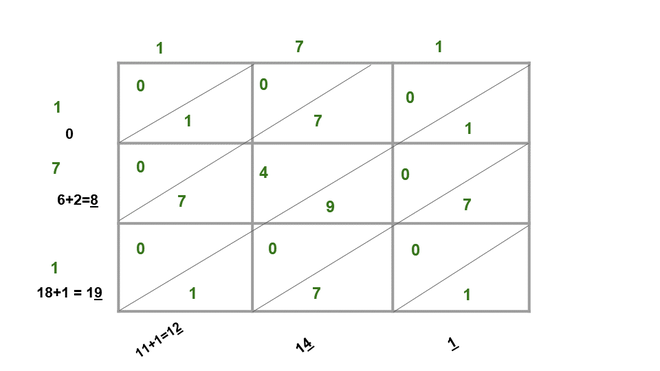
(v) 171
**Solution:
Because, 1712 = 29241
Now, write each one's digit as the square of 171,
1712 = 29241
Question 3. Find the square of the following numbers:
(i) 127
**Solution:
Here let's take a = 120, b = 7
1272 = (120 + 7)2 = 1202 + (2 x 120 x 7) + 72
= (120 x 120) + 1680 + (7 x 7)
= 14400 + 1680 + 49
= 16129
**Alternatively:
We could also take a = 100, b = 27,
1272 = 10000 + 5400 + 729 = 16129
Thus, 1272 = 16129
(ii) 503
**Solution:
Here, let's take a = 500, b = 3.
5032 = (500 + 3)2 = 5002 + (2 x 500 x 3) + 32
= 250000 + 3000 + 9
= 253009
**Alternatively:
5032 = 503 x 503 = 253009
Thus, 5032 = 253009
(iii) 451
**Solution:
Here, let's take a = 400, b = 51.
4512 = (400 + 51)2 = 4002 + (2 x 400 x 51) + 512
= 160000 + 40800 + 2601
= 203401
**Alternatively:
451² = 451 x 451 = 203401
451² = 203401
(iv) 862
**Solution:
Here, let's take a = 800, b = 62.
8622 = (800 + 62)2 = 8002 + (2 x 800 x 62) + 622
= 640000 + 99200 + 3844
= 743044
**Alternatively:
862² = 862 x 862 = 743044
862² = 743044
(v) 265
**Solution:
Here, let's take a = 200, b = 65.
2652 = (200 + 65)2 = 2002 + (2 x 200 x 65) + 652
= 40000 + 26000 + 4225
= 70225
**Alternatively:
265² = 265 x 265 = 70225
265² = 70225
Summary
Exercise 3.3 | Set 1 of Chapter 3 in RD Sharma's Class 8 mathematics textbook applies the concepts of squares and square roots to geometric problems. This set focuses on calculating areas and perimeters of squares and rectangles, as well as solving more complex problems involving these shapes. Students learn to use the Pythagorean theorem to find diagonal lengths and to manipulate algebraic expressions involving areas and perimeters. The problems in this set are designed to develop students' problem-solving skills in practical contexts, helping them understand the real-world applications of squares and square roots. By working through these exercises, students enhance their ability to translate word problems into mathematical equations, choose appropriate formulas, and interpret results in the context of the original problem.