Class 9 NCERT Solutions Chapter 6 Lines And Angles Exercise 6.1 (original) (raw)
Last Updated : 23 Jul, 2025
Chapter 6 of the Class 9 NCERT Mathematics textbook, titled "Lines and Angles," explores fundamental concepts related to angles and the relationships between them. This chapter includes topics such as the types of angles, the properties of parallel lines cut by a transversal, and theorems related to angles. Exercise 6.1 focuses on solving problems involving the measurement and relationships of angles.
Class 9 NCERT Solutions - Chapter 6 Lines and Angles - Exercise 6.1
This section provides detailed solutions for Exercise 6.1 from Chapter 6 of the Class 9 NCERT Mathematics textbook. The solutions are designed to help students understand and apply the concepts related to lines and angles.
Lines and angles are fundamental concepts in geometry, forming the basis for many geometric principles and theorems. In this article, we will be going to solve the entire exercise 6.1 of our NCERT textbook.
What are Lines and Angles?
Lines
**Definition: A line is a straight one-dimensional figure that extends infinitely in both directions. It has no curvature, thickness, or endpoints.
**Types of Lines
- **Horizontal Line: A line that runs left to right and is parallel to the horizon.
- **Vertical Line: A line that runs up and down and is perpendicular to the horizon.
- **Oblique Line: A line that is neither horizontal nor vertical.
- **Parallel Lines: Two lines that never intersect and are equidistant from each other.
- **Perpendicular Lines: Two lines that intersect at a right angle (90°).
Angles
**Definition: An angle is formed by two rays (the sides of the angle) that share a common endpoint (the vertex). The amount of rotation between the two rays is measured in degrees or radians.
**Types of Angles
- **Acute Angle: An angle less than 90°.
- **Right Angle: An angle of exactly 90°.
- **Obtuse Angle: An angle greater than 90° but less than 180°.
- **Straight Angle: An angle of exactly 180°.
- **Reflex Angle: An angle greater than 180° but less than 360°.
- **Full Angle: An angle of 360°, representing a full rotation.
Question 1. In the given figure, lines AB and CD intersect at O. If ∠AOC + ∠BOE = 70° and ∠BOD = 40°, find ∠BOE and reflex ∠COE?
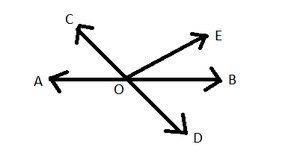
**Solution:
Given, AB and CD are straight lines.
∠AOC + ∠BOE = 70° ----eq(i)
∠BOD = 40° ----eq(ii)
Since, AB is a straight line, the sum of all angles made on it is 180°
=> ∠AOC + ∠COE + ∠BOE = 180° ---eq(iii)
We can rearrange this equation as,
=> ∠AOC + ∠BOE + ∠COE = 180°
=> 70° + ∠COE = 180° ---from eq(i)
=> ∠COE = 180° - 70° = 110°
=> ∠COE = 110° ---eq(iv)
**Reflex ∠COE = 360° - ∠COE = 360° - 110° = 250°
Now, it is also given that CD is also a straight line, so the sum of all angles made on it is 180°
=> ∠COE + ∠BOE + ∠BOD = 180° ---eq(v)
We can rearrange this equation as,
=> ∠COE + ∠BOD + ∠BOE = 180°
=> 110° + 40° + ∠BOE = 180° ---from eq(ii) and eq(iv)
=> 150° + ∠BOE = 180°
=> ∠BOE = 180° - 150° = 30°
**=> ∠BOE = 30°
Question 2. In the given figure, lines XY and MN intersect at O. If∠POY = 90° and a : b = 2 : 3, find c?
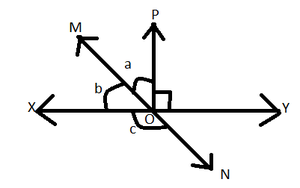
**Solution:
**Given, XY and MN are straight lines.
**∠POY = 90° --eq(i)
**a : b = 2 : 3 --eq(ii)
∠POM = a
∠XOM = b
∠XON = c
Taking XY as a straight line, so the sum of all angles made on it is 180°
=> ∠XOM + ∠POM + ∠POY = 180° ---eq(iii)
=> b + a + 90° = 180°
=> 3x + 2x + 90° = 180° from eq(i) and eq(ii)
=> 5x + 90° = 180°
=> 5x = 180° - 90° = 90°
=> 5x = 90°
=> x = 18°
**a : b = 2x : 3x = 2x18 : 3x18
**a = 36°
**b = 54°
Taking MN as a straight line so,the sum of all the angles made on it is 180°
=> ∠XOM + ∠XON = 180°
=> 54° + ∠XON = 180° from above finding value
=> **∠XON = 126° or c = 126°
Question 3. In the given figure, ∠PQR = ∠PRQ, then prove that ∠PQS = ∠PRT?
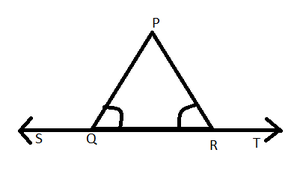
**Solution:
Given, ∠PQR = ∠PRQ
Taking ST is a straight line, so the sum of all angles made on it is 180°
=> ∠PQS + ∠PQR = 180° ----eq(i)
also, ∠PRQ + ∠PRT = 180° ---eq(ii)
By equating both the equations because RHS of both the equation is equal So, LHS will also be equal.
=> ∠PQS + ∠PQR = ∠PRQ + ∠PRT
=> ∠PQS + ∠PQR = ∠PQR + ∠PRT --[ Given in question ∠PQR = ∠PRQ ]
=> **∠PQS = ∠PRT
Question 4. In the given figure, if x + y = w + z, then prove that AOB is a line?
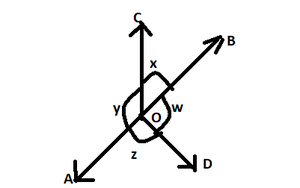
**Solution:
**Given, x + y = w + z --eq(i)
We know that , sum of all angles made along a point is 360°
So, Taking O as a point ∠AOC + ∠BOC + ∠BOD + ∠AOD = 360°
=> y + x + w + z = 360° from the given figure
=> (x + y) + (x + y) = 360° from eq(i)
=> 2x + 2y = 360°
=> 2(x + y) = 360°
=> x + y=180°
From this statement it is proved that AOB is a straight line because the sum of angles made on the line is 180°. **So, AOB is a straight line.
Question 5. In the given figure, POQ is a line. Ray OR is perpendicular to line PQ. OS is another ray lying between rays OP and OR. Prove that∠ROS = (1/2) (∠QOS – ∠POS)?
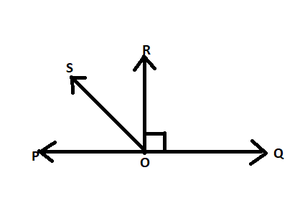
**Solution:
**Given POQ is a straight line
So, the sum of all angles made on it is 180°
=> ∠POS + ∠ROS + ∠ROQ = 180°
=> ∠POS + ∠ROS + 90° = 180° [given ∠ROQ = 90°]
=> ∠POS + ∠ROS = 90°
=> ∠ROS = 90° - ∠POS --eq(i)
Now, ∠ROS + ∠ROQ = ∠QOS [from figure]
=> ∠ROS + 90° = ∠QOS
=> ∠ROS = ∠QOS - 90° --eq(ii)
Now Adding both the equations eq(i) + eq(ii)
=> ∠ROS + ∠ROS = 90° - ∠POS + ∠QOS - 90°
=> 2∠ROS =(∠QOS - ∠POS)
=> **∠ROS = (1/2) (∠QOS - ∠POS)
**Hence Verified!!!
Question 6. It is given that ∠XYZ = 64° and XY is produced to point P. Draw a figure from the given information. If ray YQ bisects ∠ZYP, find ∠XYQ and reflex ∠QYP?
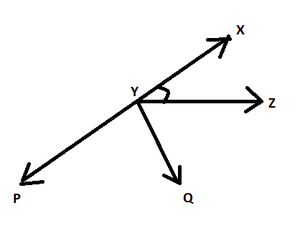
**Solution:
**From the drawn figure, it is clearly shown that XYP is a straight line.
So, ∠XYZ + ∠ZYQ + ∠QYP = 180°
=> 64°+ ∠ZYQ + ∠QYP = 180° [ given ∠XYZ = 64°]
=> 64° + 2∠QYP = 180° [ YQ bisect ∠ZYP so, ∠QYP = ∠ZYQ]
=> 2∠QYP = 180° - 64° = 116°
=> ∠QYP = 58°
**So, Reflex ∠QYP = 360° - 58° = 302°
Since ∠XYQ = ∠XYZ + ∠ZYQ
=> ∠XYQ = 64° + ∠QYP [ given ∠XYZ = 64° and ∠ZYQ = ∠QYP]
=> ∠XYQ =64° + 58° = 122°
**Thus, ∠XYQ = 122° and Reflex ∠QYP = 302°