Class 9 NCERT Solutions Chapter 6 Lines And Angles Exercise 6.3 (original) (raw)
Last Updated : 11 Sep, 2024
Chapter 6 of the Class 9 NCERT Mathematics book focuses on the Lines and Angles which are fundamental concepts in geometry. Exercise 6.3 specifically deals with the problems related to the properties of the angles formed by intersecting lines, parallel lines, and transversal lines. This exercise aims to deepen the understanding of the various angle properties and their relationships helping students build a solid foundation in geometry.
What is Lines and Angles?
Lines and Angles is a branch of geometry that studies the relationships between the different types of lines and the angles they form. Key concepts include:
- Intersecting Lines: The Lines that cross each other at a point.
- Parallel Lines: The Lines in the same plane that never meet no matter how far they are extended.
- Transversal: A line that intersects two or more other lines at distinct points.
- Types of Angles: Including the complementary, supplementary, and corresponding angles which are crucial for solving geometric problems.
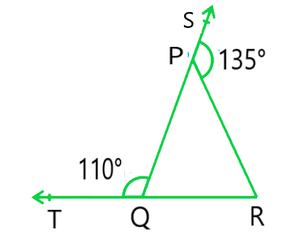
Question 1: In Figure, sides QP and RQ of ΔPQR are produced to points S and T respectively. If ∠SPR = 135° and ∠PQT = 110°, find ∠PRQ.
**Solution:
**Given: ∠TQP = 110°, ∠SPR = 135°
TQR is a Straight line as we can see in the figure
As we have studied in this chapter, TQP and PQR will form a linear pair
⇒ ∠TQP + ∠PQR = 180° ----------(i)
Putting the value of ∠TQP = 110° in Equation (i) we get,
⇒ 110° + ∠PQR = 180°
⇒ ∠PQR = 70°
Consider the ΔPQR,
Here, the side QP is extended to S and so, SPR forms the exterior angle.
Thus, ∠SPR (∠SPR = 135°) is equal to the sum of interior opposite angles. (Triangle property)
Or, ∠PQR + ∠PRQ = 135° ---------(ii)
Now, putting the value of PQR = 70° in equation (ii) we get,
∠PRQ = 135° - 70°
Hence, ∠PRQ = 65°
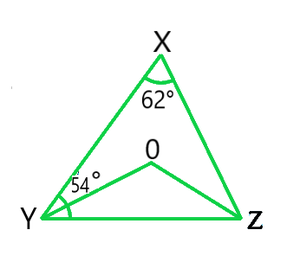
Question 2: In Figure, ∠X = 62°, ∠ XYZ = 54°. If YO and ZO are the bisectors of XYZ and XZY respectively of Δ XYZ, find OZY and YOZ.
**Solution:
**Given: ∠X = 62°, ∠XYZ = 54°
As we have studied in this chapter,
We know that the sum of the interior angles of the triangle is 180°.
So, ∠X +∠XYZ +∠XZY = 180°
Putting the values as given in the question we get,
62°+54° + ∠XZY = 180°
Or, ∠XZY = 64°
Now, we know that ZO is the bisector so,
∠OZY = ½ XZY
∴ ∠OZY = 32°
Similarly, YO is a bisector and so,
∠OYZ = ½ XYZ
Or, ∠OYZ = 27° (As XYZ = 54°)
Now, as the sum of the interior angles of the triangle,
∠OZY +∠OYZ +O = 180°
Putting their respective values, we get,
∠O = 180°-32°-27°
Hence, ∠O = 121°
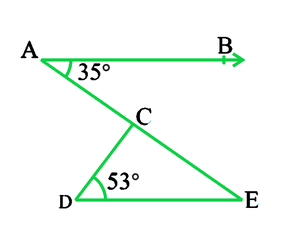
Question 3: In Figure, if AB || DE, ∠BAC = 35° and ∠CDE = 53°, find ∠DCE.
**Solution:
**Given: AB || DE,∠BAC = 35° and ∠CDE = 53°
Since, we know that AE is a transversal of AB and DE
Here, BAC and AED are alternate interior angles.
Hence, ∠BAC = ∠AED
∠BAC = 35° (Given)
∠AED = 35°
Now consider the triangle CDE. We know that the sum of the interior angles of a triangle is 180°.
∴ ∠DCE + ∠CED + ∠CDE = 180°
Putting the values, we get
∠DCE + 35° + 53° = 180°
Hence, ∠DCE = 92°
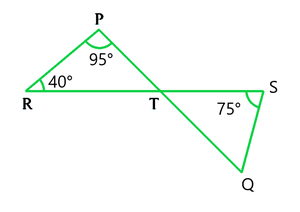
Question 4: In Figure, if lines PQ and RS intersect at point T, such that ∠PRT = 40°, ∠RPT = 95° and ∠TSQ = 75°, find ∠SQT.
**Solution:
**Given: ∠PRT = 40°, ∠RPT = 95° and ∠TSQ = 75°
In △PRT.
∠PRT +∠RPT + ∠PTR = 180° (The Sum of all the angles of Triangle is 180°)
⇒ ∠PTR = 45°
Now ∠PTR will be equal to STQ as they are vertically opposite angles.
⇒ ∠PTR = ∠STQ = 45°
Again, in triangle STQ,
⇒ ∠TSQ +∠PTR + ∠SQT = 180° (The Sum of all the angles of Triangle is 180°)
Solving this we get,
⇒ ∠SQT = 60°
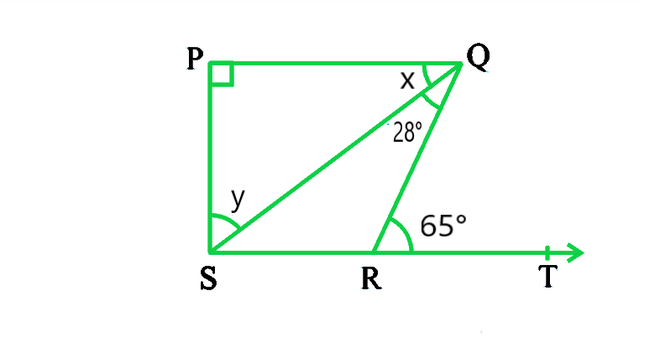
Question 5: In Figure, if PQ ⊥ PS, PQ || SR, ∠SQR = 28° and ∠QRT = 65°, then find the values of x and y.
**Solution:
**Given: PQ ⊥ PS, PQ || SR, ∠SQR = 28° and ∠QRT = 65°
x + SQR = QRT (As they are alternate angles since QR is transversal)
Now, Putting the value of ∠SQR = 28° and ∠QRT = 65°
⇒ x + 28° = 65°
∴ x = 37°
It is also known that alternate interior angles are same and
⇒ QSR = x = 37°
Also,
⇒ QRS + QRT = 180° (As they form a Linear pair)
Putting the value of ∠QRT = 65° we get,
⇒ QRS + 65° = 180°
⇒ QRS = 115°
As we know that the sum of the angles in a quadrilateral is 360°.
⇒ P + Q + R + S = 360°
Putting their respective values, we get,
⇒ S = 360° - 90° - 65° - 115° = 900
In Δ SPQ
⇒ ∠SPQ + x + y = 1800
⇒ 900 + 370 + y = 1800
⇒ y = 1800 – 1270 = 530
Hence, y = 53°
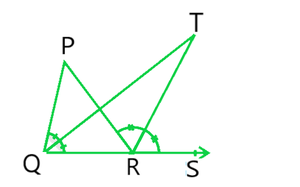
Question 6: In Figure, the side QR of ΔPQR is produced to a point S. If the bisectors of ∠PQR and ∠PRS meet at point T, then prove that ∠QTR = ½ ∠QPR.
**Solution:
**Given: T is the bisector of ∠PQR and ∠PRS,
**To Prove: ∠QTR = ½ ∠QPR
**Proof:
Consider the ΔPQR.
∠PRS is an exterior angle.
∠QPR and ∠PQR are interior angles.
⇒ ∠PRS = ∠QPR + ∠PQR (According to triangle property)
⇒ ∠PRS - ∠PQR = ∠QPR ------------(i)
Now, consider the ΔQRT,
∠TRS = ∠TQR + ∠QTR (Since exterior angle are equal)
⇒ ∠QTR = ∠TRS - ∠TQR
We know that QT and RT bisect ∠PQR and ∠PRS respectively.
So, ∠PRS = 2 ∠TRS and ∠PQR = 2∠TQR
Now,
⇒ ∠QTR = ½ ∠PRS – ½ ∠PQR
⇒ ∠QTR = ½ ∠(PRS - PQR)
From equation (i) we know that ∠PRS - ∠PQR = ∠QPR,
⇒ ∠QTR = ½ ∠QPR
Hence, Proved.
Conclusion
Exercise 6.3 in Chapter 6 of the Class 9 NCERT Mathematics book provides the practical problems to apply the theoretical concepts of the lines and angles. Mastering these problems helps students understand how lines and angles interact in the different scenarios in which is essential for solving more complex geometric problems and for progressing in the geometry.