Class 9 NCERT Solutions Chapter 7 Triangles Exercise 7.1 (original) (raw)
Last Updated : 23 Jul, 2025
Chapter 7 of the Class 9 NCERT Mathematics textbook focuses on Triangles a fundamental concept in geometry. This chapter explores various properties and theorems related to the triangles such as the congruence, similarity, and various criteria for proving the triangles congruent. Exercise 7.1 is an essential part of this chapter designed to test students' understanding of these concepts through practical problems. Mastering this exercise is crucial for building a strong foundation in geometry which is vital for higher-level math and real-world applications.
Triangles
In Class 9, Chapter 7 of the NCERT Mathematics textbook focuses on the Triangles which are fundamental shapes in geometry. Exercise 7.1 in this chapter is designed to help students understand the properties of the triangles including the criteria for the triangle congruence. Mastering this exercise is crucial as it forms the basis for the more advanced geometric concepts and problem-solving techniques. Understanding triangles is important for building a strong foundation in geometry which is essential for both academic success and practical applications in the various fields.
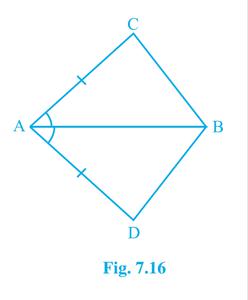
**Question 1. In quadrilateral ACBD **AC = AD and AB bisects ∠ A (see Fig. 7.16). Show that ∆ ABC ≅ ∆ ABD What can you say about BC and BD?
**Solution:
Given that AC and AD are equal
i.e. AC = AD and the line AB bisects ∠A.
Considering the two triangles ΔABC and ΔABD,
Where,
AC = AD { As given}................................................ (i)
∠CAB = ∠DAB ( As AB bisects of ∠A)................ (ii)
AB { Common side of both the triangle} ........ ...(iii)
From above three equation both the triangle satisfies "SAS" congruency criterion
So, ΔABC ≅ ΔABD.
Also,
BC and BD will be of equal lengths as they are corresponding parts of congruent triangles(CPCT).
So BC = BD.
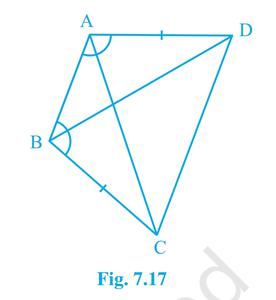
**Question 2. ABCD is a quadrilateral in which AD = BC and ∠ DAB = ∠ CBA (see Fig. 7.17). Prove that
****(i) ∆ ABD ≅ ∆ BAC**
****(ii) BD = AC**
****(iii) ∠ ABD = ∠ BAC.**
**Solution:
****(i)** Given that AD = BC,
And ∠ DAB = ∠ CBA.
Considering two triangles ΔABD and ΔBAC.
Where,
AD = BC { As given }.................................................. (i)
∠ DAB = ∠ CBA { As given also}............................. (ii)
AB {Common side of both the triangle)............. (iii)
From above three equation two triangles ABD and BAC satisfies "SAS" congruency criterion
So, ΔABD ≅ ΔBAC
****(ii)** Also,
BD and AC will be equal as they are corresponding parts of congruent triangles(CPCT).
So BD = AC
****(iii)** Similarly,
∠ABD and ∠BAC will be equal as they are corresponding parts of congruent triangles(CPCT).
So,
∠ABD = ∠BAC.
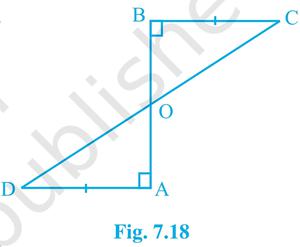
**Question 3. AD and BC are equal perpendiculars to a line segment AB (see Fig. 7.18). Show that CD bisects AB.
**Solution:
Given that AD and BC are two equal perpendiculars to a line segment AB
Considering two triangles ΔAOD and ΔBOC
Where,
∠ AOD = ∠ BOC {Vertically opposite angles}................... (i)
∠ OAD = ∠ OBC {Given that they are perpendiculars}.... (ii)
AD = BC {As given}......................................................... (iii)
From above three equation both the triangle satisfies "AAS" congruency criterion
So, ΔAOD ≅ ΔBOC
AO and BO will be equal as they are corresponding parts of congruent triangles(CPCT).
So, AO = BO
Hence, CD bisects AB at O.
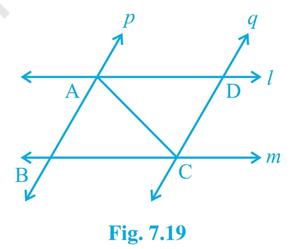
**Question 4. l and m are two parallel lines intersected by another pair of parallel lines p and q (see Fig. 7.19). Show that ∆ ABC ≅ ∆ CDA.
**Solution:
Given that l and m are two parallel lines p and q are another pair of parallel lines
Considering two triangles ΔABC and ΔCDA
Where,
∠ BCA = ∠DAC {Alternate interior angles}.... (i)
∠ BAC = ∠ DCA {Alternate interior angles}.... (ii)
AC {Common side of two triangles}.............(iii)
From above three equation both the triangle satisfies "ASA" congruency criterion
So, ΔABC ≅ ΔCDA
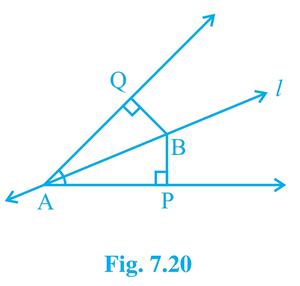
**Question 5. Line l is the bisector of an angle ∠ A and B is any point on l. BP and BQ are perpendiculars from B to the arms of ∠A (see Fig. 7.20). Show that:
****(i) ∆ APB ≅ ∆ AQB**
****(ii) BP = BQ or B is equidistant from the arms of ∠ A.**
**Solution:
Given that, Line l is the bisector of an angle ∠ A and B
BP and BQ are perpendiculars from angle A.
Considering two triangles ΔAPB and ΔAQB
Where,
∠ APB = ∠ AQB { Two right angles as given }...... (i)
∠BAP = ∠BAQ (As line l bisects angle A }......... (ii)
AB { Common sides of both the triangle }......... (iii)
From above three equation both the triangle satisfies "AAS" congruency criterion
So, ΔAPB≅ ΔAQB.
****(ii)** Also we can say BP and BQ are equal as they are corresponding parts of congruent triangles(CPCT).
So, BP = BQ
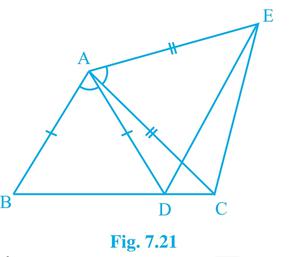
**Question 6. In Fig. 7.21, AC = AE, AB = AD and ∠ BAD = ∠ EAC. Show that BC = DE.
**Solution:
Given that AC = AE, AB = AD
And ∠BAD = ∠EAC
As given that ∠BAD = ∠EAC
Adding ∠DAC on both the sides
We get,
∠BAD + ∠DAC = ∠EAC + ∠ DAC
∠BAC = ∠EAD
Considering two triangles ΔABC and ΔADE
Where,
AC = AE { As given }........................ (i)
∠BAC = ∠EAD { Hence proven }........ (ii)
AB = AD {As also given }.................... (iii)
From above three equation both the triangle satisfies "SAS" congruency criterion
So, ΔABC ≅ ΔADE
****(ii)** Also we can say BC and DE are equal as they are corresponding parts of congruent triangles(CPCT).
So that BC = DE.
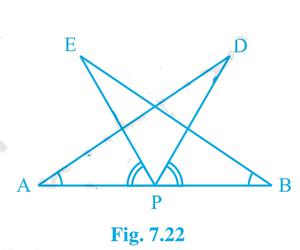
**Question 7. AB is a line segment and P is its mid-point. D and E are points on the same side of AB such that ∠ BAD = ∠ ABE and ∠ EPA = ∠ DPB (see Fig. 7.22). Show that:
****(i) ∆ DAP ≅ ∆ EBP**
****(ii) AD = BE**
**Solution:
Given that P is the mid-point of line AB, So AP = BP
Also, ∠ BAD = ∠ ABE and ∠ EPA = ∠ DPB
Now adding ∠DPE on both the sides of two equal angle ∠ EPA = ∠ DPB
∠ EPA + ∠ DPE = ∠ DPB + ∠DPE
Which implies that two angles ∠ DPA = ∠ EPB
Considering two triangles ∆ DAP and ∆ EBP
∠ DPA = ∠ EPB { Hence proven }...... (i)
AP = BP { Hence Given }.................. (ii)
∠ BAD = ∠ ABE { As given }..............(iii)
From above three equation both the triangle satisfies "ASA" congruency criterion
So, ΔDAP ≅ ΔEBP
****(ii)** Also we can say AD and BE are equal as they are corresponding parts of congruent triangles(CPCT).
So that, AD = BE
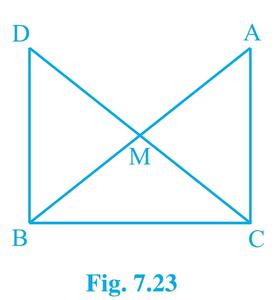
**Question 8. In right triangle ABC, right angled at C, M is the mid-point of hypotenuse AB. C is joined to M and produced to a point D such that DM = CM. Point D is joined to point B (see Fig. 7.23). Show that:
****(i) ∆ AMC ≅ ∆ BMD**
****(ii) ∠ DBC is a right angle.**
****(iii) ∆ DBC ≅ ∆ ACB**
****(iv) CM = 1/2 AB**
**Solution:
Given that M is the mid-point of AB
So AM = BM
∠ ACB = 90°
and DM = CM
****(i)** Considering two triangles ΔAMC and ΔBMD:
AM = BM { As given }.............................................. (i)
∠ CMA = ∠ DMB { Vertically opposite angles }.... (ii)
CM = DM { As given also}...................................... (iii)
From above three equation both the triangle satisfies "SAS" congruency criterion
So, ΔAMC ≅ ΔBMD
****(ii)** From above congruency we can say
∠ ACD = ∠ BDC
Also alternate interior angles of two parallel lines AC and DB.
Since sum of two co-interiors angles results to 180°.
So, ∠ ACB + ∠ DBC = 180°
∠ DBC = 180° - ∠ ACB
∠ DBC = 90° { As ∠ACB =90° }
****(iii)** In ΔDBC and ΔACB,
BC { Common side of both the triangle }....... (i)
∠ ACB = ∠ DBC { As both are right angles }....(ii)
DB = AC (by CPCT)......................................... (iii)
From above three equation both the triangle satisfies "SAS" congruency criterion
So, ΔDBC ≅ ΔACB
****(iv)** As M is the mid point so we can say
DM = CM = AM = BM
Also we can say that AB = CD ( By CPCT )
As M is the mid point of CD we can write
CM + DM = AB
Hence, CM + CM = AB (As DM = CM )
Hence, CM = (½) AB
**Read More: