Class 9 RD Sharma Solutions Chapter 10 Congruent Triangles Exercise 10.1 (original) (raw)
Last Updated : 20 Aug, 2024
In Class 9 Mathematics, Chapter 10 of "RD Sharma" focuses on the Congruent Triangles, it is a fundamental concept in geometry. This chapter introduces students to the criteria for triangle congruence and provides a variety of problems to practice these concepts. Exercise 10.1 specifically deals with the basic problems related to the congruent triangles reinforcing the understanding of the triangle congruence through practical examples.
Congruent Triangles
Congruent triangles are triangles that are identical in shape and size but not necessarily in orientation. In other words, two triangles are congruent if their corresponding sides and angles are equal. There are several criteria to establish triangle congruence:
- **Side-Side-Side (SSS) Criterion: The Two triangles are congruent if all three sides of the one triangle are equal to the corresponding sides of the other triangle.
- **Side-Angle-Side (SAS) Criterion: The Two triangles are congruent if two sides and the included angle of the one triangle are equal to the corresponding sides and angle of the other triangle.
- **Angle-Side-Angle (ASA) Criterion: The Two triangles are congruent if two angles and the included side of the one triangle are equal to the corresponding angles and side of the other triangle.
- **Angle-Angle-Side (AAS) Criterion: The Two triangles are congruent if two angles and the non-included side of the one triangle are equal to the corresponding angles and side of the other triangle.
Question 1. In the figure, the sides BA and CA have been produced such that: BA = AD and CA = AE. Prove that segment DE || BC.
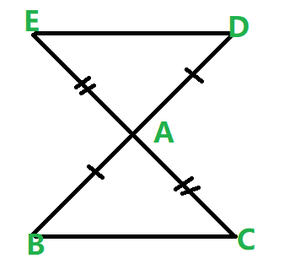
**Solution:
Given that:
BA = AD and CA = AE
Prove that DE || BC
So, here we consider triangle BAC and DAE,
BA = AD -(given)
CA= AE -(given)
And ∠BAC = ∠DAE -(vertically opposite angles)
Hence, by the SAS congruence criterion, we have
Δ BAC ≃ ΔDAE
So, we can say that:
∠DEA = ∠BCA, ∠EDA = ∠CBA -(Corresponding parts of congruent triangles are equal)
Now, lines DE and BC are intersected by a transversal DB such that ∠DEA = ∠BCA.
Hence, proved that DE || BC.
Question 2. In a Δ QPR, if PQ = QR and L, M and N are the mid-points of the sides PQ, QR, and RP respectively. Prove that LN = MN.
**Solution:
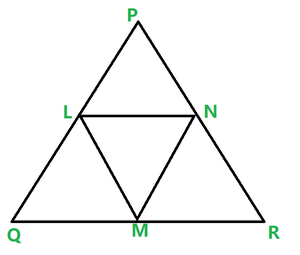
Given that,
In Δ QPR, PQ = QR
Also, L, M, N are midpoints of the sides PQ, QP, and RP.
And we are given to prove that LN = MN.
In Δ QPR, PQ = QR, and L, M, N are midpoints
Hence, Δ QPR is an isosceles triangle.
PQ = QR
∠ QPR = ∠ QRP -(1)
And also, L and M are midpoints of PQ and QR.
Hence, we can say that:
PQ = QR
PL = LQ = QM = MR = PQ/2 = QR/2
Now, we have Δ LPN and Δ MRN,
LP = MR
∠LPN = ∠MRN -(From above)
∠QPR and ∠LPN are the same.
And also ∠QRP and ∠MRN are the same.
PN = NR -(N is the midpoint of PR)
So, by SAS congruence criterion, we can say that ΔLPN = ΔMRN
By corresponding parts of congruent triangles are equal we can say that LN = MN.
Question 3. In the figure given, PQRS is a square and SRT is an equilateral triangle. Prove that (i) PT = QT (ii) ∠TQR = 15°
**Solution:
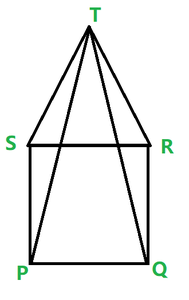
We are given that PQRS is a square and SRT is an equilateral triangle.
And we have to prove that
****(i)** PT = QT
PQRS is a square and SRT is an equilateral triangle.
Now we see that PQRS is a square
PQ = QR = RS = SP -(1)
And ∠SPQ = ∠PQR = ∠QRS = ∠RSP = 90° = right angle
And also, SRT is an equilateral triangle.
SR = RT = TS -(2)
And ∠TSR = ∠SRT = ∠RTS = 60°
From equation(1) and (2) we can say that,
PQ = QR = SP = SR = RT = TS -(3)
And also for angles we have,
∠TSP = ∠TSR + ∠RSP = 60° + 90° + 150°
∠TRQ = ∠TRS + ∠SRQ = 60° + 90° + 150°
∠TSR = ∠TRQ = 150° -(4)
SP = RQ -(From eq (3))
Hence, by SAS congruence criterion we can say that ΔTSP = ΔTRQ i.e both the triangles are congruent.
PT = QT (Corresponding parts of congruent triangles are equal)
****(ii)** ∠TQR = 15°
Let's see ΔTQR.
QR = TR
And also it is given that ΔTQR is an isosceles triangle.
∠QTR = ∠TQR -(Angles opposite to equal sides)
As we know that the sum of angles in a triangle is equal to 180∘
∠QTR + ∠TQR + ∠TRQ = 180°
2∠TQR + 150° = 180°
2∠TQR = 180° - 150°
2∠TQR = 30°
Hence, ∠TQR = 15°
Hence, proved
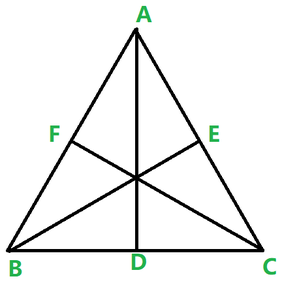
Question 4. Prove that the medians of an equilateral triangle are equal.
**Solution:
Prove that the medians of an equilateral triangle are equal.
So, let D, E, F are midpoints of BC, CA, and AB. AD, BE and CF are medians of ABC.
Then, AD, BE and CF are medians of ABC.
Now, we can say that
D Is the midpoint of BC
So now we can say that,
BD = DC = BC/2
CE = EA = AC/2
AF = FB = AB/2
Since, it is already given that ΔABC is an equilateral triangle
Therefore
AB = BC = CA
Hence, we can imply that,
BD = DC = CE = EA = AF = FB = BC/2 = AC/2 = AB/2
Also, we can say that ∠ABC = ∠BCA = ∠CAB = 60° -(Angles of equilateral triangle)
Now, consider ΔABD and ΔBCE AB = BC
Here we find that BD = CE
Now, in ΔTSR and ΔTRQ
TS = TR
∠ABD = ∠BCE
So, from SAS congruence criterion, we can conclude that ΔABD = ΔBCE
Now, consider ΔBCE and ΔCAF, BC = CA
∠BCE = ∠CAF (From above)
CE = AF
So, from SAS congruence criterion, we have, ΔBCE = ΔCAF
BE = CF [from above]
AD = BE = CF.
Hence proved
Question 5. In ΔABC, if ∠A = 120° and AB = AC. Find ∠B and ∠C.
**Solution:
In the triangle ABC
Given that ∠A = 120° and AB = AC
According to the question the triangle is isosceles
hence the angles opposite to equal sides are equal
∠B = ∠C
We also know that sum of angles in a triangle is equal to 180°
∠A + ∠B + ∠C = 180°
2∠B = 180° - 120°
∠B = ∠C = 30°
Question 6. In ΔABC, if AB = AC and ∠B = 70°. Find ∠A.
**Solution:
In the triangle ABC
Given that ∠B = 70° and AB = AC
According to the question the triangle is isosceles
hence angles opposite to equal sides are equal.
∠B = ∠C
Hence, ∠C = 70°
We also know that sum of angles in a triangle is equal to 180°
∠A + ∠B + ∠C = 180°
∠A = 40°
Hence, ∠A = 40° and ∠C = 70°
Question 7. The vertical angle of an isosceles triangle is 100°. Find its base angles.
**Solution:
Consider an isosceles ΔABC such that AB = AC
Given that vertical angle, ∠A = 100°
To find the base angles
Since ΔABC is an isosceles triangle hence ∠B = ∠C
We know that sum of interior angles of a triangle = 180°
∠A + ∠B + ∠C = 180°
100° + ∠B +∠B = 180°
2∠B = 180° - 100°
∠B = 40°
∠B = ∠C = 40°
Hence, ∠B = 40° and ∠C = 40°
Question 8. In ∆ABC AB = AC and ∠ACD = 105°. Find ∠BAC.
**Solution:
Given: AB = AC and ∠ACD = 105°
Since, ∠BCD = 180° = Straight angle
∠BCA + ∠ ACD = 180°
∠BCA + 105° = 180°
Hence, ∠BCA = 75°
Also, ΔABC is an isosceles triangle
AB = AC
∠ABC = ∠ ACB = 75°.
Now the Sum of Interior angles of a triangle = 180°
∠ABC = ∠BCA + ∠CAB = 180°
75° + 75° + ∠CAB = 180°
∠BAC = 30°
Question 9. Find the measure of each exterior angle of an equilateral triangle.
**Solution:
We know that for an equilateral triangle
∠ABC = ∠BCA = CAB =180°/3 = 60°
Now,
Extend side BC to D, CA to E, and AB to F.
∠BCA + ∠ACD = 180°
60° + ∠ACD = 180°
∠ACD = 120°
Similarly, we can say that, ∠BAE = ∠FBC = 120°
So, the measure of each exterior angle of an equilateral triangle = 120°.
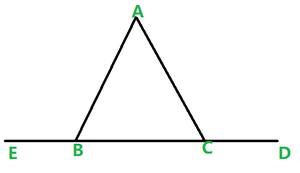
Question 10. If the base of an isosceles triangle is produced on both sides, prove that the exterior angles so formed are equal to each other.
**Solution:
ED is a straight line segment and B and C are the points on it.
∠EBC = ∠BCD -(Both are equal to 180°)
∠EBA + ∠ABC = ∠ACB + ∠ACD
Since ∠ABC = ∠ACB
Hence, ∠EBA = ∠ACD
Hence, proved
Question 11. In the given Figure AB = AC and DB = DC, find the ratio ∠ABD:∠ACD.
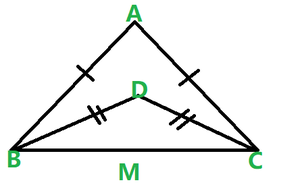
**Solution:
Given: AB = AC, DB = DC
∠ABD = ∠ACD
Hence, ΔABC and ΔDBC are isosceles triangles
∠ABC = ∠ACB and also ∠DBC = ∠DCB (Angles opposite to equal sides are equal)
Now we have to find the ratio =∠ABD : ∠ACD
∠ABD = (∠ABC - ∠DBC)
∠ACD = (∠ACB - ∠DCB)
(∠ABC - ∠DBC):(∠ACB - ∠DCB)
(∠ABC - ∠DBC):(∠ABC - ∠DBC)
1:1
Hence, ∠ ABD:∠ ACD = 1:1
Question 12. Determine the measure of each of the equal angles of a right-angled isosceles triangle.
**Solution:
ABC is a right-angled triangle
∠A = 90° and AB = AC
Since,
AB = AC
∠C = ∠B
As we know that the sum of angles in a triangle = 180°
∠A + ∠B + ∠C = 180°
90° + ∠ B+ ∠ B = 180°
2∠B = 90°
∠B = 45°
∠B = 45°, ∠C = 45°
So, the measure of each of the equal angles of a right-angled Isosceles triangle = 45°
Question 13. AB is a line segment. P and Q are points on opposite sides of AB such that each of them is equidistant from points A and B. Show that the line PQ is the perpendicular bisector of AB.
**Solution:
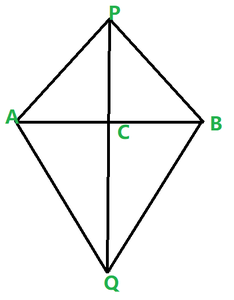
Given:
AB is a line segment and P, Q are points on opposite sides of AB such that
AP = BP
AQ = BQ
Prove that PQ is the perpendicular bisector of AB.
Let ΔPAQ and ΔPBQ,
AP = BP
AQ = BQ
PQ - PQ
Δ PAQ ≃ Δ PBQ are congruent by SAS congruent condition.
Now, we can observe that APB and ABQ are isosceles triangles.
∠ PAB = ∠ ABQ
And also ∠ QAB = ∠ QBA
Now consider Δ PAC and Δ PBC
C is the point of intersection of AB and PQ
PA = PB
∠APC = ∠BPC
PC = PC
So, by SAS congruency of triangle ΔPAC ≅ ΔPBC.
AC = CB and ∠PCA = ∠PBC
And also, ACB is the line segment
∠ACP + ∠ BCP = 180°
∠ACP = ∠PCB
∠ACP = ∠PCB = 90°
We have AC = CB
C is the midpoint of AB
So, we can conclude that PC is the perpendicular bisector of AB and C is a point on the line PQ.
Therefore, PQ is the perpendicular bisector of AB.