Class 9 RD Sharma Solutions Chapter 13 Linear Equation in Two Variable Exercise 13.3 | Set 2 (original) (raw)
Last Updated : 30 Apr, 2021
Question 11: Draw the graph of the equation 2x + 3y = 12. From the graph, find the coordinates of the point:
(i) whose y-coordinates is 3.
(ii) whose x-coordinate is −3.
Solution:
Given:
2x + 3y = 12
We get,
y=\frac{12-2x}{3}
Substituting x = 0 in y = \frac{12-2x}{3}we get,
y=\frac{12-2\times0}{3}
y = 4
Substituting x = 6 in y= \frac{12-2x}{3}, we get
y=\frac{12-2\times6}{3}
y = 4
Hence, we have the following table exhibiting the abscissa and ordinates of points on the line represented by the given equation
x 0 6 y 4 0
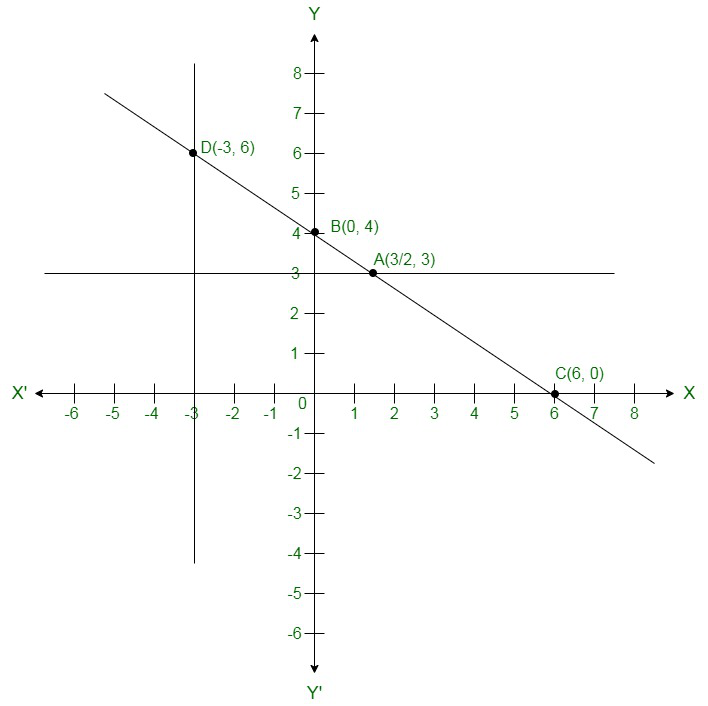
By plotting the given equation on the graph, we get the point B (0, 4) and C (6,0).
(i) Co-ordinates of the point whose y axis is 3 are A \left(\frac{3}{2},3\right)
(ii) Co-ordinates of the point whose x -coordinate is –3 are D (-3, 6)
Question 12: Draw the graph of each of the equations given below. Also, find the coordinates of the points where the graph cuts the coordinate axes:
(i) 6x − 3y = 12
(ii) −x + 4y = 8
(iii) 2x + y = 6
(iv) 3x + 2y + 6 = 0
Solution:
(i) Given:
6x - 3y = 12
We get,
y=\frac{6x-12}{3}
Now, substituting x = 0 in y=\frac{6x-12}{3}, we get
y = -4
Substituting x = 2 in y=\frac{6x-12}{3}, we get
y = 0
Hence, we have the following table exhibiting the abscissa and ordinates of points on the line represented by the given equation
x 0 2 y -4 0
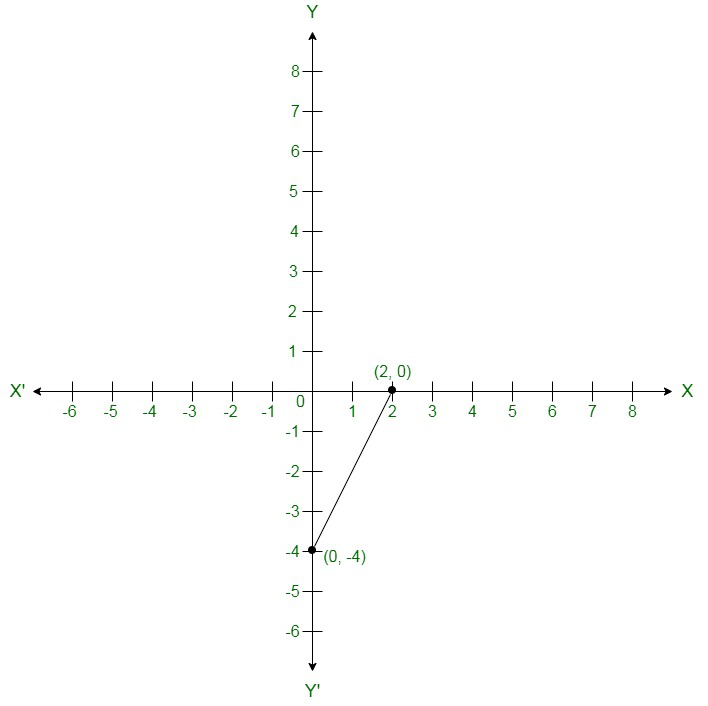
Co-ordinates of the points where graph cuts the co-ordinate axes are at y = -4 axis and x = 2
at x axis.
(ii) Given:
-x + 4y = 8
We get,
y=\frac{8+x}{4}
Now, substituting x = 0 in y=\frac{8+x}{4}, we get
y = 2
Substituting x = -8 in y=\frac{8+x}{4}, we get
y = 0
Hence, we have the following table exhibiting the abscissa and ordinates of points on the line represented by the given equation
x 0 -8 y 2 0
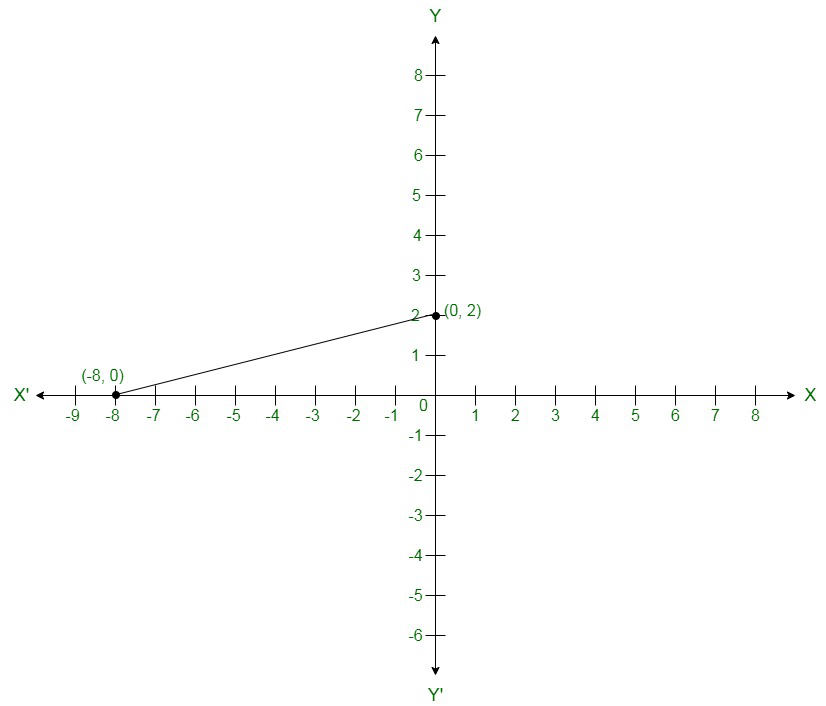
Co-ordinates of the points where graph cuts the co-ordinate axes are at y = 2 axis and x = -8
at x axis.
(iii) Given:
2x + y = 6
We get,
y = 6 - 2x
Now, substituting x= 0 in y = 6 - 2x w e get
y = 6
Substituting x = 3 in y = 6 - 2x, we get
y = 0
Hence, we have the following table exhibiting the abscissa and ordinates of points on the line represented by the given equation
x 0 3 y 6 0
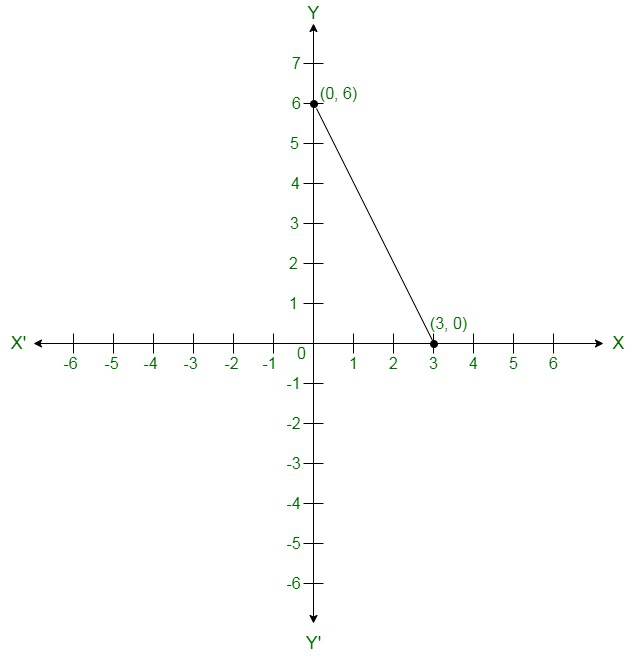
Co-ordinates of the points where graph cuts the co-ordinate axes are y = 6 at y axis and x = 3
at x axis.
(iv) Given:
3x + 2y + 6 = 0
We get,
y = \frac{-(6+3x)}{2}
Now, substituting x = -2 in y = \frac{-(6+3x)}{2}, we get
y = -3
Substituting x = -2 in y = \frac{-(6+3x)}{2}, we get
y = 0
Hence, we have the following table exhibiting the abscissa and ordinates of points on the line represented by the given equation
x 0 -2 y -3 0
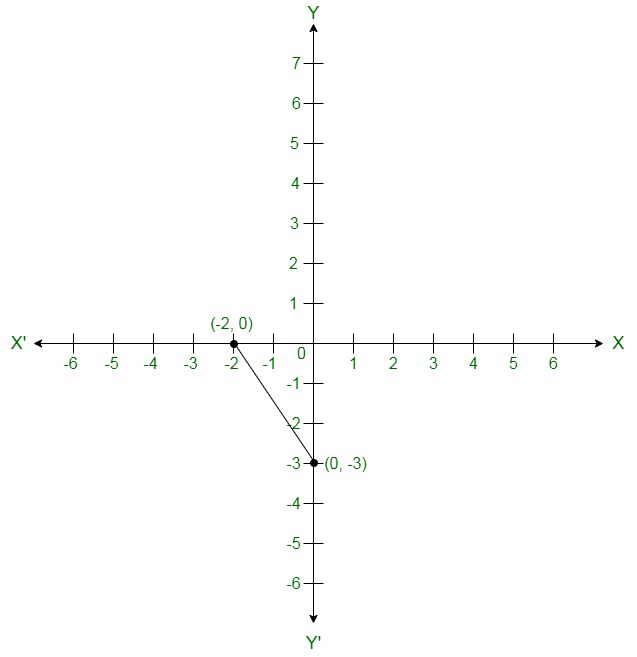
Co-ordinates of the points where graph cuts the co-ordinate axes are y = -3 at y axis and x = -2
at x axis.
Question 13: Draw the graph of the equation 2x + y = 6. Shade the region bounded by the graph and the coordinate axes. Also, find the area of the shaded region.
Solution:
Given:
2x + y = 6
We get,
y = 6 - 2 x
Now, substituting x = 0 in y = 6 - 2x ,we get
y = 6
Substituting x = 3 in y = 6 - 2x ,we get
Hence, we have the following table exhibiting the abscissa and ordinates of points on the line represented by the given equation
x 0 3 y 6 0
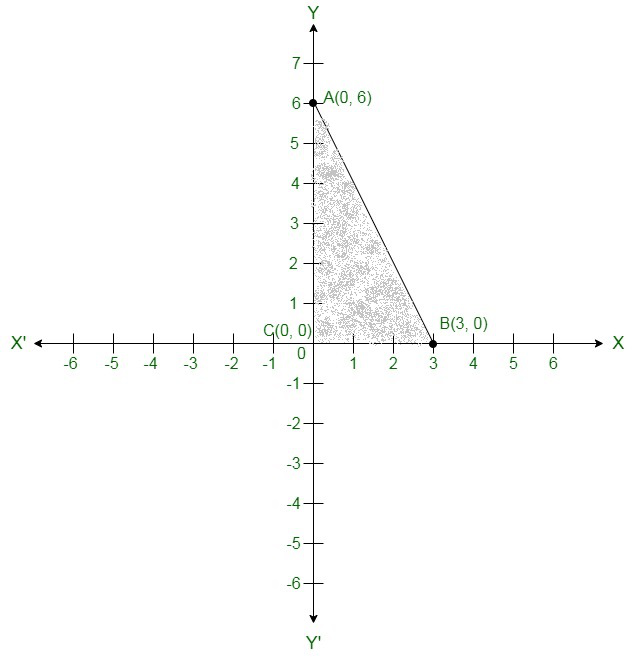
The region bounded by the graph is ABC which forms a triangle.
AC at y axis is the base of triangle having AC = 6 units on y axis.
BC at x axis is the height of triangle having BC = 3 units on x axis.
Therefore,
Area of triangle ABC, say A is given by
A=\frac{1}{2}(Base\times Height)\\ A=\frac{1}{2}(AC\times BC)\\ A=\frac{1}{2}(6\times3)
A = 9 sq. units
Question 14: Draw the graph of the equation \frac{x}{3}+\frac{y}{4}=1. Also, find the area of the triangle formed by the line and the coordinates axes.
Solution:
Given:
\frac{x}{3}+\frac{y}{4}=1
4x + 3y = 12
We get,
y=\frac{12-4x}{3}
Now, substituting x = 0 in y=\frac{12-4x}{3}, we get
y = 4
Substituting x = 3 in y=\frac{12-4x}{3}, we get
y = 0
Hence, we have the following table exhibiting the abscissa and ordinates of points on the line represented by the given equation
x 0 3 y 4 0
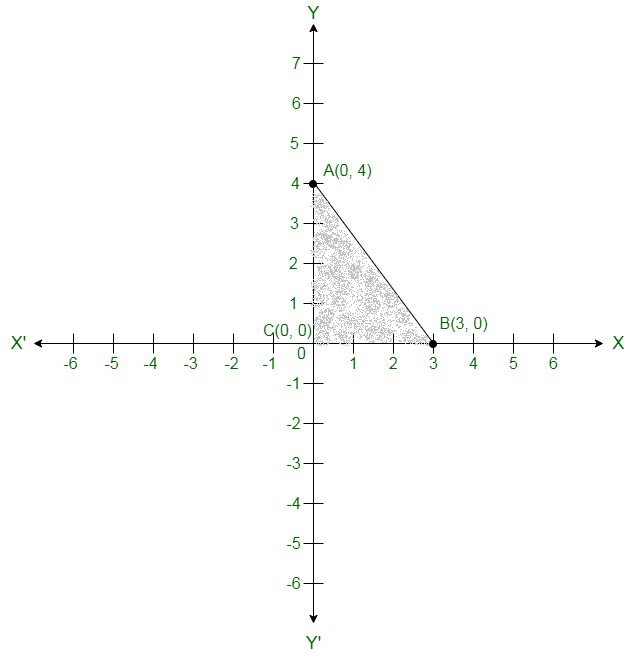
The region bounded by the graph is ABC which form a triangle.
AC at y axis is the base of triangle having AC = 4 units on y axis.
BC at x axis is the height of triangle having BC = 3 units on x axis.
Therefore,
Area of triangle ABC, say A is given by
A=\frac{1}{2}(Base\times Height)\\ A=\frac{1}{2}(AC\times BC)\\ A=\frac{1}{2}(4\times3)
A = 6 sq. units
Question 15: Draw the graph of y = | x |.
Solution:
We are given,
y = |x|
Substituting, x = 1 we get
y = 1
Substituting, x = -1 we get
y = 1
Substituting,x = 2 we get
y = 2
Substituting, x = -2 we get
y = 2
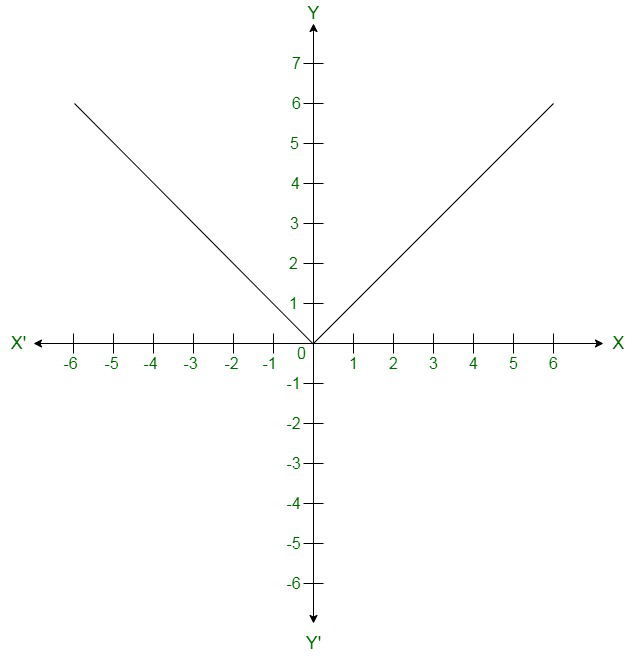
For every value of x, whether positive or negative, we get y as a positive number.
Question 16: Draw the graph of y = | x | + 2.
Solution:
Given:
y = |x| + 2
Substituting, x = 0 we get
y = 2
Substituting, x = 1 we get
y = 3
Substituting, x = -1 we get
y = 3
Substituting, x = 2 we get
y = 4
Substituting, x = -2 we get
y = 4
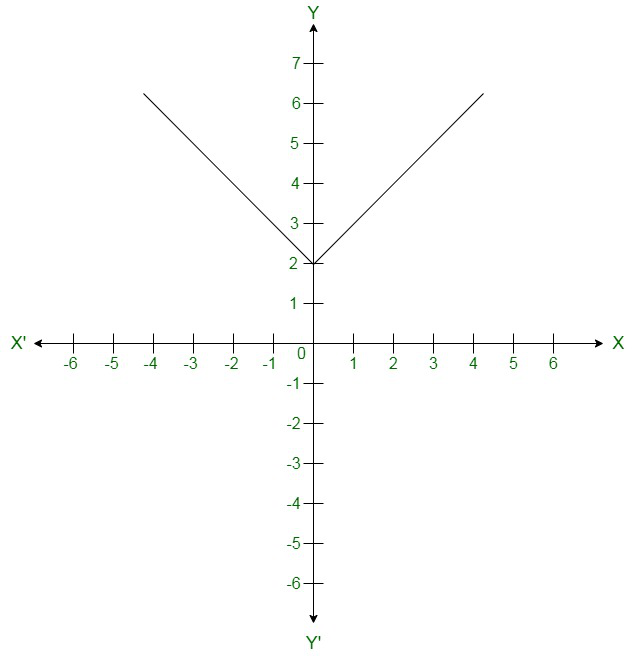
For every value of x, whether positive or negative, we get y as a positive number and the minimum value of y is equal to 2 units.
Question 17: Draw the graphs of the following linear equations on the same graph paper:
2x + 3y = 12, x − y = 1
Find the coordinates of the vertices of the triangle formed by the two straight lines and the area bounded by these lines and x-axis.
Solution:
Given:
2x + 3y = 12
We get,
y=\frac{12-2x}{3}
Now, substituting x = 0 in y=\frac{12-2x}{3} , we get
y = 4
Substituting x = 6 in y=\frac{12-2x}{3} , we get
y = 0
Therefore, we have the following table exhibiting the abscissa and ordinates of points on the line represented by the given equation
x 0 6 y 4 0 Plotting A(0,4) and E(6,0) on the graph and by joining the points , we obtain the graph of equation .
Given:
x - y = 1
We get,
y = x − 1
Now, substituting x = 0 in y = x − 1,we get
y = −1
Substituting x = -1 in y = x − 1,we get
y = −2
Therefore, we have the following table exhibiting the abscissa and ordinates of points on the line represented by the given equation
x 0 -1 y -1 -2 Plotting D(0,1) and E(-1,0) on the graph and by joining the points , we obtain the graph of equation .
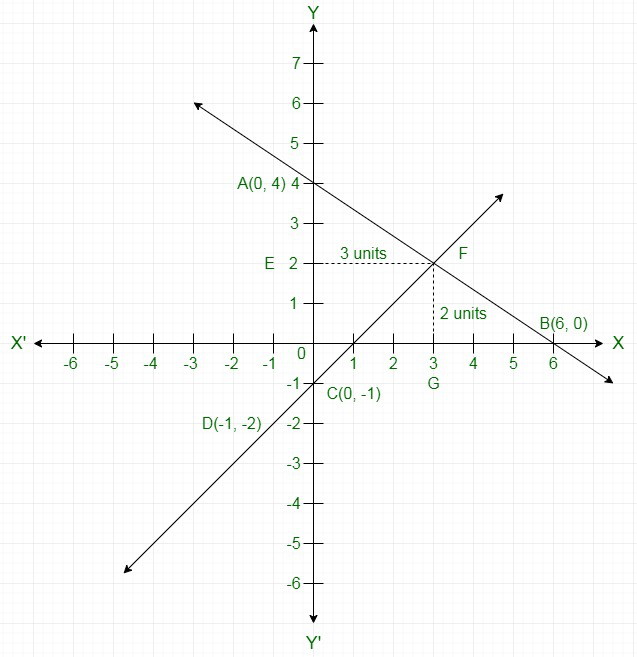
By the intersection of lines formed by 2x + 3y = 12 and x - y = 1 on the graph, triangle ABC is formed on y axis.
Therefore,
AC at y axis is the base of triangle ABC having AC = 5 units on y axis.
Draw FE perpendicular from F on y axis.
FE parallel to x axis is the height of triangle ABC having FE = 3 units on x axis.
Therefore,
Area of triangle ABC, say A is given by
A=\frac{1}{2}(Base\times Height)\\ A=\frac{1}{2}(AC\times BC)\\ A=\frac{1}{2}(5\times3)\\ =\frac{15}{2}sq.\ units
Question 18: Draw the graphs of the linear equations 4x − 3y + 4 = 0 and 4x + 3y −20 = 0. Find the area bounded by these lines and x-axis.
Solution:
Given:
4x - 3y + 4 = 0
We get,
y=\frac{4x+4}{3}
Now, substituting x = 0 in y=\frac{4x+4}{3}, we get
y=\frac{4}{3}
Substituting x = -1 in y=\frac{4x+4}{3}, we get
y = 0
Hence, we have the following table exhibiting the abscissa and ordinates of points on the line represented by the given equation
x 0 -1 y \frac{4}{3} 0 Plotting E(0, \frac{4}{3}) and A(-1,0) on the graph and by joining the points, we obtain the graph of equation.
We are given,
4x + 3y - 20 = 0
We get,
y=\frac{20-4x}{3}
Now, substituting x = 0 in y=\frac{20-4x}{3}, we get
y=\frac{20}{3}
Substituting x = 5 in y=\frac{20-4x}{3}, we get
y = 0
Therefore, we have the following table exhibiting the abscissa and ordinates of points on the line represented by the given equation
x 0 5 y \frac{20}{3} 0 Plotting D(0, \frac{20}{3}) and B(5,0) on the graph and by joining the points, we obtain the graph of equation.
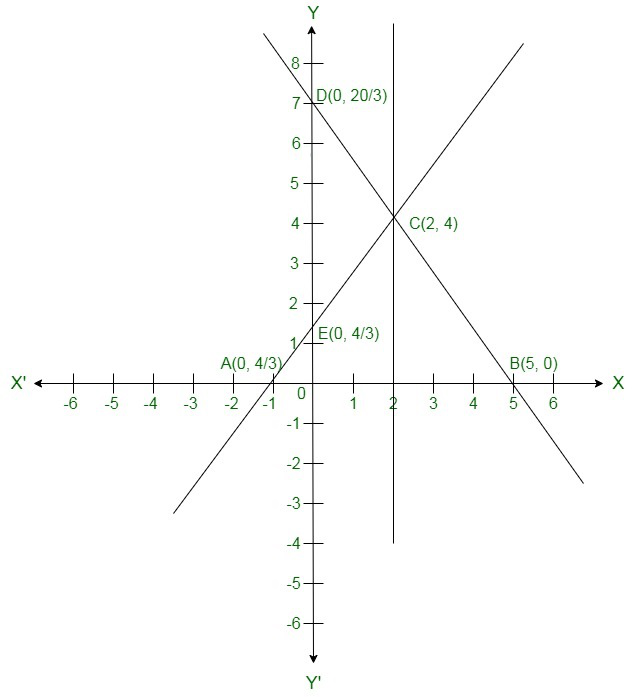
By the intersection of lines formed by 4x - 3y + 4 = 0 and 4x + 3y - 20 = 0 on the graph, triangle ABC is formed on x axis.
Therefore,
AB at x axis is the base of triangle ABC having AB = 6 units on x axis.
Draw CF perpendicular from C on x axis.
CF parallel to y axis is the height of triangle ABC having CF = 4 units on y axis.
Therefore,
Area of triangle ABC, say A is given by
A=\frac{1}{2}(Base\times Height)\\ A=\frac{1}{2}(AC\times BC)\\ A=\frac{1}{2}(6\times4)\\ A=12sq.\ units
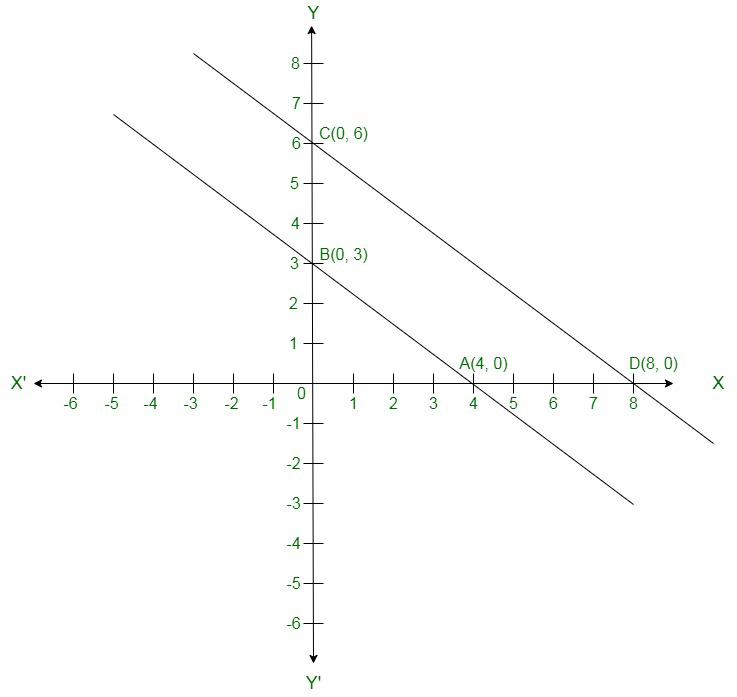
Question 19: The path of a train A is given by the equation 3x + 4y − 12 = 0 and the path of another train B is given by the equation 6x + 8y − 48 = 0. Represent this situation graphically.
Solution:
Given: Path of train A,
3x + 4y - 12 = 0
We get,
y=\frac{12-3x}{4}
Now, substituting x = 0 in y=\frac{12-3x}{4} ,we get
y = 3
Substituting x = 4 in y=\frac{12-3x}{4} ,we get
y = 0
Therefore, we have the following table exhibiting the abscissa and ordinates of points on the line represented by the given equation
x 0 4 y 3 0 Plotting A(4,0) and E(0,3) on the graph and by joining the points , we obtain the graph of equation .
We are given the path of train B,
6x + 8y - 48 = 0
We get,
y=\frac{48-6x}{8}
Now, substituting x = 0 in y=\frac{48-6x}{8},we get
y = 6
Substituting x = 8 in y=\frac{48-6x}{8},we get
y = 0
Therefore, we have the following table exhibiting the abscissa and ordinates of points on the line represented by the given equation
x 0 8 y 6 0 Plotting C(0,6) and D(8,0) on the graph and by joining the points , we obtain the graph of equation.
Question 20: Ravish tells his daughter Aarushi, ''Seven years ago, I was seven times as old as you were then. Also, three years from now, I shall be three times as old as you will be''. If present ages of Aarushi and Ravish are x and y years respectively, represent this situation algebraically as well as graphically.
Solution:
We are given the present age of Ravish as y years and Aarushi as x years.
Age of Ravish seven years ago = y - 7
Age of Aarushi seven years ago = x - 7
It has already been said by Ravish that seven years ago he was seven times old then Aarushi was then
So,
y - 7 = 7(x - 7)
y - 7 = 7x - 49
7x - y = -7 + 49
7x - y - 42 = 0
Age of Ravish three years from now = y + 3
Age of Aarushi three years from now = x + 3
It has already been said by Ravish that three years from now he will be three times old then Aarushi will be then
So,
y + 3 = 3(x + 3)
y + 3 = 3x + 9
3x + 9 - y - 3 = 0
3x - y + 6 = 0
(1) and (2) are the algebraic representation of the given statement.
Given:
7x - y - 42 = 0
We get,
y = 7x - 42
Now, substituting x = 0 in y = 7x - 42 ,we get
y = -42
Substituting x = 6 in y = 7x - 42, we get
y = 0
Therefore, we have the following table exhibiting the abscissa and ordinates of points on the line represented by the given equation
x 0 6 y -42 0 Given:
3x - y + 6 = 0
We get,
y = 3x + 6
Now, substituting x = 0 in y = 3x + 6 ,we get
y = 6
Substituting x = -2 in y = 3x + 6 ,we get
y = 0
Therefore, we have the following table exhibiting the abscissa and ordinates of points on the line represented by the given equation
x 0 -2 y 6 0
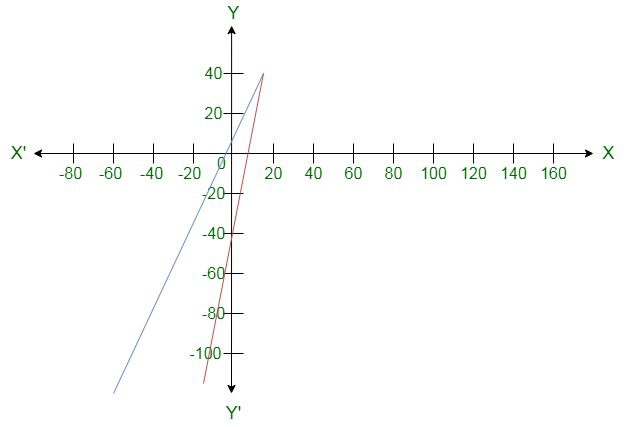
The red -line represents the equation. 7x - y - 42 = 0
The blue-line represents the equation. 3x - y + 6 = 0
Question 21: Aarushi was driving a car with uniform speed of 60km/h. Draw distance-time graph. From the graph, find the distance traveled by Aarushi in
(i) 2\frac{1}{2} Hours
(ii) \frac{1}{2} Hour
Solution:
Aarushi is driving the car with the uniform speed of 60 km/h.
We represent time on X-axis and distance on Y-axis
Now, graphically
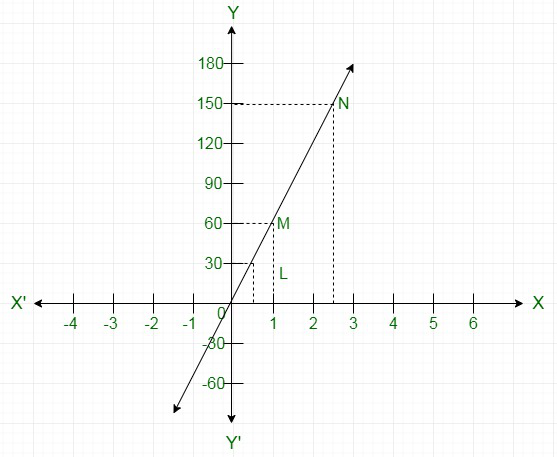
We are given that the car is travelling with a uniform speed 60 km/hr. This means car travels 60 km distance each hour. Thus the graph we get is of a straight line.
Also, we know when the car is at rest, the distance traveled is 0 km, speed is 0 km/hr and the time is also 0 hr.
Therefore, the given straight line will pass through O(0,0) and M(1,60).
Join the points O and M and extend the line in both directions.
Now, we draw a dotted line parallel to y-axis from x = \frac{1}{2} that meets the straight line graph at L from which we draw a line parallel to x-axis that crosses y-axis at 30. Thus, in \frac{1}{2}hr, distance traveled by the car is 30 km.
Now, we draw a dotted line parallel to y-axis from x = 2\frac{1}{2} that meets the straight line graph at N from which we draw a line parallel to x-axis that crosses y-axis at 150. Thus, in 2\frac{1}{2}hr, distance traveled by the car is 150 km.
(i) Distance = Speed × Time
Distance traveled in 2\frac{1}{2} hours is given by
Distance = 60\times2\frac{1}{2}
Distance = 60\times\frac{5}{2}
Distance = 150 km
(ii) Distance = Speed × Time
Distance traveled in \frac{1}{2} hours is given by
Distance = 60\times\frac{1}{2}
Distance = 30 km