Class 9 RD Sharma Solutions Chapter 14 Quadrilaterals Exercise 14.2 (original) (raw)
Last Updated : 6 Sep, 2024
In Class 9, Chapter 14 of RD Sharma focuses on Quadrilaterals. This chapter is crucial in understanding the various geometric properties and relationships that quadrilaterals exhibit. Exercise 14.2 builds upon the foundational concepts of the quadrilaterals and requires the application of the various theorems such as the properties of the parallelograms, trapeziums, rhombuses and more. Students will explore the different properties of the sides, angles and diagonals in these shapes.
Quadrilaterals
A quadrilateral is a polygon with the four sides, four vertices and four angles. The sum of the interior angles of the any quadrilateral is always 360∘. The Quadrilaterals come in the various forms such as the squares, rectangles, parallelograms, rhombuses and trapeziums. Each type of quadrilateral has its unique properties which make them an important part of the geometry.
Question 1. Two opposite angles of a parallelogram are (3x - 2)° and (50 - x)°. Find the measure of each angle of the parallelogram.
**Solution:
Given: Two opposite angles of a parallelogram are (3x – 2)° and (50 – x)°.
(3x - 2)°= (50 - x)° [Opposite sides of a parallelogram are equal]
\to 3x + x = 50 + 2
\to 4x = 52
\to x = 13
Angle x is 13°
\therefore (3x - 2) = (3*13 - 2) = 37°
(50 - x)° = (50 - 13)°= 37°
\therefore x + 37°= 180° [Adjacent angles of a parallelogram are supplementary]
\therefore x = 180°− 37°= 143°
Hence, required angles are : 37°, 143°, 37°, 143°.
**Question 2. If an angle of a parallelogram is two-third of its adjacent angle, find the angles of the parallelogram.
**Solution:
Let the measure of the angle be x.
Therefore, the measure of the angle adjacent is 2x/3
Hence, x + 2x/3 = 180° [Consecutive angles of a parallelogram are supplementary]
2x + 3x = 540°
\to 5x = 540°
\to x = 108°
Now,
⟹ x + 108°= 180° [Consecutive angles of a parallelogram are supplementary]
⟹ x + 108°= 180°
⟹ x = 180°- 108°= 72°
⟹ x = 72°
\therefore required angles are180°, 72°, 180°, 72°
Question 3. Find the measure of all the angles of a parallelogram, if one angle is 24°**less than twice the smallest angle.**
**Solution:
x + 2x - 24°= 180° [Consecutive angles of a parallelogram are supplementary]
\to 3x - 24°= 180°
\to 3x = 108° + 24°
\to 3x = 204°
\to x = 204/3 = 68°
\to x = 68°
Other angle of parallelogram=\to 2x - 24°= 2*68°- 24°= 112°
\therefore required angles are 68°,112°,68°,112°
**Question 4. The perimeter of a parallelogram is 22 cm. If the longer side measures 6.5 cm what is the measure of the shorter side?
**Solution:
Given: perimeter of a parallelogram is 22 cm
Let us consider the shorter side be 'y'.
\therefore perimeter = y + 6.5 + 6.5 + x [Sum of all sides]
22 = 2(y + 6.5)
11 = y + 6.5
\to y = 11 - 6.5 = 4.5 cm
Hence, the measure of the shorter side = 4.5 cm
Question 5. In a parallelogram ABCD, ∠D = 135°**. Determine the measures of ∠A and ∠B.**
**Solution:
In a parallelogram ABCD
Given: ∠D=135°
So, ∠D + ∠C = 180° [Consecutive angles of a parallelogram are supplementary]
∠C = 180°− 135°
∠C = 45°
In a parallelogram opposite sides are equal.
∠A = ∠C = 45° [opposite sides of parallelogram are equal]
∠B = ∠D = 135°
hence, the measures of ∠A and ∠B are 45°,135°respectively.
Question 6. ABCD is a parallelogram in which ∠A = 70°**. Compute ∠B, ∠C and ∠D.**
**Solution:
In a parallelogram ABCD
Given: ∠A = 70°
∠A + ∠B = 180° [Consecutive angles of a parallelogram are supplementary]
70°+ ∠B = 180° [given ∠A = 70°]
∠B = 180°− 70°
∠B = 110°
Now,
∠A = ∠C = 70° [opposite sides of parallelogram are equal]
∠B = ∠D = 110°
hence, the measures of ∠A and ∠B are 70°,110°respectively.
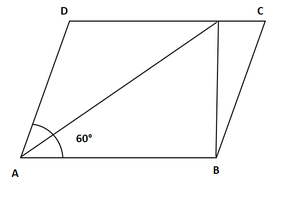
Question 7. In Figure, ABCD is a parallelogram in which ∠A = 60°**. If the bisectors of ∠A, and ∠B meet at P, prove that AD = DP, PC = BC and DC = 2AD.**
**Solution:
Given: ∠A = 60°
To prove: AD = DP, PC = BC and DC = 2AD
AP bisects ∠A
so, ∠DAP = ∠PAB = 30°
Now,
∠A + ∠B = 180° [Consecutive angles of a parallelogram are supplementary]
∠B + 60°= 180°
∠B = 180°− 60°
∠B = 120°
BP bisects ∠B
so, ∠PBA = ∠PBC = 60°
∠PAB = ∠APD = 30°[Alternate interior angles]
Therefore, AD = DP [Sides opposite to equal angles are in equal length]
Similarly
∠PBA = ∠BPC = 60° [Alternate interior angles]
Therefore, PC = BC
DC = DP + PC
DC = AD + BC [ DP = AD and PC = BC ]
DC = 2AD [Since, AD = BC, The opposite sides of parallelogram are parallel and congruent]
hence proved.
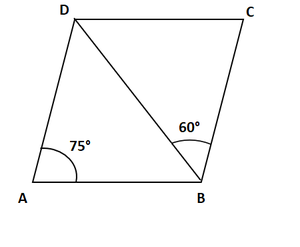
Question 8. In figure, ABCD is a parallelogram in which ∠DAB = 75°**and ∠DBC = 60°. Compute ∠CDB, and ∠ADB.
**Solution:
Given: ∠DAB = 75°and ∠DBC = 60°
To find ∠CDB and ∠ADB
∠CBD = ∠ADB = 60° [Alternate interior angle. AD∥ BC and BD is the transversal]
In\triangle BDA
∠DAB + ∠ADB + ∠ABD = 180° [Angle sum property]
\to 75°+ 60°+ ∠CDB = 180°
\to ∠ABD = 180°− (135°)
\to ∠ABD = 45°
∠ABD = ∠CDB = 45° [Alternate interior angle. AD∥ BC and BD is the transversal]
Hence, ∠CDB = 45°, ∠ADB = 60°
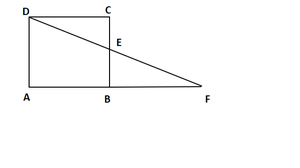
**Question 9. In figure, ABCD is a parallelogram and E is the mid-point of side BC. If DE and AB when produced meet at F, prove that AF = 2AB.
**Solution:
Given: ABCD is a parallelogram and E is the mid-point of side BC.
To prove: AF = 2AB.
Now,
In ΔBEF and ΔCED
∠BEF = ∠CED [Verified opposite angle]
BE = CE [Since, E is the mid-point of BC]
∠EBF = ∠ECD [Since, Alternate interior angles are equal]
\therefore ΔBEF ≅ ΔCED [ASA congruence]
\therefore BF = CD [Corresponding Parts of Congruent Triangle]
AF = AB + AF
AF = AB + CD [BF = CD by Corresponding Parts of Congruent Triangle ]
AF = AB + AB [CD=AB, The opposite sides of parallelogram are parallel and congruent]
AF = 2AB.
Hence proved.
**Question 10. Which of the following statements are true (T) and which are false (F)?
****(i) In a parallelogram, the diagonals are equal.**
****(ii) In a parallelogram, the diagonals bisect each other.**
****(iii) In a parallelogram, the diagonals intersect each other at right angles.**
****(iv) In any quadrilateral, if a pair of opposite sides is equal, it is a parallelogram.**
****(v) If all the angles of a quadrilateral are equal, it is a parallelogram.**
****(vi) If three sides of a quadrilateral are equal, it is a parallelogram.**
****(vii) If three angles of a quadrilateral are equal, it is a parallelogram.**
****(viii) If all the sides of a quadrilateral are equal, it is a parallelogram.**
**Solution:
(i) False
(ii) True
(iii) False
(iv) False
(v) True
(vi) False
(vii) False
(viii) True
Conclusion
Understanding quadrilaterals and their properties is a critical part of the geometry which forms the base for the more complex figures and proofs in the higher classes. Exercise 14.2 of RD Sharma helps solidify the understanding of these concepts and prepares students for the advanced geometry problems by the enhancing their problem-solving skills with the practical examples of the parallelograms, trapeziums, rhombuses and other quadrilaterals.