Class 9 RD Sharma Solutions Chapter 14 Quadrilaterals Exercise 14.4 | Set 1 (original) (raw)
Last Updated : 4 Sep, 2024
In Chapter 14 of RD Sharma's Class 9 Mathematics textbook students delve into the world of the quadrilaterals. This chapter is essential for understanding the properties and classifications of the quadrilaterals which are fundamental geometric shapes with the four sides. Exercise 14.4 | Set 1 focuses on solving problems related to various types of quadrilaterals and their properties helping students strengthen their grasp of the concepts through practical application.
Quadrilaterals
A quadrilateral is a four-sided polygon with four vertices and four angles. The sum of the interior angles of any quadrilateral is always 360 degrees. The Quadrilaterals can be classified into several types based on their properties including squares, rectangles, parallelograms, trapezoids and rhombuses. Each type of quadrilateral has unique characteristics that define its shape and angles.
Question 1. In ΔABC, D, E, and F are, respectively the midpoints of BC, CA, and AB. If the lengths of sides AB, BC, and CA are 7cm, 8 cm, and 9 cm, respectively, find the perimeter of ΔDEF.
**Solution:
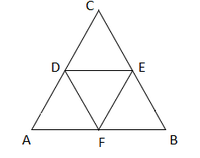
From the question it is given that
AB = 7 cm, BC = 8 cm, AC = 9 cm
Find: the perimeter of ΔDEF
In ∆ABC,
D, E and F are the mid points of BC, CA and AB.
So, by midpoint theorem
EF = 1/2 BC,
DF = 1/2 AC and DE = 1/2 AB
Now, we find the perimeter of ΔDEF
So, Perimeter of ∆DEF = DE + EF + DF
= (1/2) AB + (1/2) BC + (1/2) AC
= 1/2 (AB + BC + AC)
= 1/2(7 + 8 + 9)
= 1/2 (24)
= 12 cm
**Hence, the perimeter of ΔDEF is 12 cm
Question 2. In a ΔABC, ∠A = 50°, ∠B = 60° and ∠C = 70°. Find the measures of the angles of the triangle formed by joining the mid-points of the sides of this triangle.
**Solution:
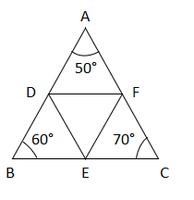
From the question it is given that
∠A = 50°, ∠B = 60° and ∠C = 70°
In ΔABC,
D, E, and F are mid points of AB, BC, and AC
So from Midpoint Theorem
DE ∥ AC, DE = (1/2) AC
DE = (1/2) AC = CF
In Quadrilateral DECF
DE ∥ AC, DE = CF [Proved above]
Hence, DECF is a parallelogram.
So, ∠C = ∠D = 70° [Because the opposite sides of a parallelogram are equal]
Similarly,
BEFD is a parallelogram,
So, ∠B = ∠F = 60°
ADEF is a parallelogram,
So, ∠A = ∠E = 50°
**Hence, the angles of ΔDEF are
**∠D = 70°, ∠E = 50°, ∠F = 60°
Question 3. In a triangle, P, Q and R are the mid points of sides BC, CA and AB respectively. If AC = 21cm, BC = 29 cm and AB = 30 cm, find the perimeter of the quadrilateral ARPQ.
**Solution:
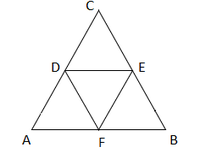
From the question it is given that
AC = 21cm, BC = 29 cm and AB = 30 cm
In ΔABC,
R and P are mid points of AB and BC
So from Midpoint Theorem
RP ∥ AC, RP = (1/2) AC
In quadrilateral ARPQ,
RP ∥ AQ, RP = AQ [Because the opposite sides of a parallelogram
are equal and parallel to each other]
Hence, AQPR is a parallelogram
Now,
AR = (1/2) AB = 1/2 x 30 = 15 cm
So, AR = QP = 15 cm [Because the opposite sides of a parallelogram are equal]
Similarly,
RP = (1/2) AC =1/2 x 21 = 10.5 cm
So, RP = AQ = 10.5 cm [Because the opposite sides of a parallelogram are equal]
Now we find the perimeter of the quadrilateral ARPQ
So, Perimeter of ARPQ = AR + QP + RP + AQ
= 15 + 15 + 10.5 + 10.5
= 51 cm
**Hence, the perimeter of the ARPQ = 51cm
Question 4. In a ΔABC median AD is produced to x such that AD = DX. Prove that ABXC is a parallelogram.
**Solution:
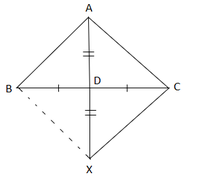
From the question it is given that
AD = DX
BD = DC
To prove: Prove that ABXC is a parallelogram.
Proof: Now,
In a quadrilateral ABXC, we have
AD = DX [Given]
BD = DC [Given]
So, diagonals AX and BC bisect each other.
Hence, ABXC is a parallelogram
Question 5. In a ΔABC, E and F are the mid-points of AC and AB respectively. The altitude AP to BC intersects FE at Q. Prove that AQ = QP.
**Solution:
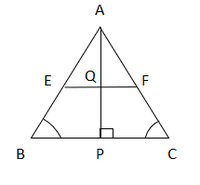
In ΔABC
E and F are mid points of AB and AC
So from midpoint theorem
EF ∥ FE, (1/2) BC = FE
Similarly,
In ΔABP
F is the mid-point of AB
So, from mid-point theorem
So, FQ ∥ BP [since EF ∥ BP]
Q is the mid-point of AP
Hence AQ = QP
Question 6. In a ΔABC, BM and CN are perpendiculars from B and C respectively on any line passing through A. If L is the mid-point of BC, prove that ML = NL.
**Solution:
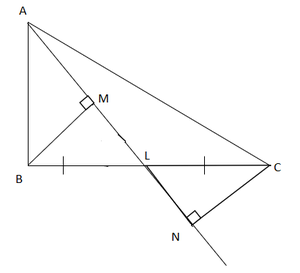
In ΔBLM and ΔCLN
∠BML = ∠CNL = 90°
BL = CL [Because L is the mid-point of BC]
∠MLB = ∠NLC [Because vertically opposite angle]
So, ΔBLM ≅ ΔCLN
Hence, by corresponding parts of congruent triangles
LM = LN
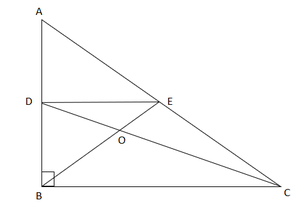
Question 7. In figure, Triangle ABC is a right angled triangle at B. Given that AB = 9 cm, AC = 15 cm and D, E are the mid-points of the sides AB and AC respectively, calculate
(i) The length of BC
(ii) The area of ΔADE.
**Solution:
From the question it is given that
AB = 9 cm, AC = 15 cm, ∠B = 90°
D, E are the mid-points of AB and AC
In ΔABC,
Using Pythagoras theorem
AC2 = AB2 + BC2
= 152 = 92 + BC2
= BC2 = 225 – 81 = 144
BC = 12
Similarly,
AD = DB = AB/2 = 9/2 = 4.5 cm [D is the mid−point of AB]
D and E are mid-points of AB and AC
So, from mid-point theorem
DE ∥ BC ⇒ DE = BC/2
Now, we find the area of ΔADE
So, Area = 1/2 x AD x DE
= 1/2 x 4.5 x 6
= 13.5
**Hence, the area of ΔADE is 13.5 cm 2
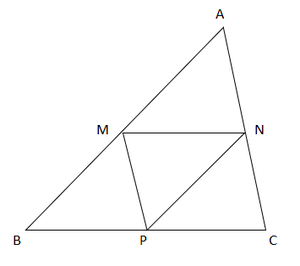
Question 8. In figure, M, N and P are mid-points of AB, AC and BC respectively. If MN = 3 cm, NP = 3.5 cm and MP = 2.5 cm, calculate BC, AB and AC.
**Solution:
From the question it is given that
MN = 3 cm, NP = 3.5 cm and MP = 2.5 cm.
Find: the value of BC, AB and AC
In ΔABC
M and N are mid-points of AB and AC
So, from mid-point theorem
MN = (1/2) BC, MN ∥ BC
= 3 = (1/2) BC
= 3 x 2 = BC
= BC = 6 cm
Similarly,
AC = 2MP = 2 (2.5) = 5 cm
AB = 2 NP = 2 (3.5) = 7 cm
**Hence, values of BC, AB, and AC are 6 cm,7 cm, and 5 cm
Question 9. ABC is a triangle and through A, B, C lines are drawn parallel to BC, CA and AB respectively intersecting at P, Q and R. Prove that the perimeter of ΔPQR is double the perimeter of ΔABC.
**Solution:
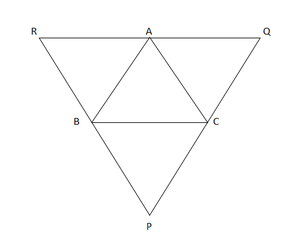
To prove: Perimeter of ΔPQR is double the perimeter of ΔABC.
Proof:
In ΔABC
It is given that the ΔABC pass through A, B, C lines are drawn
parallel to BC, CA and AB and intersecting at P, Q and R.
So, ABCQ and ARBC are parallelograms.
BC = AQ and BC = AR [ Because the opposite sides of a parallelogram are equal]
= AQ = AR
= A is the mid-point of QR
Now we know that,
B and C are the mid points of PR and PQ
So, from mid-point theorem
AB = (1/2) PQ, BC = (1/2) QR, CA = (1/2) PR
= PQ = 2AB, QR = 2BC and PR = 2CA
= PQ + QR + RP = 2 (AB + BC + CA)
Perimeter of ΔPQR = 2 (perimeter of ΔABC)
Hence proved.
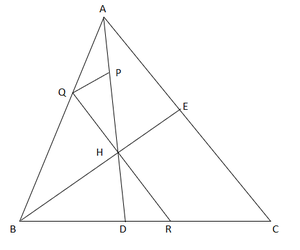
Question 10. In figure, BE⊥ AC, AD is any line from A to BC intersecting BE in H. P, Q and R are respectively the mid-points of AH, AB, and BC. Prove that ∠PQR = 90°
**Solution:
From the question it is given that
BE ⊥ AC and P, Q and R are the mid-point of AH, AB and BC.
To prove: ∠PQR = 90°
Proof:
In ΔABC,
Q and R are mid-points of AB and BC
So, from mid-point theorem
QR ∥ AC ..... (i)
In ΔABH,
Q and P are the mid-points of AB and AH
So, from mid-point theorem
QP ∥ BH ..... (ii)
But, BE⊥AC
So, from eq(i) and (ii) we have,
QP⊥QR
∠PQR = 90°
Hence Proved
Conclusion
Understanding quadrilaterals is crucial in geometry as they form the basis for the more complex shapes and figures. Exercise 14.4 | Set 1 provides students with the opportunity to apply their knowledge of the quadrilaterals reinforcing their understanding through problem-solving. The Mastery of these concepts will aid students in tackling more the advanced geometric problems in the future.